

People Have All the Resources They Need. This is perhaps the most uplifting principle in personal development. Society often makes us feel like we are “broken” and that we need an external guru to fix us. We look outside ourselves for confidence, discipline, or creativity.
NLP assumes that you already have all the resources you need inside of you to achieve your goals. You are not broken. You have simply forgotten how to access those resources, or you are running an outdated mental program that is blocking them.
If you have ever stared at a blank screen, a daunting project, or a massive life decision and thought, “I just don’t have what it takes,” you are not alone. The modern self-improvement industry is a multi-billion dollar machine built on a very specific, very profitable narrative: the deficit mindset. This narrative tells you that you are fundamentally broken, incomplete, or lacking in some essential quality—whether that is confidence, discipline, creativity, or focus. It insists that you must buy the next book, attend the next seminar, or adopt the next grueling habit to finally “fix” yourself.
But what if that narrative is completely wrong?
In the world of Neuro-Linguistic Programming (NLP), there is a foundational belief that completely shatters this deficit model. It is the empowering presupposition that people have all the resources they need to create the changes they desire.
This isn’t about toxic positivity or ignoring real-world challenges. It is a profound, neurologically grounded understanding of human capability. When you fully grasp that people have all the resources they need, you stop searching outside of yourself for salvation and start unlocking the immense toolkit you already possess.
Let’s explore what this actually means, how it works in the human brain, and how you can immediately apply it to overcome your biggest hurdles.
Table of Contents
What Are “Resources” in NLP? (Redefining Your Toolkit)
The most common pushback to the idea that people have all the resources they need is a literal one. A skeptic might say, “I want to start a global tech company, but I don’t have ten million dollars in venture capital. Clearly, I don’t have all the resources I need.”
This stems from a misunderstanding of the word “resource.” In the context of NLP, we are not talking about external, material assets like money, a perfect office setup, or extra hours in the day.
In NLP, a “resource” is an internal, neurological state.
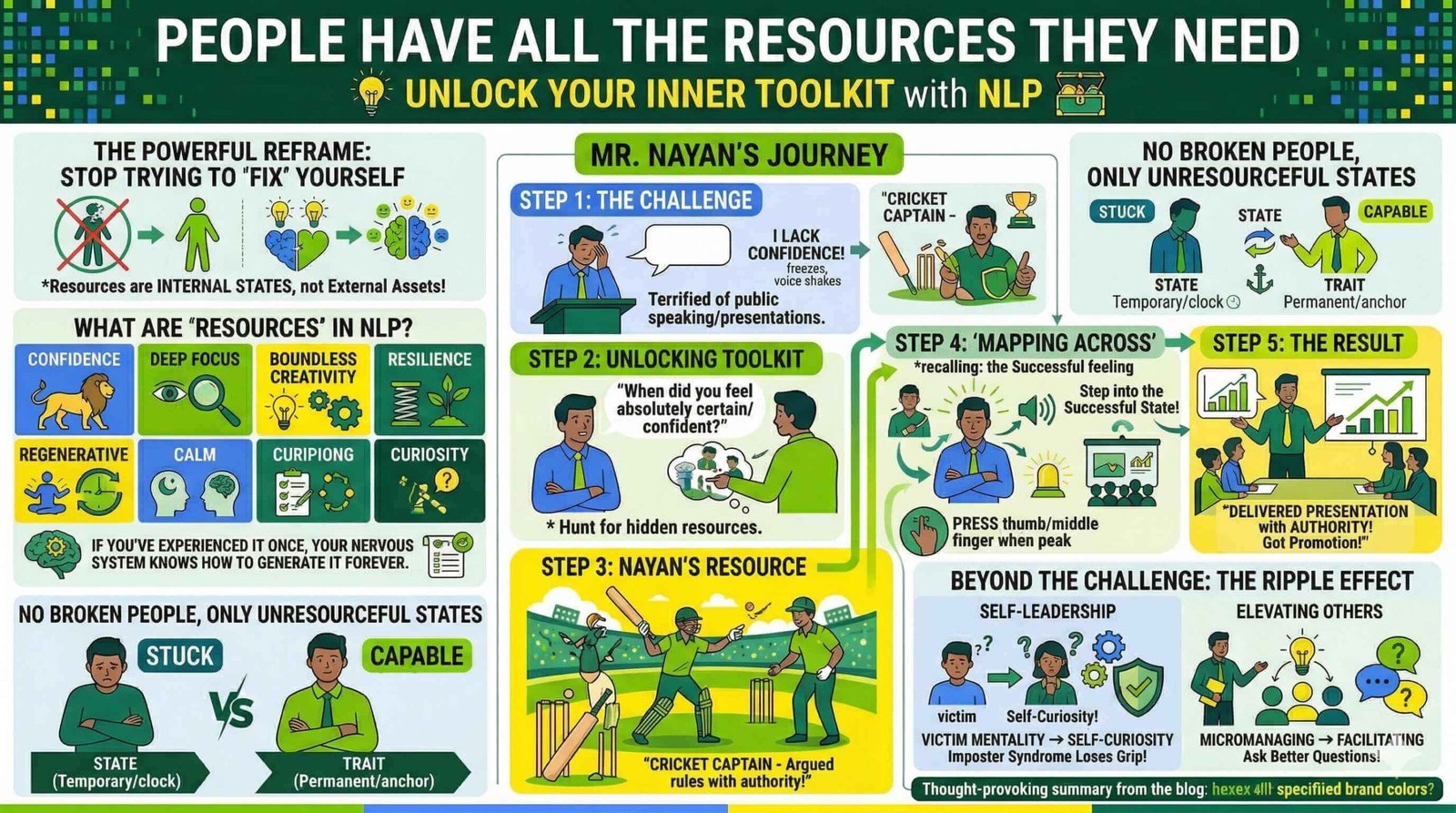
Resources are emotional and mental capabilities. They are states of being such as:
- Unshakable confidence
- Deep, penetrating focus
- Boundless creativity
- Resilience in the face of failure
- Calmness under pressure
- Insatiable curiosity
Here is the ultimate rule of thumb in NLP: If you have experienced a specific emotional or mental state even once in your entire lifetime, your nervous system knows how to generate it. You own the neurological recipe for that state forever.
If you lack the money to start a business, but you possess the internal resources of resourcefulness, tenacity, and persuasiveness, you will figure out how to get the capital. The external world bends to the internal state.
The Illusion of Lacking: Unresourceful States vs. Unresourceful People
Richard Bandler, one of the co-founders of NLP, famously stated, “There are no unresourceful people, only unresourceful states.”
When we feel stuck, we often mistake our temporary state for a permanent personality trait. We say things like, “I am just not a focused person,” or “I am terribly shy.” These identity-level statements lock us into a box of limitations.
Consider a classic “study smarter” scenario. Imagine a university student who constantly struggles to read their textbooks. They become easily distracted, feel overwhelmed, and claim, “I just lack the focus and memory required to be a top student. I don’t have what it takes.” If you view this student through the deficit mindset, you might try to medicate them, lecture them on discipline, or force them into rigid time-management systems. But an NLP practitioner looks at this differently.
If you ask that same student about their hobbies, you might discover they play complex, highly strategic video games. They can sit in a chair for four hours straight, completely absorbed, memorizing intricate maps, managing multiple variables, and executing precise strategies.
Do they lack the resource of “focus”? Absolutely not. Their nervous system is highly capable of deep, sustained concentration. They are simply experiencing an unresourceful state when they sit at their study desk. The resource is completely intact; it just hasn’t been applied to the academic context.
Understanding this allows us to stop trying to build traits from scratch and instead focus on transferring the skills we already have.
The Case of Mr. Nayan: A Real-Time Problem Solving Example
To truly understand how to apply the presupposition that people have all the resources they need, let’s look at a real-time example of a client we will call Mr. Nayan.
The Problem: Mr. Nayan was a brilliant software architect in his late 30s. He was a master of coding and system design, but his career had plateaued. He was repeatedly passed over for promotions to management. During his coaching intake session, Nayan confessed his problem: “I am terrified of public speaking and executive presentations. I freeze up, my voice shakes, and I forget my points. I just don’t have the confidence required to be a leader. I need you to teach me how to be confident.”
Nayan believed he was broken. He believed he was entirely missing the “confidence” gear in his mental machinery.
The NLP Intervention: Operating on the belief that Nayan already had all the resources he needed, the NLP practitioner didn’t give him a lecture on public speaking. Instead, they went hunting for his hidden confidence.
The practitioner asked, “Nayan, tell me about a time in your life—any time, in any context—where you felt absolutely certain, unstoppable, and completely confident.”
Nayan thought for a moment. “Well,” he said, “I am the captain of my local weekend cricket team. Last month, the umpire made a terrible call against my bowler. I marched right up to the umpire, looked him in the eye, and argued the rules with complete authority until he overturned the decision. I didn’t even think about it; I just did it because I knew I was right.”
The Reframe: Right there, the illusion was shattered. Nayan did not lack confidence. His nervous system knew exactly how to stand tall, make eye contact, speak with authority, and handle conflict. He was a highly confident man—but only on the cricket pitch.
The Technique (Mapping Across): The practitioner used an NLP technique called Anchoring and Mapping Across to transfer Nayan’s existing resource.
- Accessing the State: The practitioner had Nayan close his eyes and mentally step back into that moment on the cricket pitch. He was asked to feel the posture, breathe the way he breathed, and hear the tone of his own voice when he defended his team.
- Setting the Anchor: As Nayan reached the peak of that intense, confident feeling, the practitioner had him press his thumb and middle finger together firmly (creating a kinesthetic anchor, linking the physical touch to the neurological state of confidence).
- Testing the Context: Next, they visualized the upcoming boardroom presentation. The moment Nayan felt the familiar anxiety creeping in, he fired his anchor (pressing the fingers together). His brain immediately flooded his body with the “cricket captain” physiology.
- The Result: Nayan didn’t need to read a book on executive presence. He just needed to borrow his own strength from a Sunday afternoon. He delivered his next presentation with the exact same grounded authority he used to defend his bowler. He got the promotion three months later.
Mr. Nayan was never broken. He just needed help accessing his own internal toolkit.
How to “Map Across”: Transferring Your Hidden Superpowers
You do not need to be in a formal therapy or coaching session to utilize this powerful concept. You can actively manage your state and leverage the fact that people have all the resources they need by using a simplified version of “Mapping Across.”
Here is a step-by-step guide to unlocking your inner toolkit:
Step 1: Identify the Gap Be specific about the state you feel you are lacking in a current challenge. Don’t say, “I am bad at my job.” Say, “I am lacking decisiveness when I have to choose a marketing strategy,” or “I am lacking patience when I deal with my toddler.”
Step 2: Hunt for the Resource Take a mental inventory of your entire life. Look at your hobbies, your childhood, your friendships, your sports, or your past vacations. Find just one specific memory where you naturally, effortlessly exhibited the exact trait you identified in Step 1.
- Need patience for your business? Remember how patient you were when teaching your dog a new trick.
- Need courage for a hard conversation? Remember the courage it took to travel solo for the first time.
Step 3: Step Into the State Close your eyes and vividly recreate that successful memory. Do not watch yourself on a movie screen; step into your own body. See what you saw, hear what you heard, and most importantly, feel what you felt. Notice your posture. Notice your breathing. Amplify that feeling until it washes over you completely.
Step 4: Create the Bridge (The Anchor) While you are feeling that peak state of resourcefulness, introduce the challenging context. Visualize the difficult task (the boardroom, the blank page, the difficult conversation) while actively holding onto that powerful physical feeling. You are literally training your brain to associate the new, difficult context with your old, successful emotion.
The Ripple Effect: How This Presupposition Transforms Lives
When you fully internalize the concept that people have all the resources they need, it creates a massive ripple effect in every area of your life.
For Self-Leadership: It completely eradicates the victim mentality. You can no longer look at your goals and say, “I can’t do that because I’m not that kind of person.” Imposter syndrome loses its grip because you realize you aren’t faking anything; you are simply accessing different, authentic parts of your own neurology. It replaces self-pity with self-curiosity.
For Elevating Others: If you are a manager, a parent, or someone running a coaching business, this presupposition changes how you lead. When you stop viewing your team, your children, or your clients as “broken” people who need your brilliant advice to fix them, the dynamic shifts.
You stop micromanaging and start facilitating. You begin asking better, more empowering questions. Instead of saying, “Here is how you should handle this problem,” you ask, “Where else in your life have you successfully handled a complex situation like this, and how can we apply that strength here?” You become a mirror reflecting their own brilliance back to them.
Image Summary “People Have All the Resources They Need”
Conclusion: Unlock What Is Already Yours
The multi-billion dollar self-help industry will continue to try and sell you the missing pieces to your puzzle. But the truth is, the box is already full.
The NLP presupposition that people have all the resources they need is an invitation to step off the endless treadmill of self-correction. You do not need to invent a new personality. You do not need to wait until you are “fixed” to take the next big step in your life, your career, or your relationships.
Whether you need the hyper-focus of a gamer, the authority of a cricket captain like Mr. Nayan, or the resilience of a traveler, that capability is lying dormant in your nervous system right now. Your only job is to remember where you left it, pick it up, and bring it into the present moment.
Over to you: If you fully believed you already possessed the exact resource you need to overcome your biggest hurdle right now… where in your past would you look to find it?
Read – The Ultimate Guide to 10 NLP Presuppositions: Rewiring Your Mind for Success
Drop your thoughts in the comments below, and share the “hidden superpower” you plan to unleash this week!
The beauty of these principles is that you do not need to wait for permission to use them. You can start right now. Do you need NLP? Lets check here
Over to you: Which of these NLP Presuppositions will you consciously adopt today to shift your reality? Let us know your thoughts and experiences in the comments below!
Know more about NLP Presuppositions on YouTube.
