

The NLP Presuppositions offer a profound shift in how we approach life’s challenges. They move us away from a mindset of limitation and blame, and toward a mindset of immense flexibility and personal power.
Have you ever felt completely stuck? Maybe you are a student working hard but hitting a wall in your studies. Or perhaps you are a professional caught in a frustrating loop of miscommunication, wondering why people just cannot seem to understand you.
When we face these repeated struggles, we usually blame ourselves or the people around us. But what if the problem is not you, and it is not them? What if the issue is simply the invisible “operating system” running in the background of your mind?
Think of your brain like a smartphone. The hardware might be perfect, but if the software—the beliefs and rules you live by—is outdated, the whole system will glitch. You will experience friction, stress, and frustration.
The good news is that you can upgrade your mental software. This is where the Presuppositions NLP (Neuro-Linguistic Programming) come in. By understanding and adopting these powerful principles, you can completely change how you learn, how you lead, and how you experience the world.
Let us explore the complete list of these transformative principles and the exact actionable steps you can take to apply them today.
Table of Contents
What Are NLP Presuppositions?
Neuro-Linguistic Programming (NLP) is the study of human excellence. It looks at how our thoughts (Neuro), our language (Linguistic), and our behaviors (Programming) are deeply connected.
A presupposition is simply a foundational belief or a starting assumption. In NLP, we do not claim that these rules are absolute, scientific facts. Instead, they are empowering “working hypotheses.” You simply act as if they are true.
Why? Because when you choose to believe these principles, your behavior changes. You become more flexible, more resilient, and far more understanding of others.
Here is the complete list of core NLP presuppositions to rewire your reality.
1. “The Map is Not the Territory”
This is perhaps the most famous principle in all of NLP Presuppositions.
Imagine you are looking at a menu in a restaurant. The picture of the food is not the actual food you can eat; it is just a representation. Similarly, a map of your city is not the city itself; it is just a piece of paper to help you navigate.
In life, we do not experience reality directly. We filter everything that happens around us through our physical senses, past experiences, culture, and personal values. By the time an event registers in your brain, you have created a unique, internal “map” of reality.
How to Apply This: The biggest conflicts happen when we forget that our map is not the territory. We mistakenly believe that the way we see the world is the only correct way.
- In the Workplace: Imagine a manager who feels an employee is disrespectful because they stay very quiet during meetings. In the manager’s map, respect means speaking up. However, in the employee’s map, listening quietly is the highest sign of respect. The territory (the quiet behavior) is exactly the same, but the maps are entirely different.
- The Takeaway: Empathy begins when you realize everyone is navigating the world using a different map. The next time you strongly disagree with someone, pause and ask yourself: “What does their map of the world look like right now?”
- Take your Mental Map Audit now.
Read in Depth about “The Map is Not the Territory“
2. “There is No Failure, Only Feedback”
If you are a student or a lifelong learner, this principle will completely transform your journey.
We are conditioned to fear failure. A bad grade or a rejected proposal is often viewed as a heavy judgment on our self-worth. We internalize it and think, “I am not smart enough.”
NLP flips this completely upside down. It states that there is no such thing as failure; there are only outcomes. If an outcome does not meet your expectations, it is not a tragedy—it is just valuable feedback.
How to Apply This: Think about a student taking a difficult mock exam and scoring poorly. A student trapped in the old mindset will feel crushed and lose motivation. However, a student using the “no failure, only feedback” principle views the grade neutrally. It is simply information telling them that their current way of studying is not working.
- Building a Smarter Blueprint: Instead of stressing over the grade, use the feedback to adjust your strategy. Maybe you need to study in the morning instead of at night, or use visual mind maps instead of just reading textbooks.
- The Takeaway: Every time you stumble, you are collecting crucial data on what not to do. Removing the emotional weight of “failing” frees up a massive amount of mental energy to adapt and improve.
Read in Depth about “There is No Failure, Only Feedback“
3. “Mind and Body are Part of the Same System”
We often treat our mind and our body as two completely separate things. We try to solve mental stress only by thinking about it.
NLP teaches us that the mind and the body form a continuous, deeply connected loop. What happens in your mind instantly affects your body, and what happens in your body instantly affects your mind.
When you feel defeated, your body naturally responds: your shoulders slump and your breathing becomes shallow. Conversely, when you feel confident, your posture opens up and your head is held high.
How to Apply This: You do not always have to “think” your way out of a negative mood. Sometimes, you can simply “move” your way out of it.
- Shifting Your State: If you are feeling intense anxiety before an exam or presentation, trying to just tell yourself to “calm down” rarely works. Instead, change your physical state.
- Take Action: Stand up straight. Pull your shoulders back. Take three deep, slow breaths. By shifting your body into a state of calm confidence, you send a direct signal to your nervous system. Your mind will naturally follow your body’s lead, turning panic into focused energy.
Read detailed post about “Mind and Body are Part of the Same System“
4. “People Have All the Resources They Need”
This is perhaps the most uplifting principle in personal development.
Society often makes us feel like we are “broken” and that we need an external guru to fix us. We look outside ourselves for confidence, discipline, or creativity.
NLP assumes that you already have all the resources you need inside of you to achieve your goals. You are not broken. You have simply forgotten how to access those resources, or you are running an outdated mental program that is blocking them.
How to Apply This: True growth is not about someone else handing you the answers. It is about unlocking the doors inside your own mind.
- The Takeaway: The next time you catch yourself saying, “I just do not have the confidence for this,” remind yourself of this rule. You have felt confident before in your life—maybe while talking to a close friend or doing a hobby you love. That resource exists inside you. You just need to practice accessing that feeling and applying it to the new situation. You already have everything you need to succeed.
Must Read – “Stop Trying to ‘Fix’ Yourself | People Have All the Resources They Need“
5. “Every Behavior Has a Positive Intention”
Even our worst habits—like procrastination, losing our temper, or eating junk food—serve a hidden positive purpose for us at a deeper level. Usually, these behaviors are misguided attempts by our brain to protect us from stress, pain, or fear.
- Actionable Step: Stop beating yourself up over a bad habit. Instead, ask yourself: “What is the positive intention behind this behavior? What is it trying to protect me from?” Once you find the root intention (e.g., stress relief), you can find a healthier way to satisfy that need.
6. “The Meaning of Communication is the Response You Get”
Have you ever explained something clearly, only for the other person to completely misunderstand you? Our instinct is to blame them for not listening. NLP says that effective communication is measured by the response you get, not by what you intended to say.
- Actionable Step: If someone misunderstands you, take full responsibility. Change your delivery. If explaining it with words did not work, try drawing a diagram. If a logical explanation failed, try telling a story. Keep changing your communication style until you get the desired response.
7. “If One Person Can Do Something, Anyone Can Learn It”
This is the foundation of NLP “modeling.” It assumes that human excellence is not magic; it is a specific sequence of mental and physical steps. If you can decode the steps someone else took to achieve success, you can replicate their results.
- Actionable Step: Identify one skill you want to master. Find an expert who is already great at it. Do not just ask them what they do; figure out how they do it. What are their beliefs? What is their daily routine? Model their process to accelerate your own learning curve.
8. “The Law of Requisite Variety (Flexibility is Power)”
In any system, the person or element with the most flexibility will have the most control. If you only have one way of solving a problem, you will get stuck easily. The more choices and behaviors you have available, the more likely you are to succeed.
- Actionable Step: If what you are doing is not working, do something else—anything else. Never stubbornly push the same failed strategy. Force yourself to brainstorm at least three completely different approaches to a problem you are currently facing.
9. “People Make the Best Choices Available to Them at the Time”
Based on their current “map of the world” and the resources they have access to in a given moment, people are always doing the best they can. Even if a choice looks terrible in hindsight, it made sense to them at that exact moment.
- Actionable Step: Use this principle to practice forgiveness. If you are angry at yourself for a past mistake, or angry at someone else for hurting you, recognize that they (or you) acted based on the limited knowledge and emotional state available at that time. Let go of the resentment and move forward.
10. “Having a Choice is Better Than Having No Choice”
NLP aims to increase your behavioral and cognitive options. Having only one way to do things is a compulsion. Having two ways is a dilemma. Having three or more ways provides true choice and freedom.
- Actionable Step: Whenever you are making a big decision in life or business, never settle for just “Option A” or “Option B.” Always push yourself to create an “Option C.” Creating more choices immediately reduces anxiety and increases your feeling of control.
The image summary of NLP Presuppositions
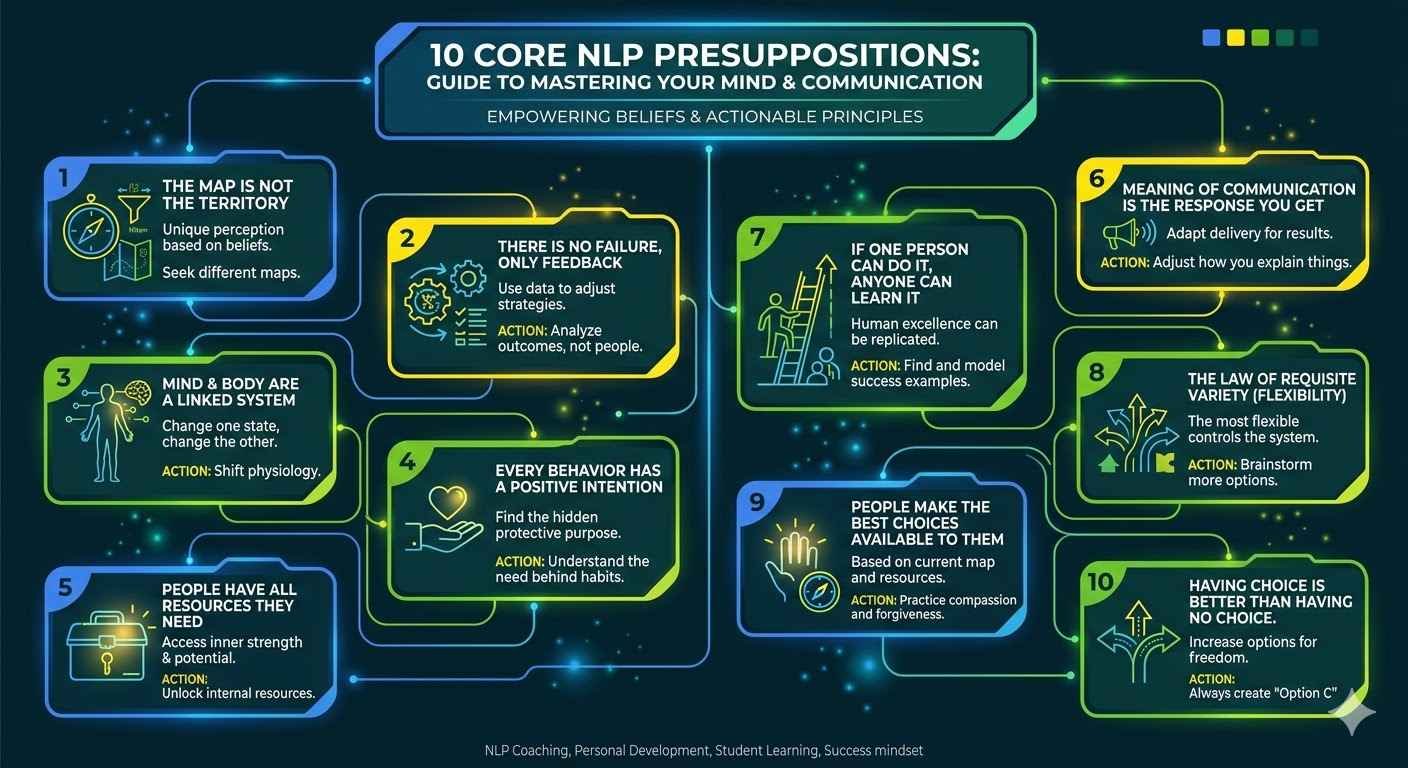
Choosing Your Reality
The NLP Presuppositions offer a profound shift in how we approach life’s challenges. They move us away from a mindset of limitation and blame, and toward a mindset of immense flexibility and personal power.
By treating every setback as valuable feedback, you become an unstoppable learner. By aligning your mind and body, you gain control over your emotions. And by trusting that you already have all the resources you need, you step fully into your true potential.
The beauty of these principles is that you do not need to wait for permission to use them. You can start right now. Do you need NLP? Lets check here
Over to you: Which of these NLP Presuppositions will you consciously adopt today to shift your reality? Let us know your thoughts and experiences in the comments below!
Know about more about NLP Presuppositions out on YouTube.
