

Discover how “Mind and Body are Part of the Same System.” This NLP guide uses science and the case of Mr. Aditya to help you hack your physiology for success.
For centuries, humanity has operated under a profound misunderstanding. We have been taught to treat our minds like a high-powered computer and our bodies like a biological machine—two separate entities that occasionally send each other “emails.” We go to a psychologist for our thoughts and a physician for our physical ailments, rarely considering that the root cause of both might be identical.
In the world of Neuro-Linguistic Programming (NLP), we shatter this partition. One of the most powerful and transformative presuppositions we live by is: “The Mind and Body are Part of the Same System.”
“Mind and Body are Part of the Same System” is not just a poetic sentiment; it is a biological reality. It is a cybernetic loop where every thought you think triggers a chemical cascade in your blood, and every breath you take recalibrates the electrical activity in your brain. When you master this connection of Mind and Body are Part of the Same System, you stop being a victim of your moods and start being the architect of your existence.
Table of Contents
1. The Great Partition: Why We Feel “Split”
Since the days of René Descartes and his “Cartesian Dualism,” Western thought has struggled with the “Mind-Body Problem.” This split has led to a society where people try to “think” their way out of clinical burnout while sitting in a slumped, oxygen-deprived posture, or try to “medicate” physical symptoms without addressing the chronic mental stress fueling them.
The Cybernetic Loop
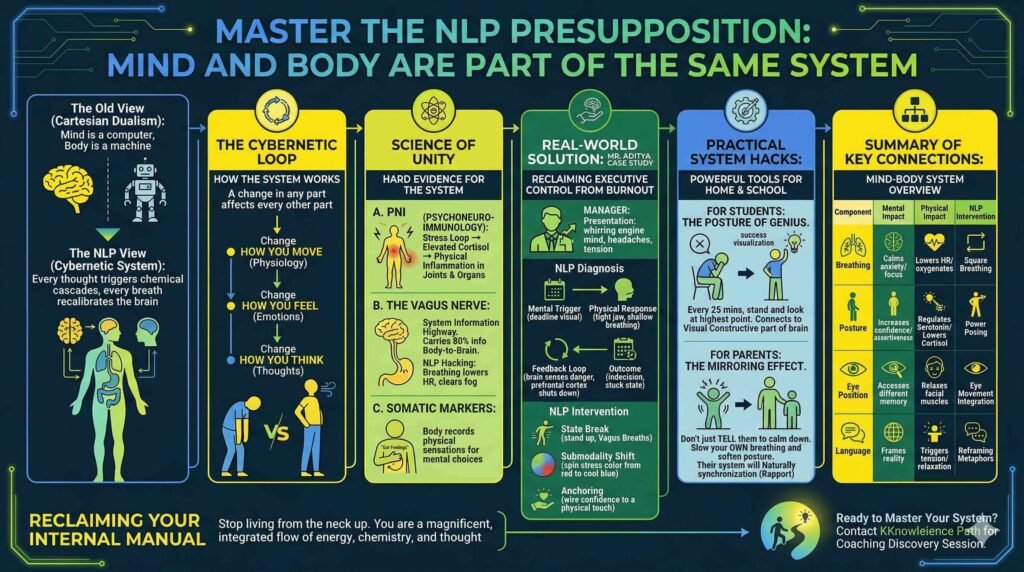
In NLP, we view the human experience as a cybernetic system. A system is defined by the fact that a change in any one part affects every other part.
“If you want to change how you feel, change how you move. If you want to change how you move, change how you think.”
Consider this: You cannot have a “depressed” thought without a “depressed” physiology. Try it right now. Slump your shoulders, look down at the floor, breathe shallowly, and try to feel incredibly excited. It is physically impossible. The system won’t allow it. Conversely, if you stand tall, breathe deeply into your chest, and look up, it is nearly impossible to maintain a state of deep sorrow.
2. The Science of Unity: Why the System is One
To rank as an authority on this topic, we must look at the hard science that supports this NLP pillar. In 2026, the evidence is overwhelming.
A. Psychoneuroimmunology (PNI)
PNI is the study of how our thoughts and emotions interact with our central nervous system and immune system. Recent studies (2024-2025) have mapped the exact pathways where cytokines (immune signaling molecules) are influenced by mental states.
- The Stress Loop: Chronic mental worry activates the HPA (Hypothalamic-Pituitary-Adrenal) axis.
- The Physical Toll: This results in elevated cortisol and pro-inflammatory markers like IL-6.
- The Outcome: Your “mind’s” worry creates actual physical inflammation in your joints and organs.
B. The Vagus Nerve: The System’s Information Highway
The Vagus nerve is the longest cranial nerve in the body, stretching from the brainstem to the abdomen. It is the physical manifestation of the mind-body system. It acts as a two-way street, carrying 80% of its information from the body to the brain. When we use NLP breathing techniques, we are manually “hacking” the Vagus nerve to tell the brain it is safe, instantly lowering the heart rate and clearing cognitive fog.
C. The Somatic Marker Hypothesis
Neuroscientist Antonio Damasio posits that our “gut feelings” are actually somatic markers. Our body records the physical sensations of past experiences. When we face a decision, the body reacts first with a physical sensation (tightness, warmth, ease). The mind then reads this “body data” to make a “mental” choice. They are inseparable.
3. Real-Time Problem Solving: The Case of Mr. Aditya
To understand the power of this presupposition, let’s look at a real-world application involving Mr. Aditya, a 42-year-old Senior Project Manager who sought coaching for “chronic indecision and executive burnout.” Its Mind and Body are Part of the Same System Case Study
The Presentation
Mr. Aditya was highly intelligent but felt “stuck.” He described his mind as a “whirring engine that never stops.” Physically, he suffered from recurring tension headaches, a tight jaw, and chronic lower back pain. He had tried “positive thinking” and “time management” apps, but nothing worked.
The NLP Diagnosis
Using the presupposition that Mind and Body are Part of the Same System, we looked for the “loop.”
- Mental Trigger: A looming deadline would trigger a mental image of failure.
- Physical Response: His jaw would clench, and his breathing would move to his upper chest.
- Feedback: The brain sensed the shallow breathing and clenched jaw as “Danger!” (activating the sympathetic nervous system).
- Result: His prefrontal cortex (the logic center) would “shut down” to prioritize survival, leading to his “indecision.”
The Intervention
Instead of talking about his childhood or his goals, we started with his physiology:
- State Break: Whenever Aditya felt “stuck,” he was instructed to physically stand up, stretch his arms wide, and take five “Vagus Breaths” (inhale for 4, exhale for 8).
- Submodality Shift: We identified the “location” of his stress. He felt it as a “tight knot” in his stomach. We asked him to imagine that knot spinning in a direction. He then mentally “reversed” the spin and changed the color from red to a cool blue.
- Anchoring: We created a “Resource Anchor.” By recalling a time he felt completely confident and touching his thumb and forefinger together at the peak of that feeling, he “wired” that mental state to a physical touch.
The Outcome
Within three weeks, Mr. Aditya’s headaches vanished. By treating his jaw tension as a “mental signal” and his shallow breathing as a “decision-making tool,” he regained control. He didn’t just “think” better; he functioned better because he finally treated his system as a whole. That’s how this NLP Presupposition Mind and Body are Part of the Same System, works.
4. Practical “System Hacks” for Students and Parents
If you are a student facing exams or a parent managing a household, this presupposition is your secret weapon.
For Students: The “Posture of Genius”
Most students study hunched over tablets or books. This posture restricts oxygen and signals “defeat” to the brain.
- The Hack: Every 25 minutes, stand up and look at the highest point in the room. This physical “upward” gaze is linked to the Visual Constructive part of the brain, making it easier to solve problems and visualize success.
For Parents: The Mirroring Effect
Because Mind and Body are Part of the Same System, and humans are social creatures, our systems “sync” with others. This is known as Rapport in NLP.
- The Hack: If your child is having a meltdown, do not “tell” them to calm down (Mind-to-Mind). Instead, slow your own breathing and soften your own posture (Body-to-Body). Their system will naturally begin to mirror yours.
5. Summary of Key Mind-Body Connections
| Component | Mental Impact | Physical Impact | NLP Intervention |
| Breathing | Calms anxiety / Increases focus | Lowers heart rate / Oxygenates blood | Square Breathing |
| Posture | Increases confidence / Assertiveness | Regulates Serotonin / Lowers Cortisol | Power Posing |
| Eye Position | Accesses different memory types | Relaxes facial muscles | Eye Movement Integration |
| Language | Frames reality | Triggers muscle tension or relaxation | Reframing Metaphors |
Conclusion: Reclaiming Your Internal Manual
The presupposition “Mind and Body are Part of the Same System” is an invitation to stop living from the neck up. You are not a ghost inhabiting a machine; you are a magnificent, integrated flow of energy, chemistry, and thought.
When you begin to listen to your body as a “mental messenger” and use your mind as a “physical architect,” you unlock a level of performance that others call “luck,” but we call NLP Mastery.
Image Summary of “Mind and Body are Part of the Same System”
The Question for You:
The next time you feel “stuck” in a negative thought, what is the first physical change you can make to break the loop? Will you change your breath, your posture, or your gaze? Will you check how Mind and Body are Part of the Same System?
Ready to Master Your System?
If you’re a student struggling with focus or a parent looking to bring harmony back to your home, understanding the Mind-Body connection is the first step. Contact us today for a coaching discovery session and start building your Knowlerience Path.
Over to you: Which of these NLP Presuppositions will you consciously adopt today to shift your reality? Let us know your thoughts and experiences in the comments below!
Read – The Ultimate Guide to 10 NLP Presuppositions: Rewiring Your Mind for Success
Know about more about NLP Presuppositions out on YouTube.
