

Stop being misunderstood. Learn why “The Meaning of Communication is the Response You Get” is the ultimate NLP tool for influence, leadership, and connection.
Have you ever walked out of a meeting feeling like you nailed the presentation, only to find out later that your team is confused, frustrated, or—worse—completely unmotivated? Or perhaps you’ve had a “heart-to-heart” with a loved one where your intention was to show support, but it ended in a heated argument?
In these moments, most of us fall into a common trap. We blame the listener. We tell ourselves, “They weren’t listening,” or “They just don’t get it.” But in the world of Neuro-Linguistic Programming (NLP), we look at it differently. We use a presupposition that acts as the ultimate “no-excuses” pill for anyone seeking mastery in their personal and professional life: The meaning of communication is the response you get.
At KKnowlerience Path LLP, we believe that communication isn’t just about what you say—it’s about the results you produce. If you aren’t getting the result you want, it’s time to stop blaming the “receiver” and start refining the “transmitter.”
Table of Contents
1. The Intent vs. Impact Gap: Why Being “Right” Isn’t Enough
Most people communicate from a place of intent. You have a thought, you wrap it in words, and you send it out into the world. If the other person reacts poorly, you defend yourself by saying, “That’s not what I meant!”
The problem? Your intent is invisible. The only thing the other person can react to is your impact.
This NLP presupposition is rooted in Systems Theory. It suggests that communication is a circular feedback loop. You are not a radio tower broadcasting into the void; you are part of a living system. If the “output” (your words and body language) doesn’t produce the desired “input” (their reaction), the system is telling you that your current strategy is ineffective.
By shifting your focus from what you meant to what they heard, you regain control. You move from being a victim of “misunderstanding” to being a master of influence.
2. The SEO Secret: Every Behavior Has a Positive Intention
To truly master the response you get, you must understand another foundational NLP pillar: Every behavior has a positive intention.
When you receive a “bad” response—whether it’s a client being defensive, a child being defiant, or a colleague being dismissive—it is easy to label that behavior as “wrong.” However, when you realize that every behavior has a positive intention, your perspective shifts.
- The defensive client is trying to protect their status or ego.
- The defiant child is trying to assert their independence.
- The dismissive colleague is trying to manage their own overwhelming workload.
When you acknowledge their positive intention, you stop fighting their response and start communicating with their need. This is the bridge between conflict and connection. If your communication triggers defensiveness, the “meaning” of your message was perceived as a threat. To get a different response, you must address the underlying positive intention with a new approach.
3. Case Study: How Ms. Neha Transformed a Toxic Team Dynamic
Let’s look at a real-world application. Ms. Neha, a Senior Project Manager and coaching client at KKnowlerience Path LLP, came to us with a recurring problem. She was highly intelligent and direct, but her team meetings were becoming increasingly tense.
The Problem: Neha would provide detailed, “constructive” feedback on project errors. Her intent was to ensure the project’s success (a positive intention). However, the response she got was a team that was quiet, uncreative, and prone to making even more mistakes out of fear.
The NLP Intervention: We challenged Neha to look at the “meaning” of her communication based on the response she was getting.
- The Response: Silence and fear.
- The NLP Meaning: Her communication was being received as “punishment” rather than “coaching.”
The Solution: Neha applied the principle that every behavior has a positive intention. She realized her team’s withdrawal was an attempt to avoid further criticism. She changed her modality. Instead of public, auditory-heavy feedback, she switched to a “Collaborative Visual” approach. She began using mind maps and digital whiteboards to brainstorm solutions with the team, rather than pointing out errors to them.
The Result: Within three weeks, the team’s engagement spiked. By taking Radical Responsibility for the response she was getting, Neha transformed from a “boss they feared” into a “leader they followed.”
4. The Three-Step Mastery Framework: Observe, Calibrate, Flex
If you want to master this presupposition, you need a repeatable process. Here is the framework we teach at KKnowlerience Path LLP:
Step 1: Observe the Response (Sensory Acuity)
Stop listening only to the words. Words are only 7% of communication. Look for the micro-expressions:
- Did their pupils dilate?
- Did their breathing change?
- Did they lean in or pull back? The body never lies. If they say “I understand” while squinting their eyes, the response you got was confusion.
Step 2: Calibrate
Compare the response you are seeing to the response you actually wanted. If there is a mismatch, do not repeat yourself louder or slower. That is the definition of insanity—doing the same thing and expecting a different result.
Step 3: Behavioral Flexibility
This is the hallmark of a high-level NLP practitioner. If what you are doing isn’t working, do something else. * Change your Tonality: Move from “Authoritative” to “Approachable.”
- Change your Physiology: Sit down instead of standing.
- Change your Language: Use metaphors instead of raw data.
5. Radical Responsibility: The Leader’s Edge
In 2026, leadership isn’t about giving orders; it’s about managing energy and outcomes. When a leader adopts the mindset that the meaning of their communication is the response they get, they stop being “misunderstood.”
Think about Prompt Engineering in AI. If you give a prompt to a model and it gives you a hallucination, you don’t get angry at the AI. You realize your prompt was ambiguous. You refine the parameters.
Human beings are the same. When you take Radical Responsibility, you stop waiting for the world to “get” you. You develop the flexibility to meet the world where it is. This is the secret to building rapport with anyone, anywhere.
6. Conclusion: The Path to Mastery
Mastering the NLP presupposition “The Meaning of Communication is the Response You Get” is a lifelong journey. It requires humility, sharp observation, and the willingness to admit that your “perfect” message might have been perfectly wrong for that specific person.
Remember, even when a response is negative, every behavior has a positive intention. Your job as a communicator, coach, or leader is to find that intention and pivot your strategy until the response matches your intent.
At KKnowlerience Path LLP, we specialize in helping individuals and organizations bridge this gap. Whether it’s through our “Study Smarter Blueprint” or our executive coaching, we focus on the results—because in the end, the response is the only thing that matters.
The Question for You: Think of one person you find “difficult” to talk to. If you took 100% responsibility for the response they give you, what is the one thing you would change about your approach today?
7. The Image summary of “The Meaning of Communication is the Response You Get”
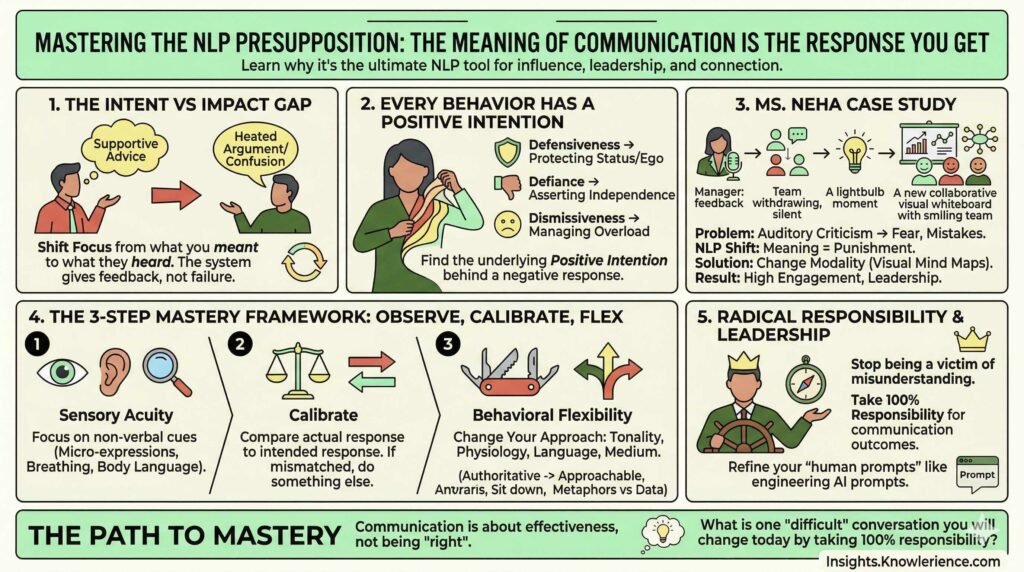
The beauty of these principles is that you do not need to wait for permission to use them. You can start right now. Do you need NLP? Lets check here
Read – The Ultimate Guide to 10 NLP Presuppositions: Rewiring Your Mind for Success
Over to you: Which of these NLP Presuppositions will you consciously adopt today to shift your reality? Let us know your thoughts and experiences in the comments below!
Know about more about NLP Presuppositions out on YouTube.
