

“If One Person Can Do Something, Anyone Can Learn It.” Unlock the power of NLP modeling to boost success and transform your mindset for excellence.
Imagine for a moment a high-pressure classroom in Mumbai. A student sits at the back, staring at a complex calculus problem, convinced they simply “don’t have a math brain.” Across the room, another student breezes through the same equations with a smile. To the observer, it looks like a difference in innate talent. To the student at the back, it feels like a wall they were born to never climb.
But what if that wall is an illusion? What if “talent” is actually a specific sequence of thoughts, breaths, and internal images that can be decoded, copied, and pasted into your own mind?
In the world of Neuro-Linguistic Programming (NLP), we live by a radical presupposition: “If One Person Can Do Something, Anyone Can Learn It.” This isn’t just a motivational quote to hang on a wall; it is the scientific foundation of Modeling, the process of replicating human excellence. In this deep dive, we will dismantle the talent myth and show you how to “download” the strategies of the world’s most successful people.
Table of Contents
1. Decoding the Presupposition: What It Really Means
When people first hear the phrase “If One Person Can Do Something, Anyone Can Learn It,” they often meet it with skepticism. “I can’t become Virat Kohli just by thinking about it,” they argue. And they are right—to an extent.
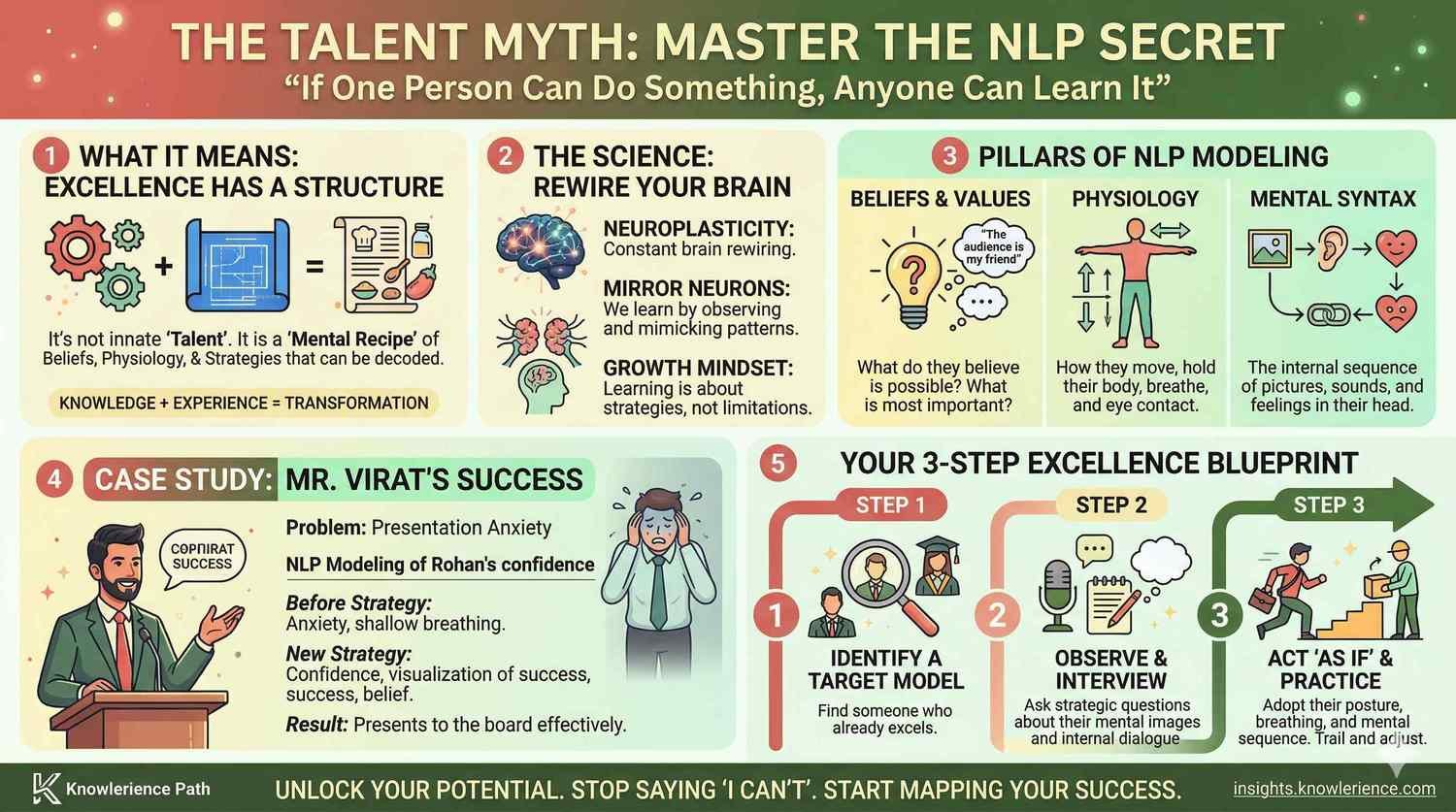
This presupposition does not claim that we will all achieve the exact same level of world-class fame. Biological factors and decades of physical conditioning matter. However, it does assert that excellence has a structure. If a human being is capable of a specific skill—whether it’s staying calm during an exam, public speaking, or complex problem solving—that skill is produced by a “mental recipe.”
If you have the same ingredients (beliefs), follow the same steps (mental syntax), and use the same equipment (physiology), you will produce a similar result.
At KKnowlerience Path, we define this as the fusion of Knowledge + Experience. You don’t just know the theory; you experience the transformation by mapping the success of others.
2. The Science of Replicable Success: Why 2026 is the Era of the Brain
For decades, NLP was seen as “fringe” psychology. But as we move through 2026, modern neuroscience is finally providing the hard data to back up what NLP practitioners have known for years.
Neuroplasticity: The Rewireable Mind
We now know that the brain is not a static organ. Through neuroplasticity, our neural pathways are constantly being forged and pruned. When you model an expert, you aren’t just “copying” them; you are consciously directing your brain to build the same neural superhighways that the expert uses.
Mirror Neurons: The Biological Blueprint
In our brains, we have “mirror neurons.” These fire not only when we perform an action but also when we observe someone else performing that action. This is the biological basis for the NLP presupposition. Your brain is literally designed to learn by imitation.
The Growth Mindset Connection
Stanford psychologist Carol Dweck’s research on the “Growth Mindset” is the academic twin of this NLP principle. When students and parents shift from “I am smart/dumb” (Fixed) to “I am learning the strategy” (Growth), academic performance skyrockets.
3. The Pillars of NLP Modeling
To master the secret of “If One Person Can Do Something, Anyone Can Learn It,” you must understand that human behavior is made of three distinct layers. If you want to replicate a result, you must model all three:
- Beliefs & Values: What does the person believe is possible? What do they value most during the task? (e.g., An expert public speaker believes “The audience is my friend.”)
- Physiology: How do they hold their body? What is their breathing pattern? Where is their eye tension?
- Mental Syntax: This is the “code.” Do they see a picture first, then talk to themselves, then get a feeling? Or do they hear a sound first?
In NLP, we often represent the structure of an experience using the R.O.L.E. Model (Representational systems, Orientation, Links, Effect).
4. Real-Time Problem Solving: The Case of Mr. Virat
Let’s look at a practical example of how this presupposition changes lives.
The Subject: Mr. Virat, a 42-year-old senior manager and father of two.
The Problem: Despite his professional success, Virat suffered from “Imposter Syndrome” whenever he had to present to the board of directors. He would sweat, stutter, and lose his train of thought. He believed he simply “wasn’t a natural leader” like his colleague, Rohan.
The NLP Intervention:
Instead of traditional “confidence building,” we used the presupposition: If Rohan can do it, Virat can learn it. We didn’t look for Rohan’s “talent”; we looked for his strategy.
Step 1: Eliciting the Model (Rohan)
We observed Rohan. We found that before a meeting, Rohan would stand with his feet shoulder-width apart (Physiology), imagine the board members as people he was helping (Belief), and visualize the end of the meeting with everyone shaking hands (Mental Syntax).
Step 2: Mapping the Differences
Virat’s current “failure strategy” was:
- Physiology: Shoulders hunched, shallow chest breathing.
- Belief: “They are looking for my mistakes.”
- Mental Syntax: Visualizing himself forgetting a slide –> Internal Dialogue (“Don’t mess up”) –> Feeling of panic.
Step 3: The Installation
We taught Virat to “act as if” he was Rohan for 15 minutes before the meeting.
- Physiology: He adopted Rohan’s “Power Pose” and diaphragmatic breathing.
- Belief Shift: He adopted the temporary belief: “I am here to provide value to my friends.”
- The Result: Within three sessions, Virat’s “Imposter Syndrome” vanished. He didn’t become a different person; he simply learned a more effective Strategy for Excellence.
5. Success Stories: From Spelling Bees to the Cricket Pitch
The Spelling Genius
One of the most famous applications of this presupposition involves Robert Dilts and spelling. Dilts modeled “natural spellers” and found they all shared a specific mental syntax: they looked up and to the left to see the word in their mind’s eye. “Bad spellers” usually tried to “sound it out.” By teaching the “visual strategy” to struggling students, their spelling improved by over 40% almost instantly.
The “Flow State” in Sports
In India, cricket is more than a sport; it’s a religion. Many young cricketers model the “anchoring” techniques of legends. When a batsman touches his helmet or taps the crease in a specific rhythm, they are often triggering a “learned state” of peak performance. If one legendary finisher can stay calm in the last over, that calm is a learnable sequence.
6. The 3-Step “Excellence Blueprint” for Students and Parents
How can you apply “If One Person Can Do Something, Anyone Can Learn It” in your home today?
Step 1: Identify the “Target Model”
Don’t look for a celebrity; look for someone in your immediate circle who excels at what you want to learn. Parents, find a student who actually enjoys studying. Students, find a teacher who stays incredibly patient.
Step 2: The “Strategic” Interview
Ask them questions they’ve probably never been asked:
- “When you are about to start [the task], what is the very first thing that happens in your head?”
- “Do you see a picture? Is it big or small? Is it in color?”
- “What do you say to yourself in that moment?”
Step 3: Practice the “Physiology of Excellence”
Before you try to think like them, move like them. If your “model” sits upright and moves their hands with confidence, mimic that. You will find that your internal state begins to shift to match your external posture.
7. Why This Is the Ultimate Competitive Advantage in 2026
The world is changing faster than ever. The skills you learn today might be obsolete in three years. Therefore, the most valuable skill you can possess is the ability to learn how to learn.
By mastering the NLP presupposition “If One Person Can Do Something, Anyone Can Learn It,” you stop being a victim of your “limitations” and start becoming a “Social Architect.” You begin to see every successful person not as a source of envy, but as a resource for your own growth.
For the parents reading this: Imagine the confidence your child will have when they realize that “weaknesses” are just “missing strategies.”
For the students: Imagine the freedom of knowing that any peak performance you admire is something you can eventually “map” and make your own.
Conclusion: What Will You Learn Today?
The “Talent Myth” is a comfort for the lazy and a cage for the ambitious. It suggests that our fates are sealed by our DNA. But NLP tells a different story—a story of infinite possibility and replicable excellence.
If one person can speak with charisma, so can you.
If one person can master a difficult subject, so can you.
If one person can bounce back from failure with a smile, so can you.
At KKnowlerience Path, we are dedicated to helping you bridge the gap between where you are and where you want to be. Our Study Smarter Blueprint is built on these very principles, designed to give students the mental strategies used by top performers worldwide.
Visual summary ‘If One Person Can Do Something, Anyone Can Learn It’
The question is no longer “Can I do it?” The question is “Whose strategy will I model today?”
Join the Conversation
What is one skill you’ve always thought was “innate talent”? Based on what you’ve read today, who could you model to start learning that skill? Share your thoughts in the comments below!
The beauty of these principles is that you do not need to wait for permission to use them. You can start right now. Do you need NLP? Lets check here
Read – The Ultimate Guide to 10 NLP Presuppositions: Rewiring Your Mind for Success
For more insights into NLP, personal development, and science-backed coaching, visit our online portal at insights.knowlerience.com or subscribe to our YouTube channel @KKnowlerience.
