

Speed Reading is the high-bandwidth “firmware update” for your optical system, moving you away from the archaic habit of reading one word at a time. Within the Study Smarter Blueprint, it is a surgical tool for strategic data extraction. By eliminating subvocalization (the slow inner voice that caps your speed at talking speed) and mastering the Z-Pattern to scan for core patterns, you bypass the 80% filler in any textbook to download the 20% that actually builds your Permanent Knowledge Vault.
The Bottom Line: You don’t have a learning problem; you have a bandwidth bottleneck. Speed Reading allows you to “interrogate” a chapter in half the time, turning your eyes into high-speed scanners that hunt for information rather than passively consuming it.
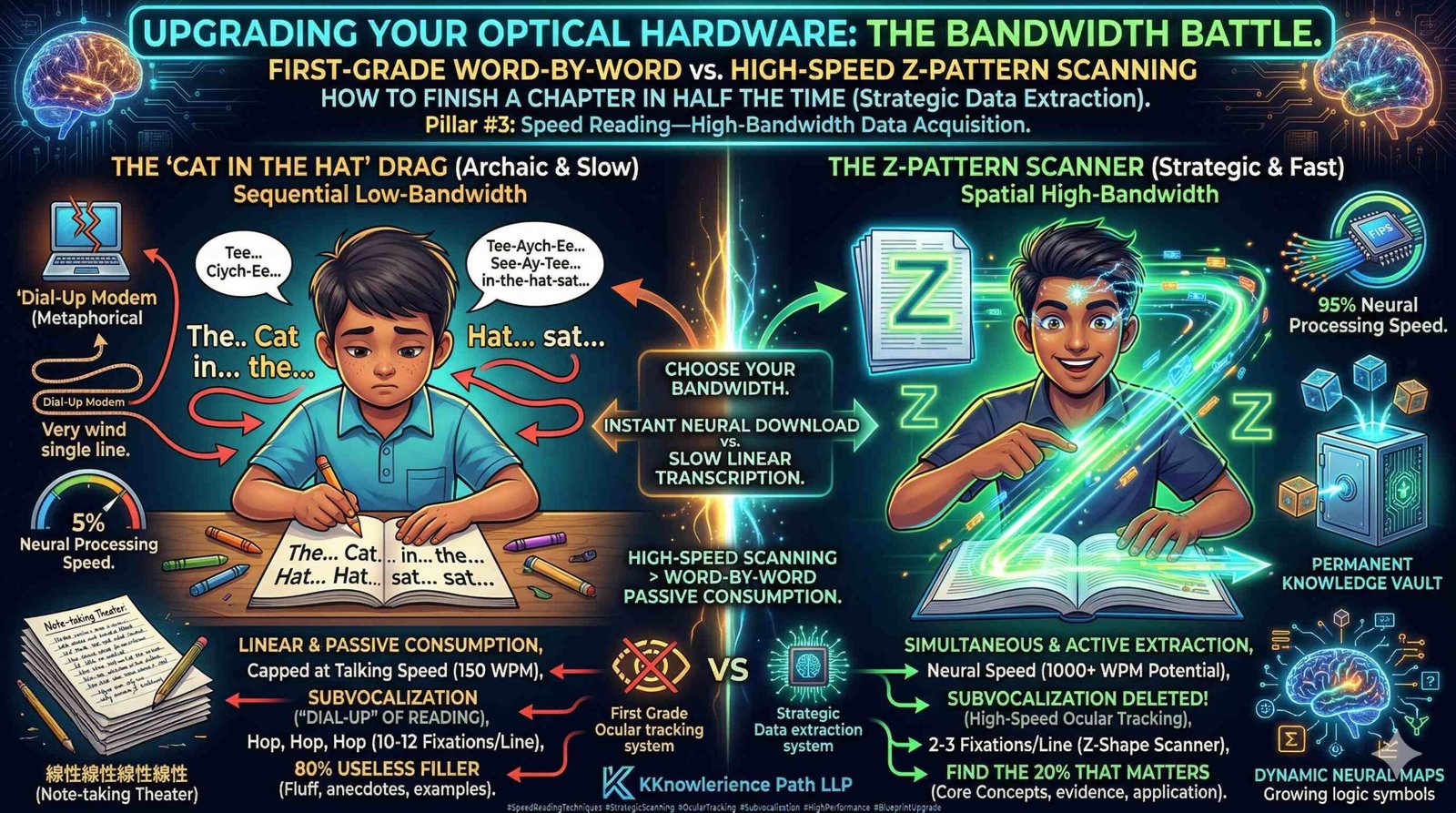
Let’s be brutally honest for a moment. You’re still reading one word at a time like a first grader. Stop it now. I know that sounds harsh, but think about it. You were taught to read in primary school by sounding out syllables, then words, then sentences. Most people never receive a second “reading update” for the rest of their lives. You are trying to process the complex, high-volume information of 2026 using an optical system designed for “The Cat in the Hat.”
At KKnowlerience Path LLP, we see students drowning in 1,000-page textbooks not because they lack intelligence, but because they are using an outdated interface. You aren’t a slow learner; you just have an outdated ocular tracking system in place. It’s time to stop the linear drag and start the high-speed download.
Table of Contents
Section 1: The “Dial-Up” of the Mind (Subvocalization)
The biggest reason you are stuck at a reading speed of 200–250 words per minute is a phenomenon called subvocalization. This is that “voice” you hear in your head as you read every single word.
That little voice in your head while reading is actually your biggest speed limiter. Why? Because your brain can process images at the speed of light, but your inner voice can only “speak” at about 150 words per minute. If you have to say the word in your head to understand it, you have capped your learning speed at the speed of your speech. Subvocalization is the ‘dial-up’ of reading. It is time to upgrade to fiber optic.
In Pillar #3 of the Study Smarter Blueprint, we teach you to move from “Auditory Reading” to “Visual Reading.” Pillar #3 of the Blueprint turns your eyes into high-speed scanners for permanent knowledge. Your eyes are capable of taking “snapshots” of entire phrases, but you have been conditioned to ignore this superpower.
Section 2: The 80/20 Rule of Information Extraction
One of the most common mistakes students make is treating every word in a textbook as if it were sacred scripture. It isn’t. 80% of your textbook is useless filler. Learn to find the 20% that matters. Textbooks are written to be comprehensive, not efficient. They are filled with anecdotes, redundant examples, and fluff. Elite students don’t read books; they ‘interrogate’ them for the specific data they need. They don’t start at page one and hope for the best. They go in with a surgical intent: “Where is the core concept? Where is the evidence? Where is the application?”
If you finish a chapter and remember nothing, you didn’t read; you just hallucinated. This “hallucinated reading” happens when your eyes move across the page while your mind is thinking about lunch. By using strategic scanning, you force your brain to stay active. You aren’t “consuming” the book; you are “hunting” the information.
Section 3: The Ocular Hardware Upgrade (Scanning Techniques)
How do we actually increase the speed? It starts with your physical eye movement. Most people’s eyes “hop” across a line of text in 10-12 different fixations. We want to reduce that to 2 or 3.
Your peripheral vision is a superpower you’re ignoring every single time you open a book. When you look at the center of a line, your peripheral vision can actually see the beginning and the end. You don’t need to look directly at the margins.
The Z-Pattern and The Visual Pacer
The ‘Z-Pattern’ scanning technique is the closest thing to a literal knowledge download button. Instead of reading left-to-right, line-by-line, you move your eyes in a “Z” shape across the page, capturing the headings, bold words, and the first and last sentences of paragraphs. This gives your brain a “skeleton” of the information before you even begin a deep dive.
To keep your eyes from wandering or “regressing” (re-reading lines), you need a guide. I taught a student to triple their reading speed using only a common pencil. By using a pencil or your finger as a visual pacer, you force your eyes to maintain a smooth, forward rhythm. It prevents the “eye-stutter” that kills your speed.
Section 4: The 2026 Competitive Edge
We have to face the reality of the era we live in. Information is exploding, and time is shrinking. In 2026, reading at 200 words per minute is basically the new form of illiteracy. If you can’t digest a 500-page report or a massive syllabus in a single afternoon, you will be left behind by those who can.
POV: You just finished a 40-page chapter in 15 minutes while your friends are struggling. That isn’t magic. It’s the result of strategic ocular tracking. Stop reading every word. Your brain was designed to scan for patterns, not syllables. When you master the pattern, the syllables take care of themselves.
Ultimately, reading speed is about decision-making. Reading for four hours is a choice. Reading for forty minutes is a high-level strategy. You are choosing how much of your life you want to trade for a specific set of facts. In the Study Smarter Blueprint, we choose the high-efficiency path every single time.
Section 5: Beyond the Page—Strategic Integration
Speed reading is useless if it doesn’t lead to retention. This is why Pillar #3 is integrated with the other modules of our system. Once you’ve used the “Z-Pattern” to extract the 20% of core data, you immediately move to “Chunking” (Pillar #4) to organize it.
Stop reading every word. Your brain was designed to scan for patterns, not syllables. By focusing on the structure of the information rather than the noise of the text, you create a stronger neural map. You aren’t just reading faster; you are thinking faster.
Conclusion: Stop Reading, Start Extracting
The era of passive, slow, linear reading is over. If you want to survive and thrive in the modern academic and professional landscape, you need a hardware upgrade.
Pillar #3 of the Blueprint turns your eyes into high-speed scanners. It moves you from “First-Grade” habits to “Master Architect” execution. You have the peripheral vision. You have the cognitive capacity. You just need the system to unlock it.
Are you ready to finish the book and start the mastery?
[Enroll in the Study Smarter Blueprint. Master Speed Reading and reclaim your time at KKnowlerience Path LLP.]
Upgrade your neural bandwidth and join the high-speed learning revolution: 👉 Subscribe to KKnowlerience on YouTube
