

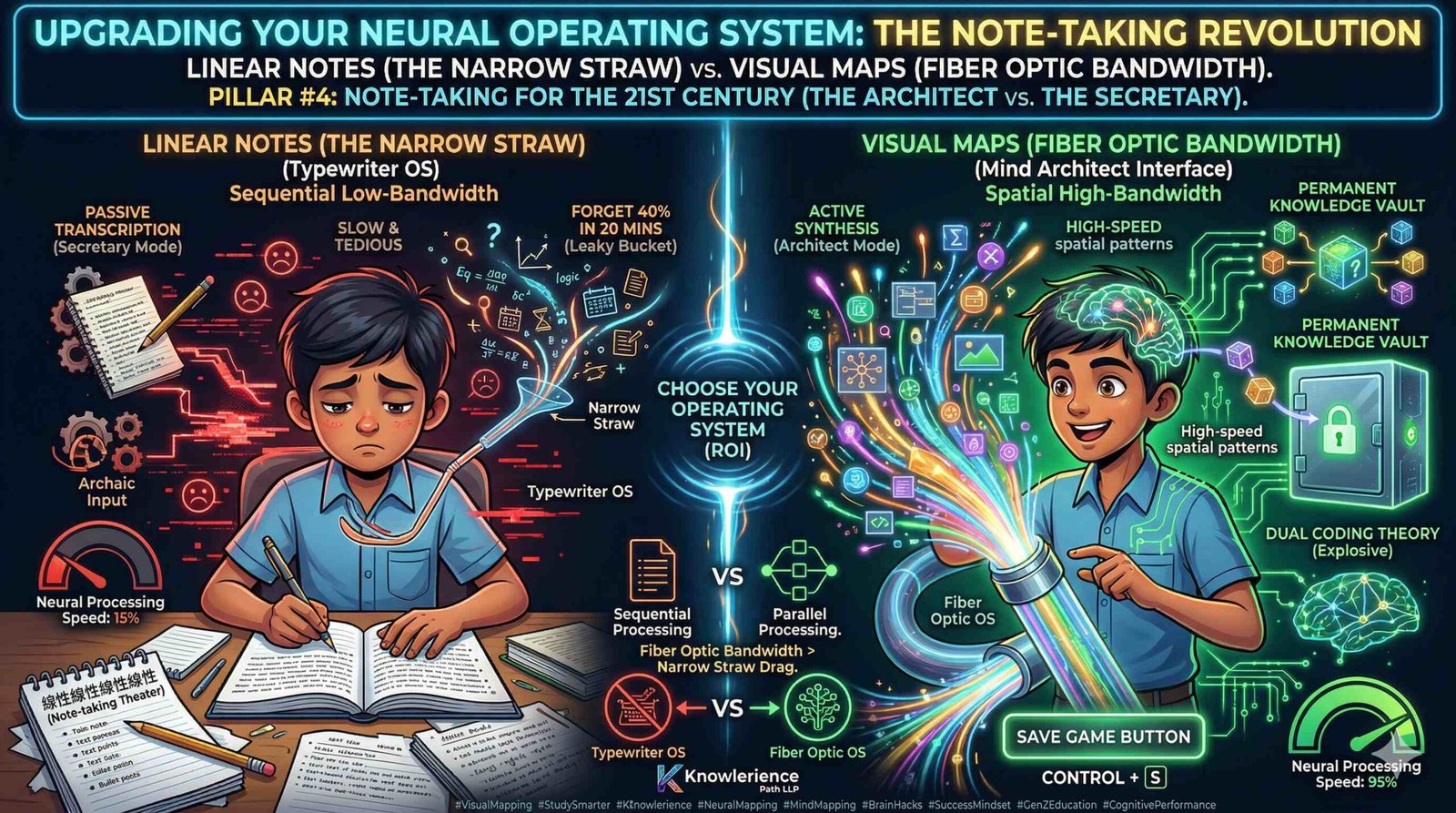
Brain-Friendly Notes are the high-bandwidth alternative to traditional, linear transcribing. Instead of acting like a secretary—simply recording words—you become a Mind Architect, building spatial maps of information. Within the Study Smarter Blueprint, this pillar leverages your brain’s natural affinity for patterns and shapes. By using the Box-and-Arrow method and visual mapping, you replace 50 pages of overwhelming text with a single, high-intensity visual map that triples retention and simplifies complex synthesis.
The Bottom Line: If you can’t draw it, you don’t own it. Brain-Friendly Notes turn your notebook into a powerful neural external drive, moving you away from “Note-taking Theater” and into the realm of permanent, structural mastery.
Look at your notebooks from last semester. Rows upon rows of blue ink, neatly organized bullet points, and perhaps a few highlighted sentences. Now, ask yourself: How much of that information do you actually own?
The harsh reality is that linear notes are the slowest way to learn. Your brain thinks in webs, not lists. We have been conditioned to write from left to right, top to bottom, as if we were feeding data into a 19th-century ledger. You aren’t bad at taking notes. You’re just using a format meant for typewriters. At KKnowlerience Path LLP, I have spent over two decades helping students move away from “Secretary Mode” and into “Architect Mode.” In the Study Smarter Blueprint, note-taking isn’t about recording what was said; it’s about building a neural external drive for your brain.
Table of Contents
Section 1: The Tragedy of “Note-Taking Theater”
We see it all over social media: “Studygram” accounts with perfectly color-coded headers and aesthetic calligraphy. While it looks beautiful, it is often a trap. Stop doing ‘Note-taking Theater’ for the aesthetic. Start building a permanent knowledge vault. If you are spending more time choosing the right highlighter color than you are synthesizing the concept, you are performing theater. You are trying to convince yourself you are working because you are busy. But “busy” does not equal “effective.” The education system taught you to be a secretary, not a master of information. Secretaries transcribe; Masters synthesize.
Transcribing your lectures is a waste of time. You forget 40% within twenty minutes. When you simply copy what a professor says, your brain stays in “Passive Mode.” It doesn’t have to work to understand, so it doesn’t bother to store. I once saw a student cry over 100 pages of notes they had painstakingly written for a single exam. They were overwhelmed and exhausted. I saw a student cry over 100 pages of notes. We turned them into five. By shifting to a brain-friendly system, we didn’t just save their grades; we saved their mental health.
Section 2: The Science of Spatial Memory
Why do lists fail us? Because the human brain evolved to navigate 3D environments, not 2D lines of text. Spatial memory is your secret superpower. Stop forcing your brain into narrow, linear lines. Think about your house. You don’t need a list of where your furniture is; you have a “mental map.” You can navigate it in the dark. Linear notes are a narrow straw. Brain-friendly notes are a high-speed fiber optic cable. When you use a list, you are trying to shove a 3D concept through a 1D straw. It creates a bottleneck that leads to “Brain Rot” and fatigue.
By using visual maps, you tap into the brain’s native language: patterns, shapes, and connections. A list is a dead end. A map is a neural highway to your academic success. When information is mapped spatially, your brain can “see” the relationships between ideas instantly.
Section 3: The Architect’s Toolkit (The Box-and-Arrow Method)
So, how do we build these “Neural Highways”? In Pillar #4 of the Study Smarter Blueprint, we focus on active synthesis.
Use the ‘Box-and-Arrow’ method to download complex concepts directly into your long-term memory. Instead of writing sentences, you write the “Core Identity” of an idea in a box and use arrows to show how it relates to other ideas. This forces your brain to answer the question: “How does this connect to what I already know?”
If you can’t draw a diagram of the concept, you don’t actually understand it. This is the ultimate litmus test for knowledge. If you can only repeat a definition, you have “Rote Knowledge.” If you can draw the relationship between variables, you have “Structural Knowledge.”
| Aspect | Linear Note-Taking (The Secretary) | Brain-Friendly Mapping (The Architect) |
| Mental State | Passive / Transcribing | Active / Synthesizing |
| Brain Region | Verbal Only | Spatial + Verbal (Dual Coding) |
| Speed | Slow & Tedious | High-Bandwidth & Rapid |
| Retention | Leaky Bucket | Permanent Vault |
Section 4: The 2026 Competitive Advantage
In the age of Artificial Intelligence, the world doesn’t need more people who can summarize. AI can summarize a 500-page book in three seconds. In an AI world, summarizing is cheap. Synthesis through visual mapping is your value. Your value lies in your ability to connect disparate ideas and create something new.
The top 1% don’t take notes; they architect knowledge using high-speed spatial patterns. They understand that their time is their most valuable asset. Why spend ten hours reviewing 100 pages of linear notes when you can spend ten minutes reviewing one visual map? Replace 50 pages of text with one visual map and triple your memory retention. This isn’t magic; it’s cognitive engineering. It’s about increasing the ROI of every minute you spend at your desk.
Section 5: Building Your Neural External Drive
Ultimately, your notes should serve as an extension of your brain. Pillar #4 of the Blueprint turns your notebook into a powerful neural external drive. When you open your map, your brain should immediately “re-load” the entire concept, complete with the emotional anchors and focus states we established in Pillars #1 and #2.
This is the integration of the Study Smarter Blueprint. We don’t just give you “tips”; we give you a unified system.
- Mindset/NLP prepares the soil.
- The Science of Focus protects the environment.
- Speed Reading gathers the raw materials.
- Brain-Friendly Note-Taking builds the structure.
Conclusion: Choose Your Operating System
You are currently standing at a crossroads. You can continue to be a “Secretary,” transcribing information into lists that will be forgotten the moment the exam is over. You can keep doing “Note-taking Theater” and wondering why you feel so burned out.
Or, you can become a “Mind Architect.” You can upgrade your “Typewriter OS” to a “Fiber Optic OS.” You can start building a Permanent Knowledge Vault that grows with you throughout your career.
Are you ready to stop transcribing and start architecting?
[Enroll in the Study Smarter Blueprint. Master the art of Brain-Friendly Note-Taking at KKnowlerience Path LLP.]
Join the high-bandwidth revolution and never lose a thought again: 👉 Subscribe to KKnowlerience on YouTube
