

This is the 1st written podcast featuring a deep-dive conversation with an NLP Expert Practitioner. It serves as a comprehensive guide to “upgrading” the human operating system through the principles of Neuro-Linguistic Programming.
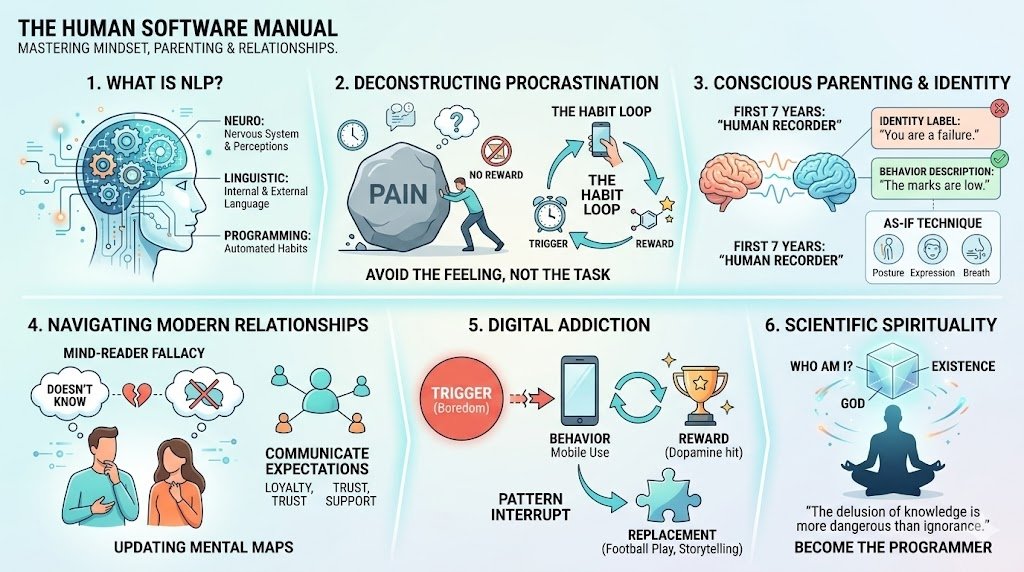
#1. What is NLP? (The Brain Manual)
The core of the discussion defines NLP as a “Brain Manual” for mastering thoughts, emotions, and behaviors. It breaks down into:
- Neuro: Our nervous system and the perception patterns we build.
- Linguistic: The internal and external language that influences our results.
- Programming: The automated habits and “software” that run our lives.
#2. Deconstructing Procrastination
A highlight of the podcast is the psychological breakdown of why we delay tasks. The expert argues that we don’t avoid the task, but rather the negative feeling associated with it.
- The 5 “Glitches”: Tasks are often avoided if they are unstructured, lack personal meaning, trigger a fear of failure, offer no reward, or if the body is biologically depleted (nutrient deficiencies).
- The Solution: Deal with the feeling first, and the action will follow.
#3. Conscious Parenting & Identity
The conversation shifts heavily toward how parents program their children’s “hard drives” during the first seven years.
- The Recording Phase: Children record a parent’s nervous system state (anxiety, anger) more than their actual words.
- Identity vs. Behavior: A critical distinction is made between labeling a child (“You are a failure”) versus describing an event (“The marks are low”). Identity labels create permanent, limiting beliefs.
- The “As-If” Technique: A powerful tool for parents to regulate their own emotions by physically shifting their posture, facial expressions, and breathing to “reverse engineer” a calm state.
The expert addresses the rising divorce rates and the “DINK” (Double Income, No Kids) lifestyle by focusing on Role Expectations.
- The Mind-Reader Fallacy: The common belief that “if they love me, they should know what I want” is debunked. Healthy relationships require the explicit communication of expectations.
- Updating Mental Maps: Conflicts often arise when we fail to “update” the mental image of our partner or children as they grow and evolve.
#5. Digital Addiction & The Habit Loop
To break digital addiction, the expert suggests moving beyond willpower.
- Pattern Interrupt: You must identify the specific triggers (boredom, loneliness, visual cues) and replace the “mobile-using” behavior with another activity that provides the same dopamine Reward (e.g., physical play or storytelling).
#6. The Ultimate Goal: Scientific Spirituality
The podcast concludes with a vision for the future—a world tour to spread these insights and an eventual shift toward Scientific Spirituality.
“What is more dangerous than ignorance? The delusion of knowledge.”
The goal is to move from being “programmed” by society to becoming the “programmer” of one’s own life, ending with a call to remain curious rather than becoming trapped in rigid conclusions.
Summary Takeaway: Whether it’s overcoming laziness, raising a child, or fixing a marriage, the answer lies in understanding the Internal Representations we hold and having the tools to “recode” them for a more fulfilling existence.
Table of Contents
Part 1: Defining NLP – The Manual for the Human Mind
Host: What exactly is NLP?
Expert: Think of it as a “Brain Manual.” It is a guide that allows you to master your thoughts, emotions, and feelings to transform yourself.
When you are pointing out a mistake to your child, observe yourself: how are you telling them? Many children grow up to develop “Perfectionism Syndrome” because of this. Stress, anxiety, depression, and suicidal thoughts are on the rise. NCRB data shows that every hour, a child commits suicide.
We must stop giving identity-based labels to children, such as:
- “You are a failure.”
- “You are careless.”
- “You are lethargic.”
Children often watch too much TV or mobile because they receive a trigger. We must try to minimize these triggers. Every child loves it when their father plays with them—it’s a special feeling. While a mother is with them all day, the expectation for play is often higher with the father; it’s a different emotional connection for the child.
The Breakdown of NLP
If we look at the name Neuro-Linguistic Programming, the meaning is right there:
- Neuro: Refers to your nervous system. It’s about how we create perceptions and generate thoughts. Our thought patterns are the “Neuro” part.
- Linguistic: This is about how we communicate—both with ourselves and with others. The way we talk to ourselves influences our results.
- Programming: These are our automatic behaviors and habits.
In short, NLP is a subject that helps us change our thinking patterns and our language so that we can transform our behaviors and habits. Whether you want a better career, business growth, better health, or improved relationships, NLP has an application for it all. It is a manual you read to master your internal state.
Part 2: The Science of Procrastination
Host: Nowadays, I see many people struggling with procrastination. Everyone wants to be successful or get fit, but they can’t seem to take action. Can you explain the science or neuroscience behind why someone who thinks about the gym or business can’t move into action?
Expert: Procrastination is a state where a person knows a task is important—whether it’s making a video, writing a book, or starting a channel—yet they still don’t do it. This is the core condition.
Inside, they feel guilty. They criticize themselves and fight with themselves, yet they remain stuck. This happens because of two things:
- The Internal Voice: A limiting voice that says, “Not now, later,” or “I’ll do it tomorrow.”
- Kinesthetic Discomfort (K): In NLP, we represent feelings with “K” (Kinesthesis). The moment you visualize the work—opening the laptop, writing—a negative feeling of discomfort is produced.
Key Insight: We never actually avoid the task itself. We are trying to avoid the negative feeling that the task produces in our bodies. If we learn to deal with that feeling, we can overcome procrastination.
The Five Core Reasons for Procrastination
Beyond the immediate discomfort, there are five deeper causes for why we delay:
| Reason | Description |
| 1. Unstructured Task | If a task lacks a clear structure (Step 1, Step 2, Step 3), the brain gets overwhelmed and defaults to avoidance. |
| 2. Lack of Meaning | If the task doesn’t provide personal meaning or a sense of fulfillment (“I am making a difference”), you will likely postpone it. |
| 3. Fear of Results | There is often a deep, unidentified fear—fear of negative comments, being trolled, or making a mistake. The body feels this as general discomfort. |
| 4. Not Rewarding | If the process is boring and offers no immediate pleasure (like standing in a long line to pay bills), the brain sees no “win” in doing it. |
| 5. Biological Depletion | Sometimes the cause isn’t psychological, but biological. If you have chemical imbalances or deficiencies (like Vitamin D or B12), your body lacks the energy to fight the “pain” of the task. |
Part 3: The Bhagavad Gita and NLP (Process vs. Outcome)
Host: The Bhagavad Gita says, “Focus on your actions, not the fruits.” But in NLP or Mind Power, we are told to visualize what we want first. How do we reconcile these two?
Expert: People often misunderstand that Shloka (Karmanye vadhikaraste ma phaleshu kadachana). It doesn’t mean “don’t desire results.” It means: “Action is in your control; the fruit is not.”
You should not try to control the outcome because you cannot completely control it. Your focus must remain on the process.
Neuroscience backs this up. If we are doing this podcast and I am constantly thinking about how many views it will get or if people will like it, my attention fragments. This fragmentation of attention creates anxiousness and anxiety. When you focus entirely on the present moment (Deep Work), you perform at your best. Sri Krishna was teaching the ultimate focus: keep your attention in the present moment to avoid the “unresourceful state” of anxiety.
Part 4: The Parent’s Role – The “Human Recorder”
Host: Many parents tell their children, “Study or you’ll fail,” or “Your friends will get ahead of you.” This focus on the end result rather than the process seems to be why stress and anxiety are rising among kids. Can NLP help stop this? What is the parent’s role?
Expert: Parents play a massive role. For the first seven years of life, a child’s mind is like a recorder. It doesn’t talk back; it just records everything.
However, children don’t understand complex language or logic at that age. Instead, they record:
- Your facial expressions.
- Your tone of voice.
- Your nervous system’s reactions.
If a mother is anxious but tells her child “I love you,” the child won’t “catch” the words; they will “catch” the anxiety. Your nervous system programs their mind.
Part 5: Perfectionism and the Fear of Mistakes
One of the biggest issues adults face is Perfectionism Syndrome—the “I won’t start until everything is perfect” mentality. This often stems from childhood.
How We Communicate Mistakes
When a child makes a small mistake, like breaking a glass or getting lower marks, and the parent reacts dramatically or screams, the child’s brain (which is in a high state of learning) creates a belief: “Mistakes are dangerous.”
They think:
- “If I make a mistake, I will disappoint people.”
- “The world is only for perfect people; there is no room for error.”
As an adult, this person will procrastinate on starting a business, writing a book, or making a video because the deep-seated fear of making a mistake is too high.
Part 6: Identity-Based Labeling vs. Behavioral Description
In NLP, we differentiate between Identity (who you are) and Behavior (what you do). Parents often confuse the two.
| The Mistake (Identity Labeling) | The NLP Solution (Behavioral Description) |
| “You are careless.” | “You did this specific task in a messy way.” |
| “You are a failure.” | “Your marks in math need improvement.” |
| “You are lazy/lethargic.” | “You haven’t finished your homework yet.” |
Why this matters:
Labels like “careless” or “failure” shape a child’s identity. They grow up with a “Low Self-Esteem” filter, constantly feeling “I am not enough.” Instead of labeling the child, describe the incident. Don’t link the event to their being.
Linguistic Reframing for Kids
Instead of using negative commands, use possibility-based sentences:
- Instead of “Don’t fall,” say “Stay balanced.”
- Instead of “Don’t fail,” say “Focus on your studies” or “Put your heart into this.”
Part 7: The “As-If” Technique for Emotional Regulation
Host: It’s easy to say “don’t get angry,” but mothers are often frustrated with house chores, work, and family pressure. When a child misbehaves, how can they control that high-pitch reaction?
Expert: You cannot control a thought with another thought. If you are angry, telling yourself “I shouldn’t be angry” won’t work. However, your body listens faster than your mind. In NLP, we use the “As-If” Technique. It involves four elements to “Reverse Engineer” your emotional state:
The 4 Elements of State Change
- Posture: The moment you feel anxious or angry, shift your body. If you were relaxed, how would your spine be? How would your shoulders look? Adopt that posture immediately.
- Facial Expression: Anger usually starts with a frown or tension in the forehead. Change your expression to one of relaxation. Relax your cheeks and forehead.
- Breath: Anger leads to shallow breathing. Force your breath to become deep and steady, as if you were calm.
- Inner Voice: Change the internal dialogue. Identify yourself and your state: “My name is [Name], and I am relaxed.” Keep the tone of this inner voice soft and calm.
The Result: Within 30 seconds of changing these four physical elements, your internal emotional state will shift. You move from reacting to responding.
Part 8: Mirror Neurons
Children possess Mirror Neurons. They are hardwired to tune into your emotional state. If you are “loudly” telling them to “keep quiet,” they aren’t learning the words “keep quiet”—they are mirroring your loud, aggressive state. By regulating yourself first using the “As-If” technique, you provide a calm template for them to mirror.
Part 9: The Anatomy of Digital Addiction
Host: Mothers often struggle to get their children away from screens. Even fathers have this habit. How can we break this cycle using NLP?
Expert: We have created an environment where total elimination is difficult. However, parents often make the mistake of simply snatching the iPad away without offering a replacement. In NLP, we understand that addiction is a “loop” consisting of three parts:
- The Trigger: An internal or external cue (boredom, loneliness, seeing someone else use a phone).
- The Behavior (Routine): Using the mobile or playing the game.
- The Reward: The hit of dopamine, the excitement of winning, or the escape from boredom.
The Multi-Sensory Nature of Triggers
In NLP, we categorize triggers using our sensory systems (VAK):
- Visual (External/Internal): Seeing a parent on their phone or imagining a game in the “mind’s eye.”
- Auditory (External/Internal): A notification sound or a friend talking about a high score.
- Kinesthetic (K): A feeling of boredom, sadness, or stress.
- Time & Space: 4:00 PM (time) might trigger tea/snacking; being in a “gaming room” (space) triggers the urge to play.
Expert Insight: You cannot change an addiction with willpower alone. You must Break the Chain. To do this, you must:
- Identify and Minimize Triggers.
- Replace the Behavior while keeping the Reward intact. If the child gets joy (reward) from the phone, you must replace the phone with an activity that provides equal joy (like playing football with the father).
Part 10: The “Mismatched Repo” – Teenagers and Social Identity
Host: Teenagers behave very differently from young children. What changes in their brain from an NLP perspective?
Expert: For the first 7 years, parents are the Primary Care Givers and the main source of programming. Between ages 7 and 14, the influence shifts to Peers (Friends) and teachers.
The Power Stress and the “Refusal to Update”
A major conflict arises because parents often fail to Update the Mental Image of their child.
- The Glitch: You have a “Mental Representation” of your child as an innocent 5-year-old. When they turn 15 and change, your “Internal Model” remains outdated. When you try to treat a 15-year-old like a 5-year-old, you create a Mismatched Repo (Rapport).
- Power Stress: This is a psychological term for the stress felt when you try to control someone who wants freedom. The more you control, the more the teenager rebels, because they associate your “guidance” with fear and their “rebellion” with happiness.
The NLP Solution for Parents of Teens: Shift your role from “Controller” to “Support System.” Your job is no longer to command, but to provide values, nutrition, and a positive environment while respecting their evolving Social Identity.
Part 11: Relationship Dynamics and “Mind Reading”
Host: In modern cities, “DINK” (Double Income, No Kids) couples are increasing due to lifestyle stress. What is your take on marriage and the right age for children?
Expert: There is no “objective” right or wrong here—it depends on the Context. In NLP, we look at Subjective Experience. If you aren’t mentally prepared, no amount of social pressure should force you into marriage. However, many relationship failures occur because of Role Expectations and Unreal Expectations.
The “Mind Reader” Fallacy
Many people believe: “If I have to say what I want, then there is no love.” This is a cognitive distortion.
- The Truth: Being able to read someone’s mood isn’t a sign of love; it’s a sign of Emotional Intelligence (EQ) or body language expertise.
- The Fix: You must Communicate your Expectations. Don’t assume your partner is a “Mind Reader.” Divide expectations into:
- Real: Loyalty, trust, transparency, support.
- Unreal: Expecting total agreement at all times or expecting them to sense your mood without words.
Expert Practitioner Summary: This section highlights that whether it is a child with a phone or a husband/wife in a conflict, the root is often Communication Gaps and Outdated Mental Maps. To change the result, you must update the “Software” (the internal representation) and change the “Input” (the communication).
Part 12: Marriage – Subjective Choice vs. Social Pressure
Host: Which is better? Marrying at the “right age” and having kids, or living life on your own terms?
Expert: In NLP, we distinguish between Objective Truth (like $2 + 2 = 4$) and Subjective Reality. Marriage and kids fall into the latter. To decide if something is right or wrong, you need a Context. * Legal Context: The Constitution tells us what is right/wrong legally.
- Moral Context: Our internal values tell us what is right/wrong ethically.
Without these standards, everything is just a personal filter. My advice? Readiness is more important than age. If you aren’t internally prepared, do not succumb to peer pressure. Many modern divorces happen because people marry under pressure without being ready for the responsibility.
Part 13: Role Expectations and Conflict
Host: Why are divorce rates rising in India, especially among educated couples?
Expert: A major cause is Role Expectation. Even if a man is highly educated and his wife is working, his subconscious might still be programmed with the childhood belief that “the man provides, the woman handles the home.”
- The Mismatch: The wife expects Equality (shared chores and responsibilities), while the husband (subconsciously) expects Traditional Roles. * The Result: These mismatched expectations lead to small friction points that eventually amplify into a total breakdown of the relationship.
NLP Insight: The problem isn’t the expectation itself; it’s the Failure to Communicate the expectation. We assume our partners should “just know” (The Mind Reader Fallacy).
Part 14: Personal Anecdotes – Fatherhood and Partnership
Host: What is your best moment as a father? And how do you keep your wife happy?
Expert: My highlight isn’t my career success—it’s the moment I first held my son. I remember seeing him breathe and thinking, “This miracle came from within us.” * Active Parenting: I make time for Storytelling and Football. Every child values their father’s time because it feels distinct from the time spent with the mother.
- Supporting the “Spine”: My wife is the spine of my life. She respects my Purpose. Relationships thrive when both partners grow together. If one partner evolves and the other stays stagnant, a gap is created. We bridge this by supporting each other’s values—whether it’s her love for travel or my work-life focus.
Part 15: The Future – Global Impact and Spirituality
Host: What is your “Big Goal”?
Expert: I want to conduct a World Tour. I want to prove that Hindi-language content and NLP have a global audience. Seeing Indian creators like Zakir Khan pull 15,000 people at Madison Square Garden is a “Proof of Concept” for me.
The Transition to Spirituality
By the age of 50, I want to shift entirely to Spiritual Discourses. Not religious, but scientific and objective spirituality. I want to explore:
- “Who am I?”
- The purpose of existence.
- The concept of God without bias.
The Wrap-up: The “Delusion of Knowledge”
There is a saying: “What is more dangerous than ignorance? The delusion of knowledge.”
An ignorant person will search for truth. But someone who thinks they already know everything (because they read one book or scripture) will never seek further. My goal is to leave people with questions, not just conclusions, so they continue to grow.
Host: This has been a masterclass in NLP and Relationships. Thank you for your honesty.
Expert: Thank you for having me.
Practitioner’s Closing Note:
This transcript concludes with a powerful shift from the Behavioral (how to fix habits) to the Existential (why we are here). As an AI and an NLP practitioner, I see this as the ultimate “Software Update”—moving from fixing the code to understanding the Programmer.
Read – The Ultimate Guide to 10 NLP Presuppositions: Rewiring Your Mind for Success
Know about more about NLP Presuppositions out on YouTube.
