

Feeling stuck? In NLP, having a choice is better than having no choice. Unlock cognitive flexibility, discover new pathways, and reclaim your autonomy today.
Have you ever found yourself staring down a life decision, utterly convinced that you were trapped between a rock and a hard place? Perhaps you felt forced to choose between two equally miserable outcomes, or worse, you felt like circumstances had backed you into a corner where no choices existed at all.
When you are trapped in that psychological pressure cooker, your peripheral vision narrows. Your breathing becomes shallow. You experience what psychologists call “tunnel vision.” But here is the liberating truth that master communicators and coaches understand: feeling stuck is almost never an accurate reflection of reality. It is simply a temporary glitch in your internal mental map.
To overcome this debilitating state, we must look to one of the most foundational and empowering principles in Neuro-Linguistic Programming (NLP). If you want to radically transform how you handle stress, accelerate your learning, and cultivate profound inner peace, you must deeply learn the NLP presupposition – Having a Choice is Better Than Having No Choice.
In this comprehensive guide, we will dissect exactly why our brains fall into the “forced choice” illusion, the cybernetic science behind why we crave autonomy, and a highly practical 3-step framework you can use to generate empowering options on demand.
Table of Contents
The Anatomy of Choice: Why We Crave It
To understand why this NLP presupposition is so effective, we have to understand the human hardwiring that demands autonomy.
The Psychological Reality: Self-Determination Theory
In the realm of modern psychology, Self-Determination Theory (SDT) posits that human beings have three universal, innate psychological needs: competence, relatedness, and autonomy. Autonomy is the profound internal knowing that you are the author of your own life. It is the feeling of acting from a place of volition rather than external pressure.
When our autonomy is threatened—when we feel our choices are stripped away—our intrinsic motivation plummets, and our emotional well-being rapidly deteriorates. Conversely, when we realize we have options, our nervous system relaxes. The simple act of recognizing a choice exists is often enough to instantly alleviate anxiety, even before an action is taken.
The Cybernetic Root: The Law of Requisite Variety
NLP did not pull this concept out of thin air. It is firmly rooted in systems theory, specifically W. Ross Ashby’s “Law of Requisite Variety.” Ashby, a pioneer in cybernetics, discovered a universal truth about how systems operate, whether that system is a computer network, a corporate ecosystem, or the human mind.
The Law of Requisite Variety states: In any given system, the element with the greatest flexibility of behavior will control the system. If you only have one way of dealing with a problem, and that way fails, you are entirely at the mercy of your environment. You are rigid, and rigid things break under pressure. However, if you possess the cognitive flexibility to approach a problem from five different angles, you become adaptable, resilient, and ultimately in control of your destiny. Therefore, having a choice is better than having no choice, because choice equals behavioral flexibility, and flexibility equals personal power.
Quality Over Quantity: Avoiding the Paradox
It is important to clarify that this presupposition is not advocating for the overwhelming “paradox of choice.” We aren’t talking about the anxiety of standing in a supermarket aisle staring at eighty-five different brands of toothpaste. In NLP, having a choice means moving from a state of zero or one option (which is a compulsion) or two options (which is a dilemma) into a state of three or more strategic, value-aligned pathways.
The “Forced Choice” Illusion: How We Trap Ourselves
If choice is so vital to our spiritual and psychological well-being, why do we constantly convince ourselves that we don’t have any? The answer lies in how society conditions us and the language we unconsciously use.
Linguistic Red Flags: The Modal Operators of Necessity
In NLP, we pay close attention to language because the words you use do not just describe your reality; they actively construct it. When people are trapped in the “no choice” illusion, their vocabulary becomes heavily populated with what linguists call Modal Operators of Necessity.
Listen to your internal monologue. How often do you hear phrases like:
- “I have to do it this way.”
- “There is no other way.”
- “I must endure this.”
- “I cannot change.”
These words are the linguistic bars of a psychological prison. They delete the vast array of possibilities that exist in the world and force your brain to look down a single, dark tunnel.
The Danger of the Binary
From a young age, we are conditioned to think in binary terms: win or lose, success or failure, right or wrong, fight or flight. This binary programming is the enemy of a dynamic personality. When you view the world strictly in black and white, you miss the infinite spectrum of colors in between.
On a deeper, more spiritual level, this binary thinking creates profound internal turbulence. It distances you from your center. True inner peace requires moving beyond the “this or that” mindset and recognizing that the universe is abundant with alternative paths. Breaking the binary is the first step toward spiritual and emotional liberation.
Real-World Mastery: Applying the Presupposition
Understanding the theory is only half the battle. True mastery comes from applying it to the friction points in your daily life. Let’s look at how expanding your choices transforms different domains of your human experience.
Accelerating Learning and Skill Acquisition
One of the most common places people get stuck is in their pursuit of knowledge. Many students and professionals believe there is only one “right” way to learn: staring at a textbook and memorizing text. When this inevitably leads to boredom and poor retention, they conclude, “I’m just not smart,” or “I have no choice but to drop out.”
This is a map failure. By implementing a framework like the Study Smarter Blueprint, learners can shatter this limitation. NLP teaches us that we process the world through different sensory modalities (Visual, Auditory, Kinesthetic). By giving yourself choices in how you learn—perhaps drawing mind maps, listening to recorded lectures while walking, or teaching the concept to a friend—you bypass the roadblock. Failure to learn via one method is no longer a dead end; it is simply feedback prompting you to choose a different strategy from your blueprint.
Emotional Self-Regulation
Victor Frankl famously said, “Between stimulus and response there is a space. In that space is our power to choose our response.”
Cultivating a dynamic personality means mastering this space. When someone sends you an aggressive email, your default, conditioned response might be immediate anger. You might feel you “have no choice” but to lash out. But as you integrate this NLP presupposition into your neurology, you begin to stretch that micro-second between stimulus and response. You realize you can choose curiosity. You can choose amusement. You can choose strategic silence. Having a choice is better than having no choice, especially when it comes to the emotions you permit to inhabit your body.
The 3-Step Framework in Action: The Case of Mrs. Robert
To fully illustrate how powerful this concept is, let us look at a real-time problem-solving scenario.
Meet Mrs. Robert. She is a highly capable mid-level corporate manager and a dedicated mother of two. She recently came to a standstill, physically exhausted and emotionally drained.
During our initial conversation, her language was riddled with necessity: “I have to quit my job. It’s either my career or my family’s sanity. I simply can’t do both anymore. There is no other option.”
Mrs. Robert was suffering from a classic binary trap. She believed her map of reality (quitting vs. suffering) was the actual territory. She was entirely disconnected from her autonomy. To rectify her problem, we applied the following 3-step NLP framework to generate choices on demand.
Step 1: The Pattern Interrupt
You cannot change a pattern while you are spinning inside of it. The first step is to recognize the “no choice” language and aggressively interrupt it.
When Mrs. Robert said, “There is no other option,” I stopped her. I didn’t validate her feeling of being trapped; I challenged the linguistic structure of her belief. I asked, “No other option in the entire world? If you had a magic wand and all the money in the universe, what would you do?” This question isn’t meant to solve the problem immediately; it is meant to break the trance of the binary. It forced Mrs. Robert to take a breath, pause, and step outside her tunnel vision.
Step 2: The “What Else?” Brainstorm (The Rule of Three)
Once the trance is broken, you must immediately force the brain to generate alternatives. In NLP, one choice is a compulsion, two is a dilemma, but three is a valid choice.
I challenged Mrs. Robert: “We are going to put ‘quitting’ and ‘suffering’ in a box for five minutes. I want you to brainstorm three completely different, completely new ways to handle this situation. Even if they seem ridiculous.”
Initially, her brain resisted. But as we pushed through, the creativity began to flow.
- Alternative 1: “I suppose I could aggressively negotiate a remote-work hybrid schedule, working from home three days a week.”
- Alternative 2: “I could delegate the two most draining projects to my junior team, which they actually need for their own promotions.”
- Alternative 3: “I could laterally transfer to a different department with a notoriously better work-life balance, even if it means a slight delay in my executive track.”
Suddenly, the physical tension in Mrs. Robert’s shoulders dropped. She hadn’t even taken action yet, but the mere realization that she was no longer trapped fundamentally shifted her reality. Having a choice is better than having no choice, and she just went from a binary trap to a menu of five distinct life paths.
Step 3: State Management
Choices cannot be generated from a state of panic. The final step of the framework is anchoring this new realization into the body.
We worked on shifting Mrs. Robert’s physiology. We moved her from a slumped, defeated posture into an upright, deeply breathing, resourceful state. We visualized her executing Alternative 1, imagining the conversation with her boss, the tone of her voice, and the feeling of asserting her boundaries. By managing her state, she ensured that when she walked back into the office, she wasn’t operating from a place of desperation, but from a place of empowered autonomy.
Ultimately, Mrs. Robert didn’t quit her job. She successfully negotiated a hybrid schedule and delegated her draining tasks, a solution she literally couldn’t “see” when she was locked in her binary trance.
Visual Summary “Having a Choice is Better Than Having No Choice”
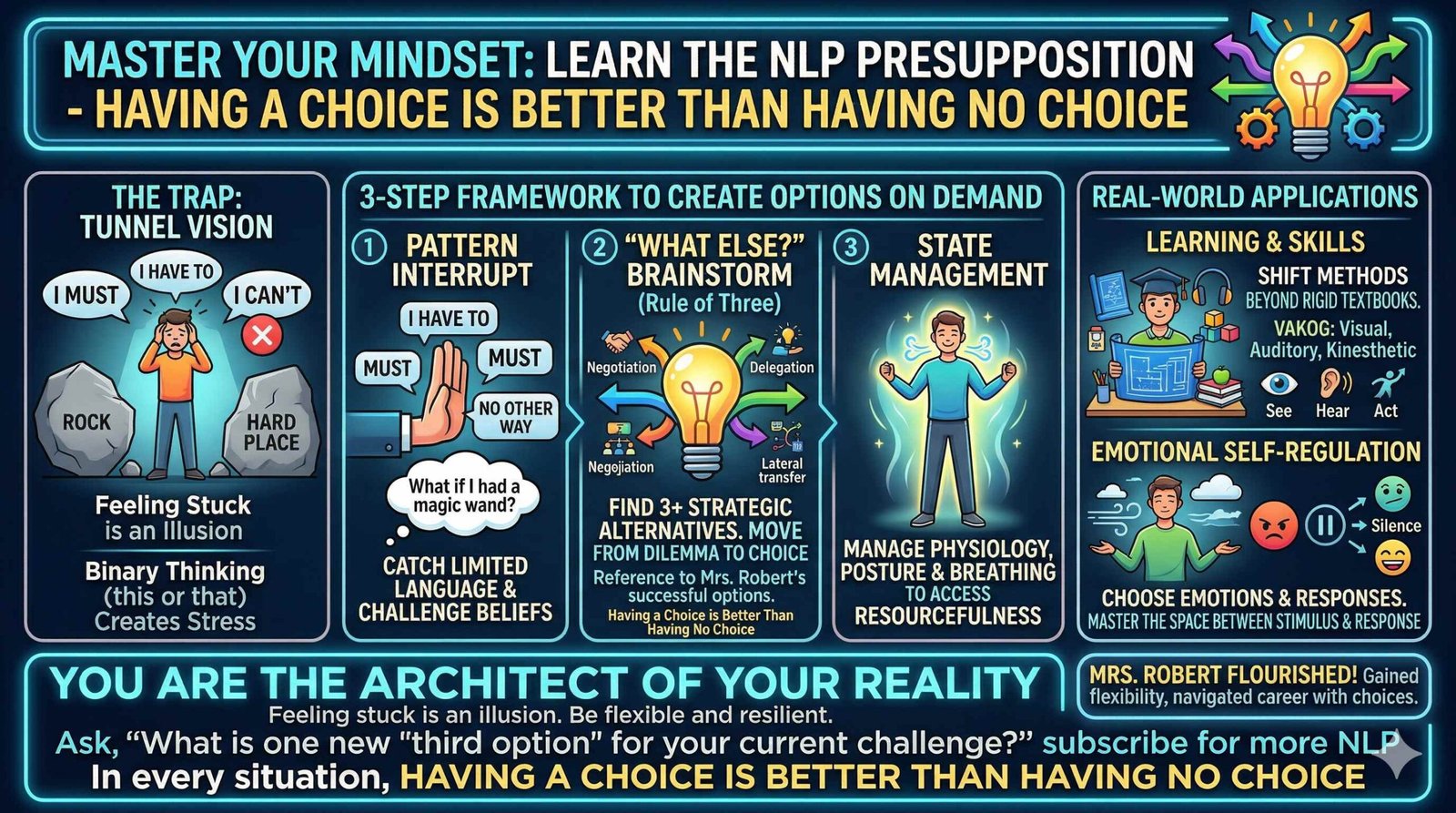
Conclusion: Becoming the Architect of Your Reality
Feeling stuck is an illusion. It is a sign that you are operating with an outdated or overly restricted map of the world. Remember the Law of Requisite Variety: the person with the most flexibility in their thinking and behavior will ultimately navigate the complexities of life with grace and power.
When you find yourself using words like “must,” “can’t,” or “have to,” let it serve as an alarm bell. Pause, interrupt the pattern, and force your mind to generate at least three new alternatives.
By integrating this wisdom into your daily life—whether you are trying to master a new skill, regulate your emotions, or navigate a complex career dilemma—you stop being a victim of circumstance. You step into your inherent power as the architect of your own reality, deeply understanding that, in every conceivable situation, having a choice is better than having no choice.
What about you? Think about a challenge you are currently facing where you feel you only have one or two bad options. What is one entirely new, slightly out-of-the-box “third option” you haven’t considered yet? Drop it in the comments below!
For more deep dives into applied cognitive flexibility, personal development, and strategies to unlock your full potential, be sure to subscribe and visit Knowlerience insights portal. Let’s continue building a life of infinite possibilities together.
Read in depth The Ultimate Guide to 10 NLP Presuppositions: Rewiring Your Mind for Success
Over to you: Which of these NLP Presuppositions will you consciously adopt today to shift your reality? Let us know your thoughts and experiences in the comments below!
Know about more about NLP Presuppositions out on YouTube.
