

Discover the dopamine-based morning routine that helped a student achieve a 98% average. Learn how to protect your dopamine baseline and make studying feel addictive.
We’ve all been there. You sit down at your desk, textbook open, highlighter in hand, and a genuine intention to be productive. But then, your phone vibrates. It’s a notification—a DM, a TikTok tag, or just a news alert. You tell yourself, “Just five minutes.”
Fast forward two hours: you’re deep in a rabbit hole about the history of sea sponges, your brain feels like fried chicken, and the mere thought of reading Page 1 of your biology chapter makes you want to crawl into a dark hole.
Most people call this “laziness” or a “lack of willpower.” But what if I told you that your struggle isn’t a character flaw? It’s a biological consequence. I used a specific, science-backed dopamine-based morning routine to go from struggling to focus to maintaining a 98% grade average. The best part? This routine didn’t make studying harder; it made it addictive. Here is exactly how to hack your brain’s chemistry to turn “dreaded work” into your favorite part of the day.
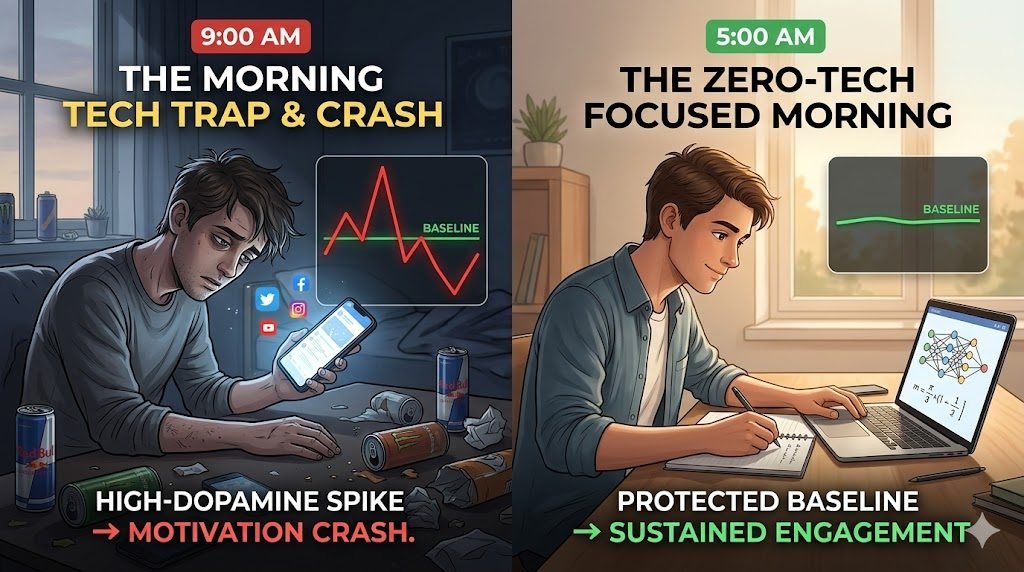
Table of Contents
The Science of the “Dopamine Spike” (Why You’re Tired at 9 AM)
To understand why you can’t focus, you have to understand Dopamine. Many people think dopamine is about pleasure. It’s actually about anticipation and motivation. It is the “seeking” chemical.
The Baseline and the Spike
When you wake up, your dopamine is at a natural baseline. This is your “neutral” gear. However, the modern student’s first instinct is to reach for their phone. Scrolling through Instagram, TikTok, or YouTube provides instant, high-intensity hits of dopamine. This causes a massive spike.
The Homeostasis Trap
Your body is a master of balance, a process known as homeostasis. When you force a massive dopamine spike early in the morning, your brain panics. To protect itself, it forces a massive drop below your baseline to compensate.
This is the “crash.” During this period, your dopamine levels are lower than when you woke up. Because your brain is now starving for stimulation, low-dopamine tasks—like solving a math problem or reading a historical text—feel physically painful. This is why, after using your phone, studying feels like a chore. You’ve essentially “numbed” your brain to the rewards of hard work.
Step 1: The “Zero-Tech” Rule
The first and most vital pillar of this routine is simple: Do not touch a piece of technology for the first hour of your day.
This means:
- No checking DMs.
- No “quick” emails.
- No checking school announcements.
- No scrolling.
Why “Zero-Tech” Works
By avoiding the screen, you are protecting your dopamine baseline. You are keeping your brain in its natural state of “mild boredom.” When your brain is at baseline, the stimulation provided by a textbook is actually enough to keep it engaged.
When you remove the “hyper-stimulants” (social media), the “subtle-stimulants” (learning) become fascinating. You aren’t fighting your brain; you’re working with its natural settings. Put your phone in another room or keep it on “Do Not Disturb” until your first study session is complete.
Step 2: Meditation and Identity Priming
Once you’re out of bed, don’t rush to your desk immediately. You need to stabilize your mental state.
The Utility of Meditation
Meditation isn’t just about “zen” or relaxation; for a student, it’s about reducing cognitive load. When you wake up, your mind is often cluttered with thoughts about yesterday’s drama or today’s anxieties. Meditation “flushes” these away, creating a blank canvas for the information you’re about to learn.
Identity Priming: The Secret to Consistency
The speaker in the transcript mentions a crucial step: Aligning yourself. Most students fail because they try to “do” a habit without “being” the person that habit requires. During your meditation, spend 2–3 minutes on Identity Priming. Ask yourself:
- Who do I need to be today?
- What are my high aspirations?
- Why is deeply learning this material important to my future self?
By constantly reminding yourself of your “Why,” you move from a state of forced discipline to a state of intrinsic motivation. You aren’t studying because you have to; you’re studying because you are the type of person who values knowledge and high achievement.
Step 3: The Frictionless Start (Immediate Deep Work)
One of the most radical parts of this routine is the immediate transition. The transcript suggests: “I don’t even wash my face. I don’t even eat. I just go straight to studying.”
Why Speed Matters
Every task you do between waking up and studying—making coffee, choosing an outfit, checking the fridge—is an opportunity for a distraction to creep in. It’s also an exercise in Decision Fatigue. By going straight from your meditation cushion to your desk, you are utilizing your “primed” brain state before the world has a chance to interrupt you.
The Minimalist Environment
To make this work, your environment must be “frictionless.”
- The Night Before: Clear your desk. Your laptop should be there, your notebook open to the right page, and your pen ready.
- The Result: You don’t have to “prepare” to study. You just sit down and begin. By the time your brain “wakes up” enough to want to procrastinate, you’re already 20 minutes into a deep work session.
Step 4: The 5 AM Advantage and “Pre-Learning”
While you don’t have to wake up at 5:00 AM to see results, there is a strategic advantage to being an early riser.
The Solo Edge
At 5:00 AM, the digital world is quiet. There are no new DMs coming in, no friends tempting you to go out, and no “FOMO” (Fear Of Missing Out). It is just you and the work. This isolation is a powerful productivity multiplier.
The “Gnarly” Secret of Pre-Learning
If you study in the morning before your classes, something magical happens: Your classes become your secondary review. Instead of sitting in a lecture trying to understand a concept for the first time while the professor drones on, you already know the material. You’re simply reinforcing it. This makes your time in school twice as efficient and is the primary reason why this routine leads to 98% grade averages.
Overcoming the “Boredom” Threshold
You might be thinking, “But studying is boring!” This routine proves that boredom is relative. If you spend your morning watching high-octane action movies and eating sugary cereal, a math problem will feel like a death sentence. But if you spend your morning in a “dopamine-neutral” environment—quiet, tech-free, and mindful—the math problem becomes an interesting puzzle to solve.
You are not making the math more fun; you are making your brain more sensitive to the fun that is already there.
Summary: The Dopamine Management Checklist
To implement this today, follow this simple checklist:
- Protect the Morning: No phone or screens for the first 60 minutes.
- Stabilize the Baseline: Meditate for 5–10 minutes to clear mental clutter.
- Prime the Identity: Remind yourself of your goals and who you want to become.
- Remove Friction: Prep your desk the night before so you can start instantly.
- Eat the Frog: Do your hardest, most important study session first.
- Reward Later: Save your “cheap” dopamine (social media, games, snacks) for the afternoon or evening as a reward for a job well done.
Conclusion: Subtracting Your Way to Success
True productivity isn’t about finding a “secret” app or a new “hack.” It is about removing the obstacles that you’ve accidentally placed in your own way.
By managing your dopamine baseline, you stop fighting against your biology and start using it as a wind at your back. You can still enjoy your phone, your games, and your friends—just don’t give them the “most important hour” of your day. Give that hour to your future self.
The Challenge: Tomorrow morning, try the “Zero-Tech” rule. Don’t touch your phone until you’ve completed 30 minutes of focused work.
Tell us in the comments: What is the hardest part about staying off your phone in the morning? Let’s brainstorm some solutions together!
Study Smarter Blueprint – ReadMap
Learn how to hack your brain’s clock with daily visuals and coaching
