

I’ve been learning in coaching since 2005, and the biggest lie we were told was ‘hard work’ wins.
In 2005, the world felt different. Facebook was a college experiment, the Nokia 1100 was the peak of technology, and “studying” meant sitting in a room with a physical textbook until your back ached and your eyes blurred. I started my coaching journey in that analog world, believing—like everyone else—that the secret to success was pure, unadulterated “grind.”
But as I stand here in 2026, looking back at two decades of neural evolution, I realize that everything I taught about ‘studying hard’ in 2005 is now a recipe for career failure. The game hasn’t just changed; the stadium was knocked down and rebuilt as a digital fortress. At KKnowlerience Path LLP, we’ve spent twenty-one years documenting this shift. I watched the education system rot for 20 years. Here is the cure I built.
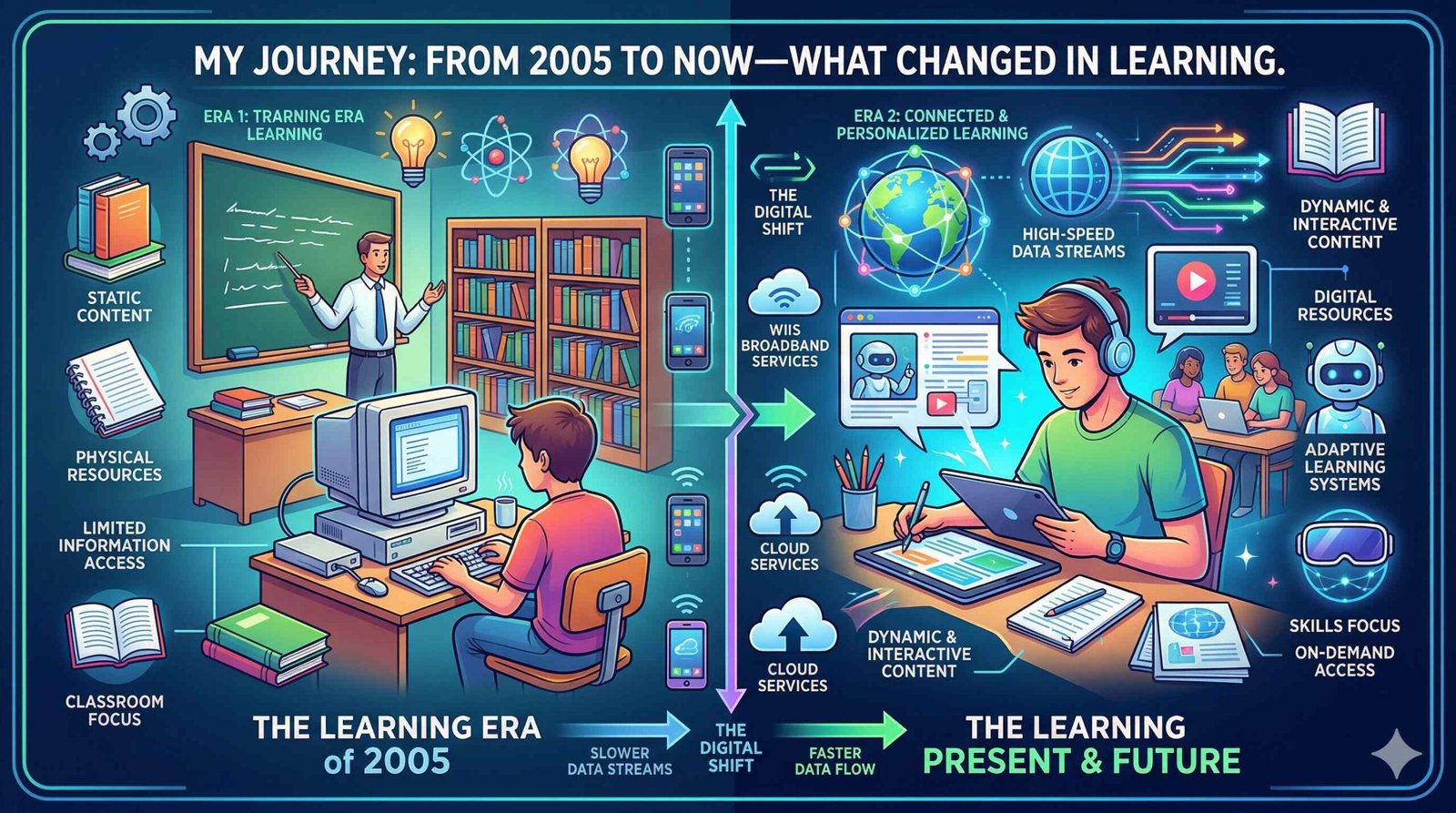
Table of Contents
Section 1: The Great Attention Collapse
In 2005, we had 12-minute attention spans. In 2026, you’re lucky to get 8 seconds.
Two decades ago, a student could sit with a math problem for thirty minutes without the itch to check a notification. Today, your brain is competing with algorithmic precision designed to keep you scrolling. We are using 2005 brains to solve 2026 problems. It’s time for a firmware update.
The Shift from Gathering to Filtering
Learning used to be about ‘gathering’ info. Now it’s about ‘filtering’ the noise out. In 2005, information was scarce. You went to a library to “find” things. In 2026, information is a flood. If you don’t have a filter, you drown. The modern student isn’t struggling because they don’t know enough; they are struggling because they know too much of the wrong things.
Section 2: Why Your Parents’ Advice is “Mid”
Your parents’ 2005 study advice is ‘lowkey’ why you are struggling in the AI era.
“Just read it again,” they say. “Wake up at 4 AM,” they suggest. While well-intentioned, this advice belongs in a museum. The ‘Toppers’ of 2005 would fail today’s market. Here is the new survival blueprint. In the old days, being a “human encyclopedia” was the goal. If you could memorize the most, you won. But in 2005, memory was a superpower. In 2026, it’s just a poorly managed digital folder. AI can recall facts instantly. If your only value is “knowing things,” you are competing with a tool that costs $20 a month and never sleeps.
Section 3: The Hard Truth About AI and Your Brain
If you’re still studying like it’s 2005, you’re training yourself to be replaced by AI.
This is the “Hard Truth” I’ve had to accept as a coach. We can no longer teach students to be better “storage devices.” We must teach them to be better “processors.”
Memory vs. Synthesis
| Era | Goal | Method |
| 2005 | Memorization | Rote Learning (Ratta) |
| 2026 | Synthesis & Connection | Study Smarter Blueprint |
If you are just doing “Ratta,” you are becoming a low-level version of ChatGPT. To survive the 2020s, you need to develop what we call at KKnowlerience “High-Order Cognition”—the ability to connect unrelated dots, think critically under pressure, and manage your own neural state.
Section 4: The 1% Secret (20 Years in the Making)
After 20 years of coaching, I found one pattern that separates the 1% from everyone.
I have sat across from thousands of students—from the ones crying over failed exams to the ones topping national boards. The difference was never IQ. It was never “hours spent.” I’ve seen 20 years of student burnout. It’s not you; it’s the outdated software. The 1% don’t “study” in the traditional sense. They Optimize. They treat their brain like an athlete treats their body. They understand that a 2-hour session in a “Flow State” is worth more than a 10-hour session in a “Stress State.”
Section 5: The Birth of the Study Smarter Blueprint
I turned two decades of failures into the Study Smarter Blueprint. You get the shortcut.
The Blueprint didn’t appear overnight. It was forged in the fire of seeing students “Blank Out” in exam halls and seeing professionals crumble under the weight of information overload. It’s a synthesis of Neuro-Linguistic Programming (NLP), spiritual grounding, and cognitive science.
The Science of Retrieval
I’ve spent 21 years perfecting this. Can your 2-week ‘cramming’ session beat my science? The Blueprint focuses on “Active Retrieval” over “Passive Consumption.” We don’t care how many pages you read; we care how many neural pathways you successfully fired.
- 2005 method: Read, Highlight, Forget.
- Blueprint method: Prime, Encode, Recall, Anchor.
Conclusion: The Legacy of Strategy
From blackboards to VR, one thing hasn’t changed: your brain needs a strategy, not stress.
My journey from 2005 to now has been a lesson in humility. It taught me that the “old ways” are comfortable, but they are traps. To succeed in 2026 and beyond, you have to be willing to kill your old habits.
You don’t need more “Hard Work.” You need a Firmware Update. You need a system that understands how your 2026 brain actually functions.
I’ve done the twenty years of research so you don’t have to. The shortcut is here. The evolution is now.
Are you ready to move from 2005 habits to 2026 results?
[Join the KKnowlerience Path LLP movement. Enroll in the Study Smarter Blueprint and start your own evolution today.]
Follow the 20-year evolution of learning and get daily neuro-hacks:
