

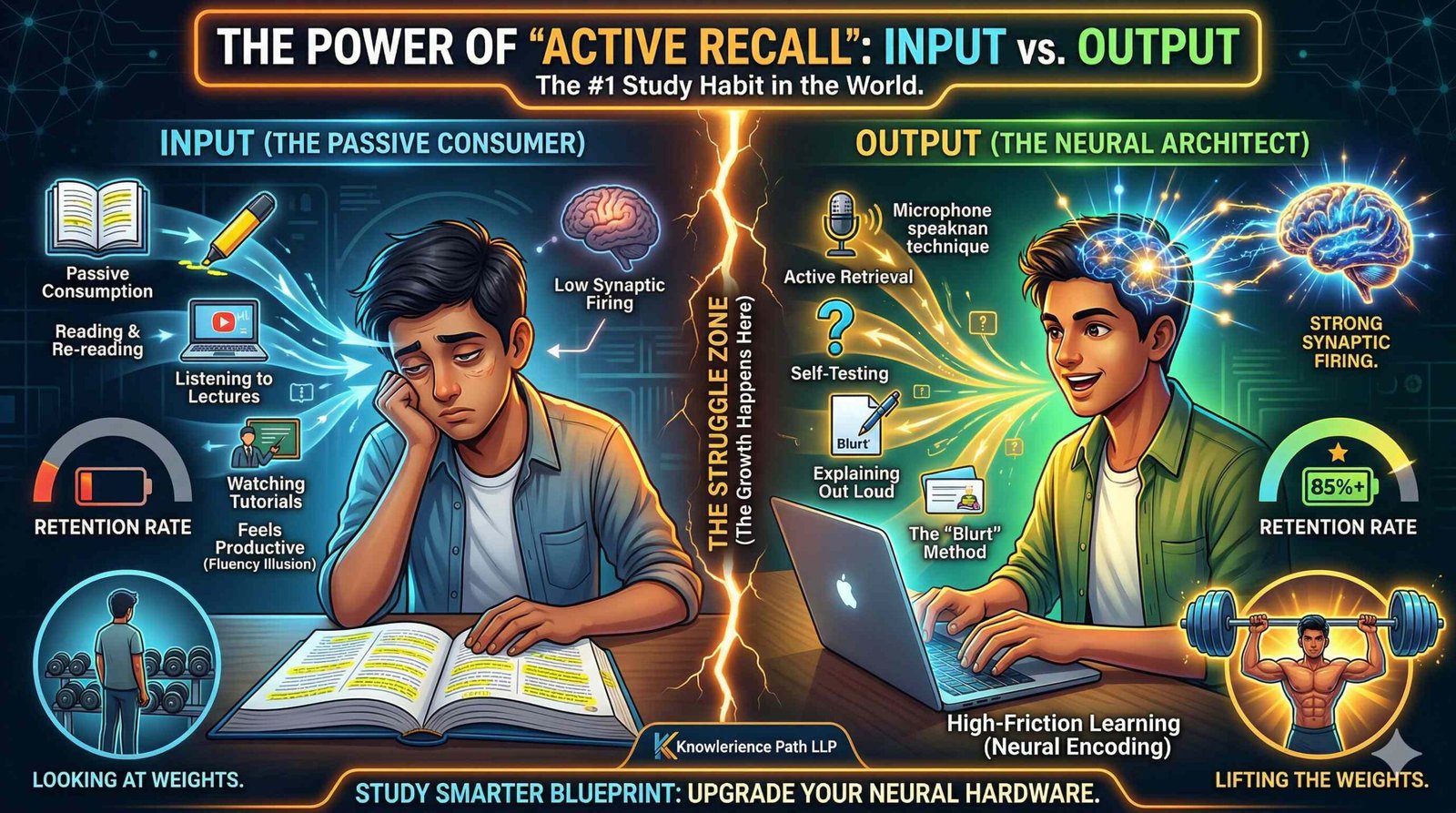
Most students fail because they practice the “Input” (reading) but are tested on the “Output” (remembering). Active Recall is the high-performance habit of forcing your brain to retrieve information without looking at your notes. It is the core engine of the Study Smarter Blueprint, turning your memory into a “Fortress” rather than a “Leaky Bucket.”
The Bottom Line: If you aren’t testing yourself, you aren’t learning. Stop being a spectator in your own education and start lifting the cognitive weights.
Let’s start with a brutal reality check. You forget 70% of what you read in 24 hours without this one habit. Imagine spending five hours in the library, downing three espressos, and highlighting enough yellow ink to be seen from space, only for your brain to hit “Delete” on nearly three-quarters of that data while you sleep. It’s not just frustrating; it’s a systematic failure of the traditional education model.
At KKnowlerience Path LLP, we don’t believe in working harder; we believe in working anatomically. If you want to stop the “Memory Leak,” you need to stop reading and start retrieving. It’s time to talk about the “Holy Grail” of learning: Active Recall.
Table of Contents
Section 1: The “Adult Coloring” Epidemic
We need to address the aesthetic trap that is killing your grades. Highlighting your textbook is just adult coloring. It does zero for your actual memory. Most students are ‘Shadow Studying’—performing work that results in zero actual neural encoding. You feel productive because your notes look like a rainbow, but your brain is essentially on “View-Only” mode. Your notes are a graveyard of information until you use Active Recall to revive them. #The Fluency Illusion
Why do we love re-reading so much? Because it’s easy. Stop re-reading. It creates a ‘Fluency Illusion’ that tricks you into feeling prepared. When you read a page for the fourth time, your brain recognizes the words. It whispers, “I know this.” But “Recognition” is a trap. Recognition is what happens when you see a face in a crowd; “Recall” is being able to remember that person’s name, phone number, and favorite movie when they aren’t in front of you.
Exams don’t ask you if you recognize the answer. They ask you to produce it.
Section 2: The Neuroscience of the “Output” Muscle
To understand why Active Recall works, you have to understand what a brain actually is. Your brain isn’t a storage unit; it’s a muscle that grows only during struggle. #### Input vs. Output
Reading is input, but exams are output. Why are you only practicing the input? Think about it this way: Reading is just looking at weights; Active Recall is actually lifting them in the gym. You can watch “Fitness YouTubers” for ten hours a day, but your muscles won’t grow until you pick up the heavy stuff.
When you force your brain to retrieve a piece of information without looking at your notes, you are creating a high-friction neural event. This struggle signals to your hippocampus that this specific data point is a matter of “survival.” The brain responds by thickening the neural pathway.
| Activity | Brain State | Retention Rate |
| Re-reading | Passive / Low Friction | ~10% |
| Highlighting | Aesthetic / Zero Friction | ~5% |
| Active Recall | Aggressive / High Friction | ~85% |
Section 3: How to Implement the “Master Key” (Practical Steps)
I cut my study time by 60% using one simple, evidence-based mental retrieval hack. You don’t need more hours; you need better cycles. Here is how the Study Smarter Blueprint integrates Active Recall into your daily routine.
1. The “Blurt” Method
Read a chapter once. Close your book right now. If you can’t summarize this, you learned nothing today. Get a blank sheet of paper and “blurt” out everything you remember. Don’t look at the book. Write it in your own slang. Draw messy diagrams. When you finally hit a wall and can’t remember any more, then open the book and see what you missed. The “Gap” you found is where the real learning happens.
2. The Feynman Technique
If you can’t explain a concept to a six-year-old (or your dog), you don’t understand it. Explain the concept out loud from memory. The moment you stumble on a word or a logic jump, that is your “Weak Link.” Fix the link, then recall again.
3. Flashcards (Done Right)
Don’t just read the back of the card. Force yourself to say the answer out loud before flipping it. If you flip too early, you’ve failed the rep.
Section 4: The 1% Competitive Edge
Active Recall is ‘lowkey’ the only reason that one kid in class never stresses. You know the one. They go to the gym, they have a social life, and they still ace the finals. They aren’t “born geniuses.” The top 1% of students aren’t smarter; they just practice pulling information out constantly. #The Pre-Exam Audit
If you don’t test yourself before the exam, the exam will test you first. Most students use the actual exam as their first “Recall” attempt. That is a recipe for an “Exam Hall Blank.” Inside the Study Smarter Blueprint, we treat the weeks leading up to the final as a series of “Micro-Exams.” By the time the real paper sits on your desk, your brain has already retrieved that information fifty times. It’s muscle memory.
Section 5: Retrieval in the AI Era
In 2026, information is cheap. ChatGPT can give you a summary of anything in three seconds. So, why bother learning?
Because the Study Smarter Blueprint uses Active Recall to make your memory literally bulletproof. In a world of digital noise, the person who can synthesize and recall information without a screen is the one who leads. You aren’t just studying for a grade; you are building a high-performance cognitive engine that can compete with algorithms.
Conclusion: The Science of Certainty
Science proves that testing yourself is more effective than every other study method combined. You have a choice. You can keep “Shadow Studying.” You can keep coloring your textbooks and wondering why you feel like a failure on exam day. Or, you can embrace the struggle. You can lean into the friction of Active Recall and watch your study time shrink while your results explode.
At KKnowlerience Path LLP, we don’t give you more work. We give you the “Master Key.”
Are you ready to stop ‘staring’ and start ‘steering’ your brain?
[Enroll in the Study Smarter Blueprint today. Master the art of Active Recall and turn your memory into a fortress.]
Master the science of retrieval with daily visuals and coaching: 👉 Subscribe to KKnowlerience on YouTube
