

You’ve been “grinding” for four hours, but your brain is essentially on Airplane Mode. You are a Passive Reader—you are in the aesthetic trap of highlighting everything while learning absolutely nothing.
Let’s be real for a second: Reading isn’t studying. Most people are just ‘organized staring’ at their textbooks.
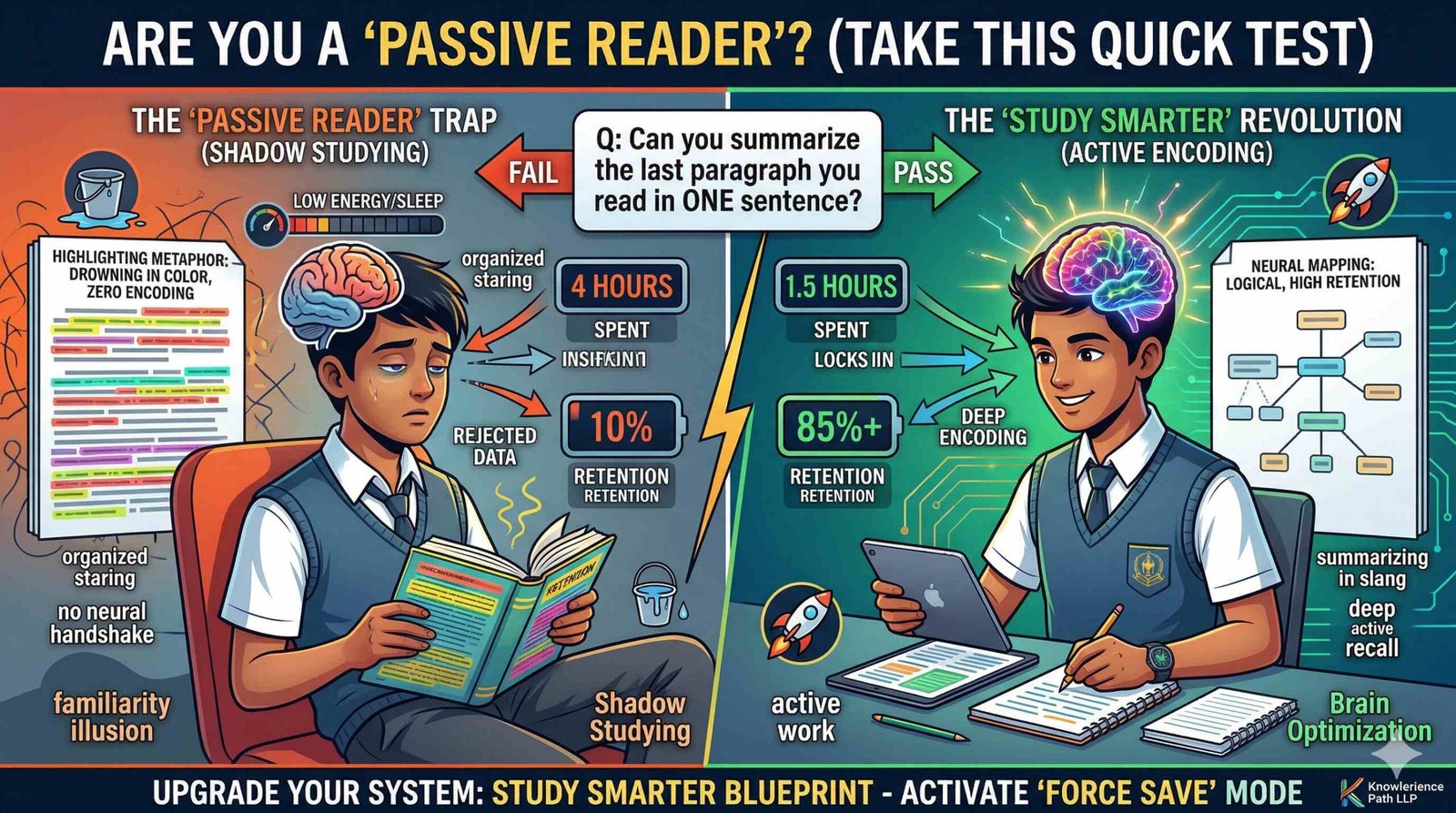
You know the vibe. You’ve been at your desk for three hours. The room is quiet, the lighting is perfect, and you’ve “covered” forty pages of history. But if someone walked in right now and asked you to explain the core thesis of page twelve, you’d probably glitch.
At KKnowlerience Path LLP, we’ve spent years auditing how students actually process information. What we’ve found is a quiet epidemic we call “Shadow Studying.” It’s that feeling of being busy without being productive. Passive reading is ‘lowkey’ the biggest waste of time in the history of education. It’s the reason you feel burnt out but still see “Mid” grades on your report card.
It’s time to stop the cap. Let’s figure out if you’re actually learning or just performing “Productivity Theater.”
Table of Contents
The 10-Second Reality Check
Before we dive into the science, let’s do a live audit of your brain.
Close your eyes. If you can’t summarize the last paragraph you read in one simple sentence, you’re a passive reader. Did you pass? If you felt that “loading” icon spinning in your head, don’t panic. It’s not your attention span; it’s your technique. You’re not bored, you’re just passive. Your brain is simply doing what it was evolved to do: conserve energy.
Section 1: The Neuroscience of “Organized Staring”
Why does this happen? Why can we read an entire chapter and feel like an NPC (Non-Player Character) in our own education?
The “Scan-Only” Glitch
Your brain has a ‘Scan only’ mode. Most students never flip the switch to ‘Save’. Think of your eyes like a high-end document scanner. They are perfectly capable of moving across the lines, identifying words, and even turning pages. But the scanner doesn’t understand the document; it just creates a flat image.
Your eyes move, but your neurons are asleep. In the Study Smarter Blueprint, we call this “Shallow Encoding.” You are touching the information, but you aren’t grabbing it. Real learning requires a neural handshake. If you aren’t engaging with the text, the handshake never happens, and the data is sent straight to the “Trash” folder.
The Highlighter Trap
We need to talk about your stationery addiction. Your highlighters are making you stupid. They trick your brain into skipping the work. When you highlight a sentence in neon yellow, your brain gets a hit of dopamine. It thinks, “I’ve identified the important part! Task complete.” Because you’ve “marked” it, your brain feels it no longer needs to “store” it. You are effectively outsourcing your memory to a piece of plastic. Highlighting is aesthetic, but it’s zero-effort learning.
Section 2: The High Cost of “Shadow Studying”
You might think, “So what? I’ll just read it again.” But the math doesn’t add up.
80% of students spend hours ‘reading’ but only retain 10% of the data. Imagine if you went to a job and worked for 10 hours, but your boss only paid you for one. You’d quit immediately. Yet, you do this to yourself every single day during finals week. You are wasting 4 hours a day on ‘Shadow Studying.’ That is time you could be spending at the gym, hanging with friends, or actually sleeping.
A Personal Confession
I’ve been there. Before I developed the Study Smarter Blueprint, I was the king of the “Late Night Grind.” I read 50 pages today and couldn’t explain a single one to my dog. I felt like I was working hard, but I was just spinning my wheels. I was addicted to the feeling of being a “serious student” rather than the result of being a knowledgeable one.
Section 3: Passive Reading vs. The “Study Smarter” Revolution
Passive reading is like watching a workout video and expecting to get a six-pack. It sounds ridiculous when you put it that way, right? You can watch 1,000 hours of Olympic swimming, but the moment you jump in the pool, you’re going to sink if you haven’t practiced the strokes.
Learning is a contact sport. You have to get messy with the data.
The “Top 1%” Secret
The top 1% don’t read more than you; they just process 5x deeper. How? They use what we call Active Retrieval. Instead of letting the information flow into their eyes, they practice pulling it out of their brains.
When you see a “Pro” student, they aren’t just reading. They are questioning. They are debating the author. They are drawing “Mental Maps.”
Section 4: Stop Lying to Yourself (The Fix)
Stop lying to yourself. If you re-read notes to ‘learn,’ you’re doing it wrong. Re-reading creates “Fluency Illusion.” Because the text looks familiar, you think you know it. But “Recognition” is not “Recall.” Recognition is seeing a face you’ve seen before; Recall is being able to name their father’s middle name. You need Recall for exams.
Step 1: The “Mapping” Shift
I stopped ‘reading’ and started ‘mapping.’ My study time dropped by half immediately. Inside the Study Smarter Blueprint, we replace linear reading with “Neural Mapping.” We teach you how to convert 10 pages of text into a single, 3D visual structure that your brain can actually hold onto.
Step 2: The “Force Save” Command
Every 15 minutes, you must stop. Close the book. Write down three things you just learned in your own slang. If you can’t, you didn’t learn them. Go back and fight the text until you do.
Conclusion: Turn Your Eyes into Data Processors
The “Hard Work” era is dead. No one cares if you sat at your desk for 12 hours if you walk into the exam hall with a blank mind.
The Study Smarter Blueprint turns your eyes from ‘scanners’ into high-speed data processors. It’s the difference between being a spectator and being the MVP. It’s about taking your time back. It’s about moving from “Struggling Student” to “High-Performance Architect.”
Don’t spend another night “Shadow Studying.” Take the test. Expose the passivity. And then, upgrade your system.
Are you ready to stop ‘staring’ and start ‘steering’ your brain?
Follow the movement for daily neuro-hacks and NLP coaching: 👉 Subscribe to KKnowlerience on YouTube
