

Discover why people make the best choices available to them at the time. Master this NLP presupposition to end regret, build empathy, and understand behavior.
Have you ever looked back at a decision you made five years ago and cringed? Or perhaps you’ve sat in a boardroom, staring at a colleague, wondering, “How on earth could a rational person think that was a good idea?”
We spend an exhausting amount of energy judging ourselves and others based on the information we have now. But here is the radical, life-changing truth: at any given moment, people make the best choices available to them at the time.
This isn’t just a feel-good mantra; it is one of the core presuppositions of Neuro-Linguistic Programming (NLP). When you truly integrate this belief into your life, the heavy armor of resentment and the sharp sting of regret begin to dissolve. In this masterclass, we will explore the science, psychology, and practical application of this principle to help you navigate your world with more grace and effectiveness.
Table of Contents
What Does This NLP Presupposition Actually Mean?
To understand this concept, we have to look at what NLP calls “Resources.” In the world of NLP, a “choice” isn’t just a logical selection from a menu; it is the result of your internal processing system.
When we say that people make the best choices available to them at the time, we are acknowledging that their “menu” of options is limited by three specific factors:
1. Internal State
Your emotional and physical state dictates what you are capable of seeing. If you are in a state of peak flow and confidence, your menu of choices is vast. However, if you are exhausted, terrified, or grieving, your brain enters survival mode. In that state, the “best” choice might simply be to yell, hide, or shut down.
2. Available Information
We often judge past versions of ourselves using information we didn’t have back then. This is the “hindsight bias.” You cannot choose an exit you don’t know exists. If your “map” of a situation only shows two paths, you will choose the better of the two, even if a third, invisible path is objectively superior.
3. Belief Systems (The Map)
NLP teaches us that “The Map is Not the Territory.” We don’t operate in reality; we operate in our perception of reality. Our upbringing, culture, and past traumas create filters. If someone was raised to believe that vulnerability is a weakness, their “best choice” during a conflict will always be aggression or withdrawal, because their map tells them that being open is “dangerous.”
The Science of the “Bad” Choice: Why We Glitch
Critics of this NLP principle often argue, “But some people make terrible choices! How can that be their best?” To answer this, we look to neuroscience.
The Amygdala Hijack
When we are under significant stress, the prefrontal cortex—the part of the brain responsible for logic, long-term planning, and empathy—effectively goes offline. The amygdala takes over. In this “emergency” state, the brain isn’t looking for the perfect choice; it is looking for the fastest survival choice.
According to the Yerkes-Dodson Law, there is an optimal level of arousal for performance. Once you pass that threshold into high stress, your cognitive flexibility plummets. You might know “logically” that you shouldn’t snap at your partner, but in a state of high cortisol, your brain determines that snapping is the best choice to release pressure or protect your ego.
Real-World Problem Solving: The Case of Mrs. Neha
To see this in action, let’s look at a common corporate conflict involving Mrs. Neha, a Senior Project Manager at a fast-paced tech firm.
The Problem: Mrs. Neha was reaching a breaking point with her lead developer, Arjun. Arjun had missed three consecutive deadlines and was becoming increasingly defensive in meetings. Mrs. Neha felt disrespected and was convinced Arjun was being “lazy” and “unprofessional.” She was ready to initiate a formal disciplinary process.
The NLP Shift: Before taking action, Mrs. Neha worked with an NLP coach who challenged her to adopt the presupposition that people make the best choices available to them at the time.
Instead of asking, “Why is he being so difficult?” she started asking, “What resources is he missing that make ‘defensiveness’ his best available choice?”
The Discovery: Mrs. Neha called Arjun for a one-on-one, not to reprimand him, but to conduct a “resource audit.” She discovered that Arjun was dealing with a serious health crisis in his family and was trying to code through extreme sleep deprivation. Furthermore, he felt that asking for help was a sign of incompetence—a belief ingrained in him from a previous toxic workplace.
The Resolution: Once Mrs. Neha realized that Arjun was making the “best choice” given his exhaustion and his limiting beliefs about asking for help, her anger evaporated. She didn’t excuse the missed deadlines, but she changed the “choices available” to him. She provided:
- The Resource of Support: She brought in a junior dev to assist.
- The Resource of Psychological Safety: She reassured him that asking for help was a professional strength, not a weakness.
Within two weeks, Arjun’s productivity returned to peak levels. By assuming he was doing his best, Mrs. Neha solved the problem rather than just punishing the person.
Reframing Others: The Power of Positive Intent
Another pillar of this mindset is the belief that every behavior has a positive intention. The person cutting you off in traffic has a positive intent (perhaps to get to an emergency or to feel a sense of control in a chaotic life). The teenager who lies has a positive intent (perhaps to avoid a conflict they don’t feel equipped to handle).
When you stop viewing people as “bad” and start viewing them as “resource-depleted,” your communication strategy changes. You stop trying to “fix” their character and start trying to “expand their map.” You realize that people make the best choices available to them at the time, and if you want them to make a better choice, you must help them find better resources.
Healing Yourself: Ending the Cycle of Regret
Perhaps the most profound application of this NLP principle is inward. Many of us carry the “Should-Have” virus.
- “I should have known better.”
- “I should have started that business sooner.”
- “I shouldn’t have stayed in that relationship for so long.”
This is a form of self-torture because you are evaluating your 25-year-old self with the wisdom of your 40-year-old self.
The Resource Audit Exercise
If you are struggling with a past regret, try this NLP technique:
- Identify the Event: Close your eyes and see that younger version of yourself.
- Assess the Resources: Honestly ask, what was that person feeling? Were they scared? Were they lacking mentors? Were they operating on a “map” that said they weren’t worthy of love?
- Release the Judgment: Acknowledge that, given the specific cocktail of stress, information, and beliefs that person had at 2 PM on that Tuesday, they made the “best” choice they could see.
- Integrate the Learning: What resource do you have now that you can give to that younger version of you? (Forgiveness, wisdom, boundaries).
By accepting that you were doing your best, you free up the mental energy needed to make even better choices today.
How to Expand Your Map for Better Choices Tomorrow
If we accept that we always choose the best option currently visible to us, then the secret to a better life is simply to make more options visible. In NLP, this is known as “adding choices.”
1. State Management
Since our “best choice” is dictated by our internal state, learning to manage your physiology is key. Before making a major decision, check your “HALT” status: Are you Hungry, Angry, Lonely, or Tired? If so, your available choices are currently subpar.
2. Continuous Learning (Gathering Data)
The more you know, the larger your map becomes. This is why reading, coaching, and seeking diverse perspectives are so vital. You are literally adding “exits” to your map so that when a crisis hits, you have a better “best choice” to pick from.
3. Challenging Limiting Beliefs
If your map says, “People are out to get me,” your best choice will always be a defensive one. NLP techniques like Reframing or The Meta Model help you poke holes in these old maps, allowing more collaborative and creative choices to emerge.
Conclusion: Freedom from the “Should Have” Trap
Understanding that people make the best choices available to them at the time is the ultimate act of emotional intelligence. It doesn’t mean we stop holding people accountable. It means we stop being surprised by human behavior and start being curious about it.
When you lead with empathy—for Mrs. Neha’s employees, for your family, and most importantly, for yourself—you create a world where growth is possible. You move from a place of “What is wrong with you?” to “What do you need?”
The Challenge for You: Think of one person in your life right now who is frustrating you. For the next 24 hours, operate under the assumption that they are making the absolute best choice they can with the resources they have.
How does your tone change? How does your blood pressure shift? Leave a comment below: If you could go back and give your younger self one “resource” (confidence, patience, a specific piece of advice), what would it be? Let’s expand our maps together.
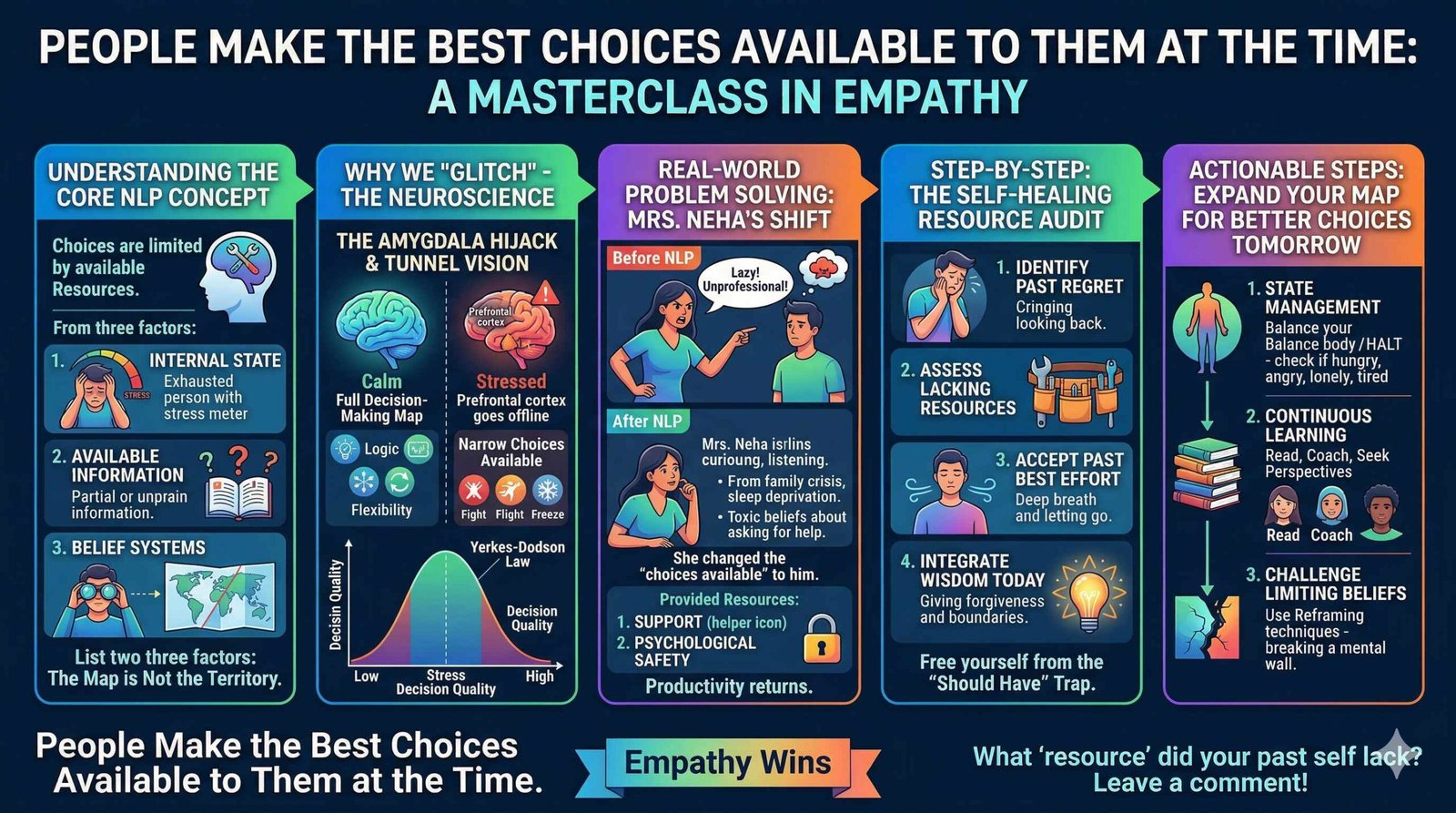
Visual summary “People Make the Best Choices Available to Them at the Time”
Interested in learning more NLP techniques to transform your coaching or leadership?
Read – The Ultimate Guide to 10 NLP Presuppositions: Rewiring Your Mind for Success
We’d love to hear from you! Leave a comment below sharing a time when you completely changed your approach to a problem and ended up winning. And if you found this breakdown valuable, be sure to share it with someone who might need a little help getting “unstuck” today.
The beauty of these principles is that you do not need to wait for permission to use them. You can start right now. Do you need NLP? Lets check here
Over to you: Which of these NLP Presuppositions will you consciously adopt today to shift your reality? Let us know your thoughts and experiences in the comments below!
Know about more about NLP Presuppositions out on YouTube.
