

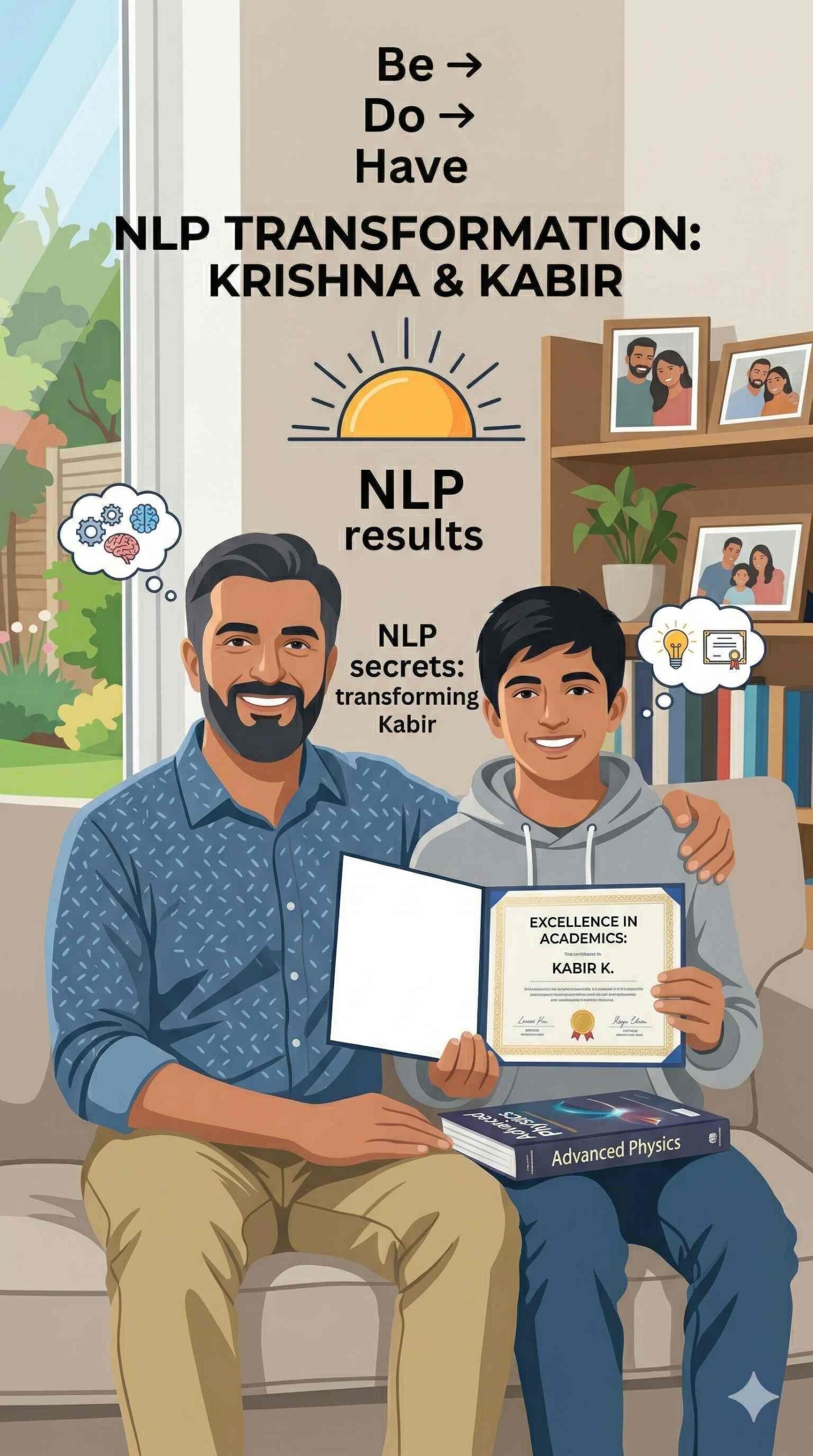
This article episode reveals how parents can use NLP (Neuro-Linguistic Programming) to transform their children from angry and procrastinating to disciplined and focused. It debunks the “talent myth,” explaining that a child’s resistance is often just the brain’s natural instinct to conserve energy. To overcome this, parents must help children associate difficult tasks, like studying, with vivid, long-term rewards rather than immediate pain.
Furthermore, the article emphasizes programming the subconscious mind with highly specific visual goals. Instead of fighting bad habits like mobile addiction directly, parents should identify the underlying sensory triggers and replace them with healthier, equally rewarding activities. Finally, it advises against saying a direct “no” to tantrums—suggesting a “postpone” technique instead to bypass the brain’s panic response—while urging parents to allow healthy struggles and foster a unified, loving household to build their child’s ultimate mental resilience.
As a parent, there are few things more frustrating than watching your child waste their potential. You see the intelligence in their eyes, yet they refuse to open their textbooks. You buy them the best resources, yet they complain of being “too tired” to study, only to spend hours scrolling through mobile phones or running outside to play cricket.
You might catch yourself thinking, “Maybe they just aren’t talented enough. Maybe they are just naturally lazy or angry.” Welcome to the Talent Myth. The belief that discipline, focus, and drive are inherent traits you are either born with or lack entirely is one of the most damaging misconceptions in modern parenting. The truth, backed by the science of Neuro-Linguistic Programming (NLP), is far more empowering. You do not need to wait for a miracle to change your child’s trajectory. You simply need to understand the mechanics of their brain.
In this comprehensive guide, we are going to dive deep into the 3 NLP Secrets to Transform Your Child | From Angry & Lazy to Disciplined & Focused. By blending practical, science-backed psychological strategies with everyday parenting, we will decode exactly why your child resists hard work and how you can reprogram their mind for success.
To make this highly practical, we will follow the real-time journey of Mr. Krishna and his teenage son, Kabir. Like many parents, Mr. Krishna was at his wit’s end. Kabir was perpetually angry when asked to put his phone away, constantly procrastinated on his schoolwork, and seemed utterly devoid of discipline. By applying the NLP secrets we are about to explore, Mr. Krishna completely transformed his son’s behavior.
Let’s unpack the science of success and learn how you can achieve the exact same transformation in your own home.
Table of Contents
Secret 1: Decoding the Brain’s Energy – The Illusion of Laziness
The first step in mastering the 3 NLP Secrets to Transform Your Child | From Angry & Lazy to Disciplined & Focused is understanding that what you call “laziness” is likely something entirely different.
Laziness vs. Procrastination: The Crucial Difference
Most parents use “lazy” and “procrastinator” interchangeably. In NLP, distinguishing between the two is the foundation of behavioral change.
- Laziness is a state of total apathy. A truly lazy person has no desire to wake up early, study, or go to the gym, and they feel zero guilt about it. They are perfectly content in their inaction.
- Procrastination, on the other hand, involves intent. Your child wants to do well in their exams. They set the alarm for 5:00 AM. But when the alarm rings, they hit snooze.
Procrastination is actually a positive sign—it means the desire exists. However, when a child fails to execute their plan, the brain punishes them with a deep sense of guilt, leading to frustration, anger, and a ruined mood for the rest of the day. Kabir was a classic procrastinator. He would make grand study timetables every Sunday, fail to follow them by Monday afternoon, and then snap angrily at Mr. Krishna when asked about his progress.
The Science of “Threshold Energy”
Why did Kabir fail to execute his plans? To understand this, we must look at the brain’s 80 billion neurons. These neurons produce around 60,000 thoughts daily through electrical impulses and hormones. For the body to physically act—like getting out of a warm bed to solve math problems—the brain must generate a minimum amount of motivation or excitement. In NLP, this is called Threshold Energy.
Imagine trying to break a thick wooden stick. You can apply light pressure all day, but it won’t snap until you hit a specific threshold of force. Similarly, your child’s body won’t move until their mental motivation hits the threshold.
Mr. Krishna noticed a fascinating contradiction: Kabir couldn’t wake up at 6:00 AM for his math tuition, but when his friends organized a Sunday morning cricket tournament, Kabir was bathed, dressed, and out the door by 5:30 AM without a single alarm. Why? Because the purpose and excitement of cricket easily shattered his threshold energy barrier.
The Brain’s Primary Agenda: Saving Energy
Every human being is given 24 hours and a limited amount of daily energy. The brain’s absolute, fundamental biological agenda is a survival instinct: Save Energy.
Whenever the brain does anything new, active, or conscious—like learning to drive a car, riding a bicycle for the first time, or studying a complex new subject—it consumes massive amounts of energy. This is why you feel exhausted after driving on an unfamiliar, dark road. To prevent constant exhaustion, the brain tries to turn everything into automatic habits. Doing nothing (like sleeping or scrolling) requires zero energy, which aligns perfectly with the brain’s default desire to conserve.
The Pain-Pleasure Principle and Levels of Consciousness
The human brain is driven by a simple algorithm: move toward pleasure, move away from pain. Studying represents immediate physical and mental pain. Sleeping represents immediate pleasure. As an NLP expert will tell you, “You cannot sell heaven with hell. You can only sell heaven with a better heaven.” You must offer the brain a reward that is more appealing than the comfort of doing nothing.
This requires shifting your child from the First Level of Consciousness to the Second Level of Consciousness.
- First Level: The child only sees the immediate pain (the heavy textbook, the boring formulas, the mental strain).
- Second Level: The child vividly sees and feels the long-term reward (the pride of a top score, the respect of peers, the freedom of a great career).
How Mr. Krishna Solved It: Mr. Krishna stopped yelling at Kabir about the “pain” of failing. Instead, he worked to associate studying with the Second Level of Consciousness. He discovered Kabir dreamed of becoming a software engineer and building his own tech startup. Mr. Krishna didn’t just talk about it; he took Kabir to visit a local tech incubator. He let Kabir feel the environment, see the exciting workspaces, and talk to young founders. By giving Kabir a vivid, emotional taste of his ultimate goal, studying suddenly became the stepping stone to a “better heaven.” The threshold energy was met.
Secret 2: Activating the Subconscious Mind (The “Ramu Kaka” Effect)
If you are serious about applying the 3 NLP Secrets to Transform Your Child | From Angry & Lazy to Disciplined & Focused, you must learn how to communicate with their subconscious mind.
The Genie in the Brain
Think of the subconscious mind as “Ramu Kaka”—a tireless, incredibly loyal servant, or a magical Genie. This part of the mind works 24/7 for free and operates on one single rule: “Your wish is my command.” Have you ever told yourself firmly before sleeping, “I must wake up at 4:30 AM for my flight,” and miraculously found your eyes popping open at 4:25 AM, beating your own alarm clock? That is your subconscious mind at work. Your conscious mind went to sleep, but your inner servant stayed awake, tracking time to fulfill your command.
The tragedy is that 97% of people—including our children—never give their subconscious a clear goal.
The Power of Specific Imagery
The subconscious mind does not understand vague language. If you tell your child, “Be a good student,” or “Be successful,” the brain draws a blank. It cannot process abstract concepts.
Imagine going to a police station to report a lost child, but refusing to provide a photograph, their height, or a description of their clothes. The police cannot find what they cannot see. Similarly, your child’s Genie cannot manifest success if it doesn’t have a clear picture of what success looks like.
To program the subconscious, you must replace abstract words with highly specific, sensory-rich imagery. Consider these transformative NLP anchors:
- Instead of “My life is okay,” teach them to visualize: “My life is a rising sun for me.” (Imagine the warmth, the light breaking through darkness, the fresh energy of a morning).
- Instead of “I want good health,” visualize: “My health is a growing, green garden for me.”
- Instead of “I want to be successful,” visualize: “Success is a massive, green growing tree for me.”
When Kabir was feeling defeated by a low test score, Mr. Krishna guided him to sit quietly, breathe deeply, and repeat the “Life is a rising sun” visualization 40 to 50 times. By doing this every morning for a week, Kabir’s subconscious began to naturally seek out the “light” and opportunities in his day, dramatically reducing his lingering anger and frustration.
Breaking Bad Habits: Decoding Triggers and the VAK Model
A massive part of transforming a child from lazy to disciplined involves breaking mobile addiction or junk food habits. Most parents fail because they focus purely on the behavior (e.g., snatching the phone away).
Habits follow a strict neurological structure: Trigger -> Behavior -> Reward.
The brain doesn’t actually care about the mobile phone (the behavior). It only cares about the dopamine and entertainment (the reward). To stop the behavior, you must identify the trigger. In NLP, we categorize triggers using the VAK model:
- Visual (V): Seeing a sibling play a video game triggers the urge to play.
- Auditory (A): Hearing a notification ping.
- Kinesthetic (K): Feelings of boredom, stress, or a bruised ego.
How Mr. Krishna Solved It: Kabir was addicted to endless social media scrolling. Whenever Mr. Krishna snatched the phone, Kabir would erupt in anger. Mr. Krishna realized the behavior was scrolling, but the trigger was Kinesthetic—specifically, boredom. Kabir scrolled because his brain craved the reward of entertainment and novelty.
Instead of fighting the behavior, Mr. Krishna attacked the trigger and replaced the reward. He introduced Kabir to highly engaging, science-based documentary channels and interactive tech building kits. He provided a better source of entertainment that satisfied the brain’s craving for novelty but resulted in positive learning. The mobile addiction naturally faded because the subconscious was getting its dopamine from a healthier, equally stimulating source.
Secret 3: The n+1 Frame, Fear, and Unified Parenting
The final pillar of the 3 NLP Secrets to Transform Your Child | From Angry & Lazy to Disciplined & Focused delves into how the brain predicts the future, how to manage tantrums, and the crucial role of the parents’ own mindsets.
The n+1 Frame: How the Brain Predicts Reality
Our brains operate 24/7 in what NLP experts call the n+1 Frame. Like a grandmaster playing chess, the brain is always trying to predict the next (+1) frame of reality to keep us safe.
- As Expected: If reality matches the prediction, we feel calm.
- Negative Mismatch: If reality is radically worse than predicted (a sudden trauma), the brain records it deeply with high emotion to protect us in the future. This creates phobias and fears.
- Positive Mismatch: If reality is radically better than expected, we experience it as a miracle or extreme good luck.
When children experience fear—such as stage fright or exam anxiety—it is because their n+1 Frame is predicting a severe negative mismatch (e.g., the audience laughing, the parents scolding). The brain triggers a Fight, Flight, or Freeze response to protect them from this predicted emotional trauma. To cure this fear, you must make the action familiar. Action cures fear because it provides the brain with new data that the n+1 reality is actually safe.
Handling Tantrums: The “Postpone” Technique
One of the most practical applications of NLP in parenting is handling a child’s demands, especially in public spaces like malls. When a child screams for a toy or an extra hour of screen time, a parent’s instinct is to say a hard “NO!”
To a developing brain, a hard “no” triggers an immediate fight-or-flight panic. The brain feels denied of its learning and data-gathering experience.
The NLP Secret: Never say “No.” Instead, Postpone. When Kabir demanded an expensive gadget during a shopping trip, Mr. Krishna didn’t shout or refuse. He simply said, “That looks amazing, Kabir. Let’s look at it again in a little while before we leave, or maybe we can plan for it next week.” By postponing, you bypass the brain’s rejection trigger. The child thinks, “Okay, I’m not being denied, I just have to wait.” Because children (and teenagers) have shifting attention spans, the intense, immediate emotional demand fizzles out. They calm down, and the tantrum is completely avoided.
The Be-Do-Have Model and Building Mental Muscle
If you want your child to be disciplined and successful, you must teach them the correct sequence of reality generation. Most society operates on a flawed Have-Do-Be model: “If I HAVE good grades, I will DO great in college, and I will BE a success.” NLP teaches the inverse: Be-Do-Have. You must assume the identity first. “I AM a disciplined student (Be). Therefore, I study daily (Do). Therefore, I achieve top marks (Have).” You are poor from the inside before you are poor from the outside. If a child views themselves as “lazy,” their actions will reflect that identity.
Furthermore, as parents, we are biologically hardwired to protect our children because our deepest genetic mandate is the survival of our species. This leads to over-parenting. We want to give them the best clothes, the easiest tutors, and a friction-free life.
This is a critical mistake. Struggle is a blessing. If you help a butterfly break out of its cocoon, you destroy its ability to build wing strength, and it will die. If you remove all struggles from your child’s life, you rob them of the opportunity to build mental muscles. When they finally face rejection in the real world, they will lack the resilience to handle it, leading to deep anxiety and depression. Let your children fall. Let them face the consequences of a missed deadline. Guide them, but do not do the push-ups for them.
Unified Parenting: Breaking the “Best” Trap
Finally, the transformation of a child is heavily dependent on the environment created by the parents. You cannot expect a child to be focused and disciplined if the household is filled with unspoken expectations, resentment, or disjointed parenting styles.
Many couples fall into the “Best” Trap. They start their relationship giving their absolute peak performance—the best dates, the most expensive honeymoon, flawless behavior. But the brain adapts to everything. What was once thrilling becomes the baseline. When parents settle into comfortable, mundane routines, they often stop expressing love. They take each other for granted.
To create a powerful foundation for your child:
- Express Love Daily: Never assume your spouse or your child “just knows” you love them. Make affection a non-negotiable daily ritual.
- Total Transparency: Spouses must operate with total trust. In the modern era, hiding passwords or guarding phones creates a subtle environment of suspicion that children pick up on.
- Unified Front: You cannot play “Good Cop, Bad Cop” with critical issues like junk food or mobile addiction. If Mom says no to the phone, Dad cannot secretly hand it over to be the “cool” parent. You must operate as a team. Be unified in your discipline.
- Acceptance over Expectation: Eradicate the n+1 expectations for your partner. Accept them exactly as they are. When the marital relationship is anchored in acceptance and teamwork, the child feels secure, grounded, and ready to focus on their own growth.
Conclusion: Implementing the NLP Secrets Today
Transforming a child from angry and lazy to disciplined and focused is not about finding a magic pill, nor is it about relying on the myth of innate talent. It is about understanding the profound, elegant machinery of the human mind.
Let’s recap the 3 NLP Secrets to Transform Your Child | From Angry & Lazy to Disciplined & Focused:
- Understand Energy and Motivation: Recognize that procrastination is an energy management issue. Help your child break the threshold energy barrier by attaching their daily tasks to vivid, long-term, emotionally resonant goals (The Second Level of Consciousness).
- Command the Subconscious “Genie”: Provide the brain with highly specific visual anchors. Break bad habits not by fighting the behavior, but by identifying the VAK triggers (Visual, Auditory, Kinesthetic) and replacing the reward with healthier alternatives.
- Master the n+1 Frame and Unify the Environment: Use the postponement technique to bypass tantrums. Allow your child the blessing of struggle so they build mental resilience. Finally, ensure that you and your partner provide a unified, transparent, and actively loving foundation for them to grow upon.
Mr. Krishna didn’t change Kabir by yelling louder or punishing harder. He changed his son by becoming an architect of Kabir’s environment and subconscious mind. By shifting from the “Have-Do-Be” model to the “Be-Do-Have” mindset, Kabir internalized the identity of a focused, disciplined tech-innovator in the making.
You have the exact same power. The soft skills of emotional regulation, focus, and discipline can be taught when knowledge is combined with practical, science-backed experience. Stop viewing your child’s resistance as a character flaw, and start viewing it as a puzzle waiting to be solved. Apply these NLP secrets consistently, and watch as your child unearths their true, limitless potential.
If you found value in this breakdown of the 3 NLP Secrets to Transform Your Child | From Angry & Lazy to Disciplined & Focused, share this post with fellow parents who might be struggling. The journey to better parenting is one we are all walking together!
Transform your child like Kabir take following assessments for your child ,its Free!
Over to you: Which of these NLP Presuppositions will you consciously adopt today to shift your reality? Let us know your thoughts and experiences in the comments below!
Know more about Neuro Linguistic Programming (NLP)
The Ultimate Guide to 10 NLP Presuppositions: Rewiring Your Mind for Success
Decode Your Mind’s Code with Neuro-Linguistic Programming (NLP)
Know about more about NLP Presuppositions out on YouTube.