

The science of focus is built on the reality that concentration is a finite biological resource, not an infinite act of willpower. By aligning your work with Ultradian Rhythms—90-minute peaks of high cognitive frequency followed by short recovery troughs—you can achieve a deep Flow State that doubles your output while minimizing fatigue.
Central to the Study Smarter Blueprint, this pillar focuses on eliminating “Attention Residue” caused by digital distractions and using Focus Anchoring to trigger immediate mental clarity.
We live in an age where your attention is the most expensive commodity on the planet. Trillions of dollars have been invested in engineering algorithms specifically designed to bypass your willpower and keep you scrolling. If you feel like you can’t sit still for ten minutes without reaching for your phone, I have some news for you.
You aren’t ‘ADHD’; you’re just living in an environment designed to keep you distracted. At KKnowlerience Path LLP, we don’t look at focus as a personality trait. We look at it as a biological resource that is currently being harvested by everyone except you.
Mastering Pillar #2 turns your scattered mind into a precision-guided missile for academic success. It is time to stop being the product and start being the programmer.
Table of Contents
Section 1: The Hidden Cost of the “Quick Check”
Most students think that checking a WhatsApp notification for five seconds is harmless. They believe they can “jump” right back into their Calculus or Biology notes. The science says otherwise.
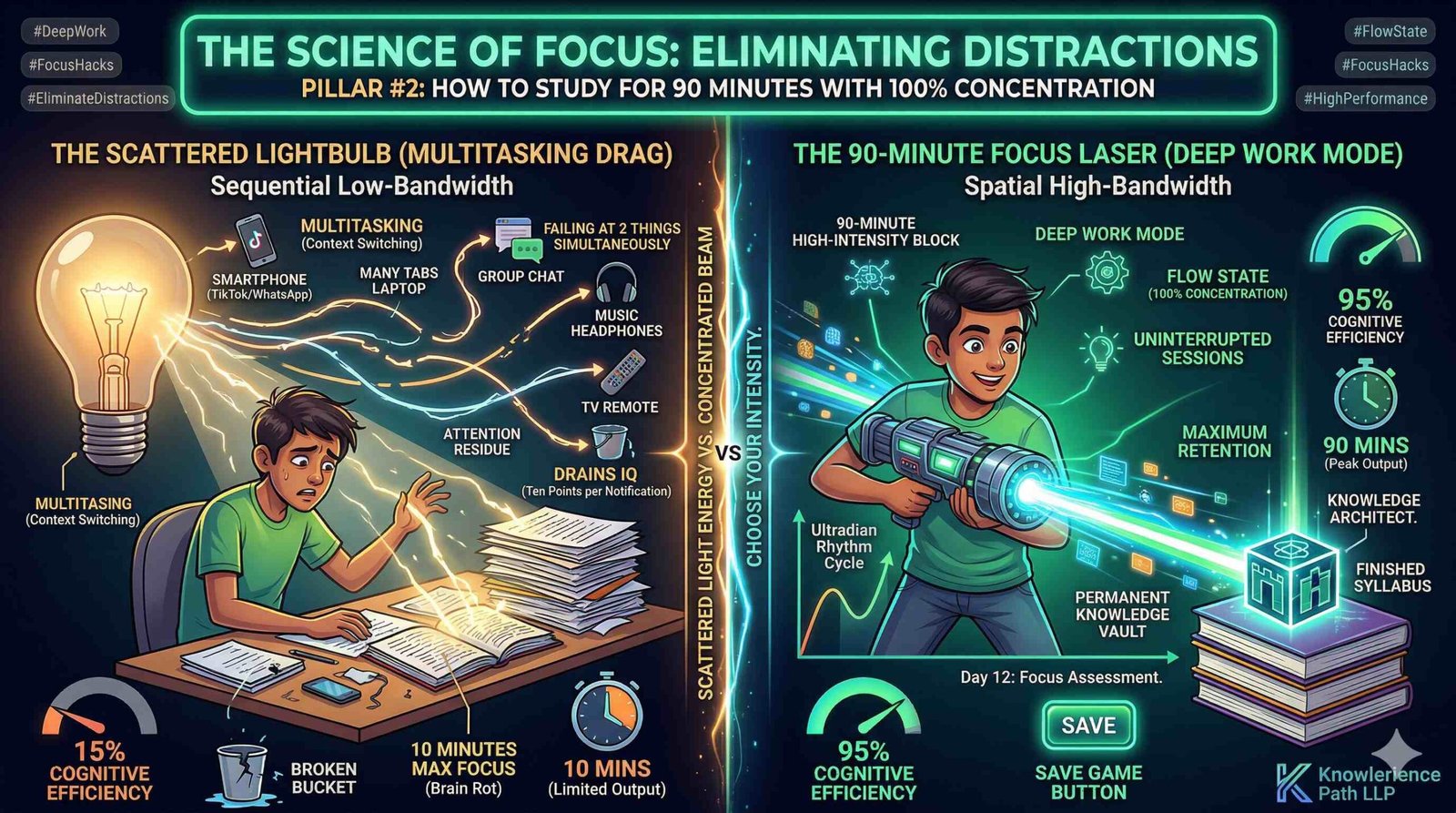
Every notification you check drains your IQ by ten points for twenty-three minutes. This is known as “Attention Residue.” When you switch tasks, a part of your brain stays stuck on the previous task. If you check your phone every ten minutes, you are essentially living in a permanent state of cognitive impairment. You are trying to run high-level academic software on a processor that is being choked by background apps.
Focus is a laser. Distraction is a lightbulb. Only one of them can cut steel. A lightbulb spreads energy everywhere but accomplishes nothing. A laser concentrates energy into a single point and becomes unstoppable. Which one are you using to build your future?
Section 2: The Myth of the “Great Multitasker”
In my 21 years of coaching, I’ve heard countless students brag about their ability to multitask. They have music playing, three tabs open, and a group chat buzzing, all while “studying.”
Let me be blunt: Multitasking is just a fancy word for failing at two things simultaneously. Stop doing it. Your brain is physically incapable of processing two high-attention tasks at once. What you are actually doing is “context switching,” which burns through your mental fuel at three times the normal rate.
Silicon Valley spent billions to break your focus. The Blueprint gives it back for free. They want you fragmented because a fragmented mind is easy to manipulate. A focused mind, however, is dangerous. It is productive. It is independent. Inside the Study Smarter Blueprint, we reclaim that independence.
Section 3: The 90-Minute Biological Blueprint
If you want to achieve 100% concentration, you have to stop fighting your body and start working with it. Your brain runs on ninety-minute cycles. If you fight them, you will always lose focus. These are called “Ultradian Rhythms.” Every 90 minutes, your brain moves through a peak of high-frequency activity followed by a trough of low-frequency recovery. If you try to study for six hours straight, you are forcing your brain to work through its recovery phases. The result? “Brain rot,” fatigue, and zero retention.
Stop working eight-hour days and start working four ninety-minute blocks of high-intensity focus. By timing your study sessions to match your biology, you can accomplish more in three hours than most people do in a full workday.
Section 4: The Sixty-Second Setup
The battle for focus is won or lost in the first minute. The first sixty seconds of your study session determine the next ninety minutes of focus. If you sit down and immediately open a browser or check a message, you have set the “neural tone” for distraction.
In the Study Smarter Blueprint, we use “Focus Anchoring.” Use ‘Focus Anchoring’ to trick your brain into entering a flow state in seconds. This involves a specific physical or auditory trigger—like a particular scent, a specific lo-fi track, or a specific desk ritual—that tells your subconscious: “We are now in deep work mode.”
Concentration isn’t a superpower you’re born with; it’s a strategic skill you develop daily. Like a muscle, it requires progressive overload. I coached a student who went from five minutes to ninety minutes of pure focus by simply following our anchoring and environment protocols.
Section 5: Environmental Warfare
You cannot win a fight against an algorithm with willpower alone. You have to change the battlefield. Put your phone in another room or admit you care more about TikTok than success. If the phone is within your line of sight—even if it is turned off—a portion of your brain is actively working to not check it. This is “Brain Drain.” You are wasting bandwidth on self-control that should be going toward your syllabus.
While you’re scrolling, your competition is mastering ninety minutes of deep, uninterrupted work sessions. The academic world is moving toward a “Winner Take All” model where deep work is the only differentiator. POV: You finally unlocked the 90-minute ‘God Mode’ focus block and finished your syllabus. That feeling of finishing a massive task with time to spare isn’t luck; it’s the result of a sanitized environment and a protected mind.
Conclusion: The Precision-Guided Mind
Focus is the engine of the Study Smarter Blueprint. Without it, the best NLP hacks and the smartest chunking methods are useless. You have to be able to stay in the seat.
Mastering Pillar #2 turns your scattered mind into a precision-guided missile. You stop being a victim of the “Attention Economy” and start being the architect of your own cognitive destiny. Stop fighting your biology. Stop falling for the multitasking trap. And for heaven’s sake, put the phone in the other room.
Are you ready to stop scrolling and start soaring?
[Enroll in the Study Smarter Blueprint. Master the Science of Focus and reclaim your attention at KKnowlerience Path LLP.]
Reclaim your brain and join the elite ranks of the focused: 👉 Subscribe to KKnowlerience on YouTube
