

Master the NLP presupposition Flexibility is Power. Discover how behavioral adaptability and neuroplasticity help you conquer any goal faster.
Picture a violent storm tearing through a dense forest. The massive, rigid oak tree—stubborn and unyielding—fights the wind until, eventually, its trunk snaps. Right next to it, the slender bamboo bends entirely to the ground, yielding to the force of the gale. When the storm passes, the oak is broken, but the bamboo snaps right back up, unharmed.
In life, business, and personal development, the question is simple: Are you the oak, or are you the bamboo?
Many smart, capable, and driven people often find themselves feeling deeply “stuck.” They hit a wall when trying to achieve a goal, launch a business, or improve a relationship. Often, this isn’t due to a lack of effort, talent, or intelligence. It is born from a lack of behavioral adaptability. They are trying to force the oak tree method in a situation that requires the bamboo.
If you want to understand how the world’s most effective communicators and high achievers operate, you must master a core Neuro-Linguistic Programming (NLP) presupposition: Flexibility is Power.
In this comprehensive guide, we are going to dive deep into the science, the psychology, and the practical application of this ultimate NLP secret. By the end of this post, you will understand exactly why flexibility guarantees success, how it literally rewires your brain, and how you can apply it to overcome any obstacle in real-time.
Table of Contents
What Does “Flexibility is Power” Actually Mean?
To truly grasp why flexibility is power, we have to look outside of psychology and step into the world of cybernetics and systems theory.
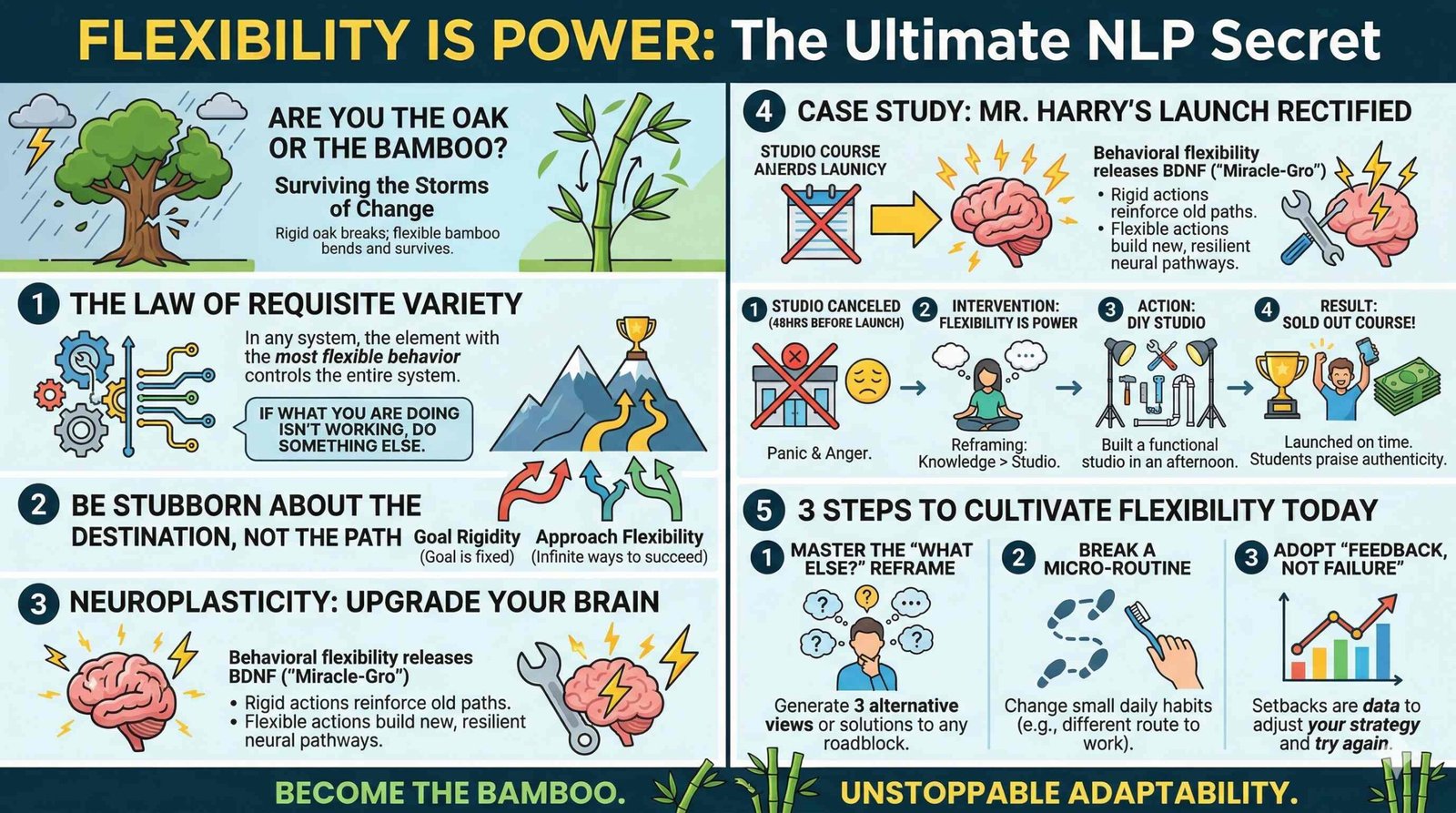
The roots of this NLP presupposition lie in the Law of Requisite Variety, coined by the pioneering psychiatrist and cyberneticist W. Ross Ashby. Ashby’s Law states: “In any given system, the element with the greatest flexibility of behavior will have the most influence.”
Think of a thermostat in a house. The thermostat controls the entire HVAC system because it has the flexibility to respond to changes in the environment. If the temperature drops, it turns on the heat; if it rises, it kicks on the AC. The thermostat rules the system because it can adapt its behavior to achieve its goal.
In human terms, if you only have one single way of dealing with a problem, you are entirely at the mercy of that problem. If your one strategy fails, you fail. However, if you have ten different ways to approach a challenge, you control the outcome.
Goal Rigidity vs. Approach Flexibility
A critical misconception about the phrase “Flexibility is Power” is that it means you should lack discipline, give up easily, or constantly change your goals. This is entirely false.
True power comes from being incredibly rigid about your destination but utterly flexible about the path you take to get there. NLP teaches us that if what you are doing isn’t working, doing it harder, louder, or longer won’t help. You must do something different.
The Neuroscience of Adaptability: Rewiring for Success
It is easy to dismiss NLP presuppositions as mere motivational slogans, but modern neuroscience proves that Flexibility is Power is a biological imperative.
Your brain is designed for adaptation, a concept known as neuroplasticity. For decades, scientists believed that the adult brain was fixed and unchangeable. We now know that the brain is highly malleable, constantly pruning old neural pathways and building new ones based on your thoughts and behaviors.
When you act with rigidity—doing the same things, thinking the same thoughts, and reacting the same way to stress—you reinforce a narrow set of neural pathways. Your brain goes on autopilot.
However, when you practice behavioral flexibility, something incredible happens. Stepping outside of your routine, trying a new learning modality, or forcing yourself to look at a problem from a completely different angle triggers the release of Brain-Derived Neurotrophic Factor (BDNF).
BDNF acts like Miracle-Gro for your brain. It encourages the growth of new synapses and strengthens cellular survival. By actively choosing to be flexible in your daily approach, you aren’t just solving the problem in front of you; you are literally upgrading your brain’s hardware, making you more cognitively resilient for the future.
The Prerequisite to Power: Sensory Acuity
Before we look at a real-world example, we must address the other half of the equation. You cannot be flexible if you don’t know that your current approach is failing.
In NLP, behavioral flexibility goes hand-in-hand with sensory acuity—the ability to notice the subtle, real-time feedback you are getting from your environment and the people around you. Are you noticing the slight shift in a client’s body language? Are you paying attention to the analytics on your website? Are you tuning into your own internal feelings of stress or burnout?
You must have the sensory acuity to recognize when you have hit a wall so that you can deploy your behavioral flexibility to climb over it.
The Case of Mr. Harry: A Real-Time Problem Solving Masterclass
To see how this works in practice, let’s look at a real-world case study of an entrepreneur who used the principle of “Flexibility is Power” to save his business launch.
The Problem
Meet Mr. Harry. Harry is an experienced coach who has spent months developing an online insights portal and a flagship digital course called the Study Smarter Blueprint. He has invested heavily in marketing, built an audience, and set a hard launch date.
To deliver the high-quality video content he promised his audience, Harry booked a premium, expensive professional recording studio downtown for a three-day weekend shoot.
Forty-eight hours before the shoot—and only a week before his portal’s launch—Harry receives a phone call. The studio’s pipes burst. The facility is flooded, his reservation is canceled, and there are no other studios available in the city within his budget.
The Rigid Reaction
Initially, Harry reacts the way most of us would. He becomes the rigid oak tree. He panics, gets angry at the studio manager, and considers canceling the entire launch. His internal monologue is stuck in a loop of failure: “I needed that studio. My competitors have professional videos. Without that specific studio, this course is ruined.”
Because he is attached to the how (the specific professional studio) rather than the what (delivering valuable insights to his students), his rigidity is rapidly leading to a total system failure.
The Intervention & Solution
Fortunately, Harry is a deeply spiritual person who understands the value of a centered mind. Instead of sending an email canceling the launch, he steps back. He takes a long walk, uses mindfulness to quiet his immediate emotional reaction, and remembers the ultimate NLP secret: Flexibility is Power.
He realizes he is getting feedback. The universe (or the plumbing) has closed one door, which means he needs to generate new behaviors to open another. Harry applies three specific NLP techniques to rectify his situation:
1. The “What Else?” Reframe: Harry stops asking, “Why did this happen to me?” and instead asks, “What else could this mean, and what is another way to achieve my goal?” He realizes his students are buying the Study Smarter Blueprint for his knowledge, not for a fancy studio background.
2. Breaking the Routine: Harry usually relies on external professionals for his tech needs. He decides to break that behavioral routine and take extreme ownership. If he can’t rent a studio, he will build one.
3. Treating the Setback as Feedback, Not Failure: Harry views the flooded studio as feedback that his business model was too dependent on fragile, external factors. He uses his behavioral flexibility to pivot entirely. He drives to the local hardware store. He buys PVC pipes to construct a custom frame, purchases a clean white backdrop, and sets up warm white lighting right in his own living room.
He builds a flawless, functional DIY studio in an afternoon.
The Result
Harry records his entire course over the weekend in his living room. The warm white lighting gives the videos an intimate, authentic feel that perfectly matches his coaching style. He launches the insights portal on time. Not only does the course sell out, but his audience praises the personal, down-to-earth aesthetic of the videos.
Because Harry demonstrated behavioral flexibility, he retained total control over his system. He stayed rigid on the goal (launching the course) but completely flexible on the approach (DIY studio vs. rented studio). That is the embodiment of power.
3 Ways to Cultivate Behavioral Flexibility Today
You don’t need to wait for a crisis like a flooded studio to practice adaptability. You can start rewiring your brain for neuroplasticity and NLP mastery right now. Here are three daily practices to cultivate your behavioral flexibility.
1. Master the “What Else?” Reframing Technique
When you encounter a roadblock, your brain will naturally want to narrow its focus and fixate on the negative. You have to consciously interrupt this pattern.
The next time someone cuts you off in traffic, a client rejects a proposal, or a piece of software crashes, do not react immediately. Pause, take a breath, and ask yourself aloud:
- “What else could this mean?”
- “What is the hidden opportunity in this situation?”
- “If I were forced to find three alternative ways to solve this right now, what would they be?”
By forcing your brain to generate alternatives, you shift from a state of emotional reaction into a state of creative problem-solving.
2. Break a Micro-Routine Intentionally
Flexibility is a muscle; if you don’t use it, it atrophies. If you live your life on strict autopilot, a sudden change will shatter your peace of mind. Train yourself to be comfortable with change by intentionally breaking your micro-routines.
- Sleep on the other side of the bed.
- Take a completely different, slightly longer route to work.
- If you always read non-fiction, force yourself to read a fiction book for a week.
- If you are right-handed, try brushing your teeth with your left hand.
These seem like trivial actions, but they require conscious thought. They force your brain out of its rut, stimulate BDNF production, and remind your nervous system that you are safe even when things are different.
3. Adopt the “Feedback, Not Failure” Mindset
In NLP, there is no such thing as failure; there is only feedback. When a strategy doesn’t yield the result you want, it is not a judgment of your worth or your capability. It is simply neutral data.
If you launch a marketing campaign and nobody clicks, you didn’t fail. The market just gave you incredibly valuable feedback that your headline or your offer needs to change. Take the data, adjust your approach, and try again. When you remove the emotional sting of “failure” from your vocabulary, you become utterly fearless in your flexibility.
Read “There is No Failure Only Feedback! Use 2nd NLP Presupposition to act smarter and transform setbacks.“
Image summary “Why Flexibility is power?”
Conclusion: Your Next Step Toward Unstoppable Adaptability
The world is changing faster than ever before. In an unpredictable landscape, the rigid oak trees are going to snap. The people who survive, thrive, and lead will be those who embrace the bamboo mindset.
Understanding W. Ross Ashby’s Law of Requisite Variety and the neuroscience of adaptability proves that the NLP presupposition Flexibility is Power is not just a catchy phrase—it is the foundational blueprint for a successful life.
By sharpening your sensory acuity, learning to reframe your challenges like Mr. Harry, breaking your daily routines, and treating every setback as valuable feedback, you take total control over your destiny. You cease to be a victim of circumstance and become the master of your outcomes.
Think about a major challenge you are currently facing in your life or business right now. Are you trying to force the same broken strategy because it’s what you’ve always done? Or are you ready to bend the rules, change your approach, and find a new way forward?
Read – The Ultimate Guide to 10 NLP Presuppositions: Rewiring Your Mind for Success
We’d love to hear from you! Leave a comment below sharing a time when you completely changed your approach to a problem and ended up winning. And if you found this breakdown valuable, be sure to share it with someone who might need a little help getting “unstuck” today.
The beauty of these principles is that you do not need to wait for permission to use them. You can start right now. Do you need NLP? Lets check here
Over to you: Which of these NLP Presuppositions will you consciously adopt today to shift your reality? Let us know your thoughts and experiences in the comments below!
Know about more about NLP Presuppositions out on YouTube.
