

Anchoring in NLP is a term used for the process by which you apply a gesture, touch or sound at the peak of a state, either in oneself or someone else. The said anchored state can then be recalled or re-activated by reapplying the gesture, touch or sound.
Have you ever smelled a certain perfume and instantly thought of a long-lost friend? Or heard a specific song and felt a sudden surge of nostalgia or joy? Perhaps you’ve felt your stomach drop at the sound of a specific notification tone on your phone.
These aren’t just random coincidences. They are anchors.
Most of us live our lives as victims of our “emotional weather.” We react to the world around us, unaware that we are being tossed about by a sea of unconscious triggers. But what if you could take the remote control of your own brain? What if you could consciously install a “button” that, when pressed, instantly flooded your system with confidence, calm, or unstoppable motivation?
In the world of Neuro-Linguistic Programming (NLP), this is called Anchoring. It is arguably the most famous and powerful state-management tool in the NLP toolkit. In this comprehensive guide, we will dive deep into the mechanics, the history, and the step-by-step execution of anchoring to help you master your destiny.
Table of Contents
What is Anchoring in NLP?
At its simplest, Anchoring in NLP is the process by which a specific stimulus (a gesture, a touch, a sound, or a visual) becomes neurologically linked to an internal emotional state. When the stimulus is triggered, the state is recalled.
As Tony Robbins, perhaps the most famous proponent of NLP, defines it:
“Anchoring is the process by which any representation (internal or external) gets connected to and triggers a subsequent string of representations and responses.”
While the concept might sound like modern “life hacking,” it is grounded in the rigid science of behavioral psychology.
The History: From Salivating Dogs to Peak Performance
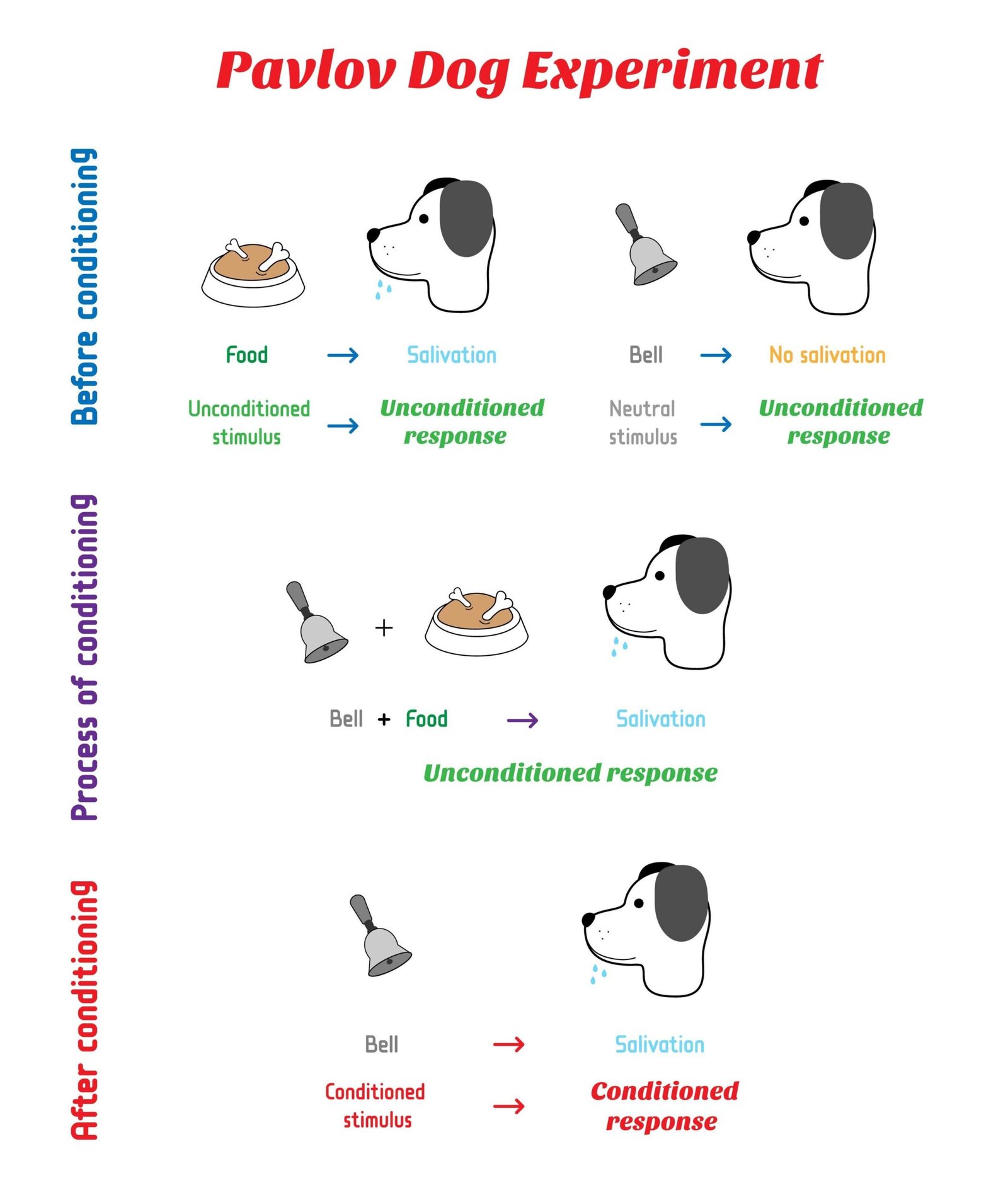
To understand anchoring, we must look back at Ivan Pavlov. Most people remember Pavlov’s dogs—the experiment where a bell was rung every time the dogs were fed. Eventually, the dogs would salivate at the sound of the bell alone, even if no food was present.
However, NLP expert Damon Cart notes that while we credit Pavlov, the first documented mention of this response actually came from Edwin Twitmyer, who studied the knee-jerk reflex. While Pavlov looked at biological “conditioning,” the founders of NLP—Richard Bandler and John Grinder—took it a step further.
Bandler and Grinder modeled the “magical” results of three legendary therapists: Virginia Satir (who used touch to shift family dynamics), Fritz Perls (who used spatial positions in Gestalt therapy), and Milton Erickson (who used vocal tonality). They realized these masters were “anchoring” their clients into resourceful states. NLP anchoring is essentially “conscious classical conditioning”—taking the mechanics of Pavlov and applying them to human excellence.
Expert Perspectives on Anchoring
To truly grasp the depth of this technique, let’s look at how the giants of the field define it:
- Robert Dilts: “Stimuli that will consistently produce the same internal data in an individual. Anchors occur naturally… you can deliberately set up a stimulus to hold a state stable.”
- Michael Brooks: “An anchor is a representation… that triggers another such representation. It’s a sensory stimulus paired with a response.”
- Leslie Cameron-Bandler: “In the same way that certain external stimuli become associated with past experiences, you can deliberately associate a stimulus to a specific experience… and trigger it at will.”
- Sid Jacobson: “An NLP way of talking about Pavlov’s conditioning, but it made a lot more sense.”
- Steve Andreas: “The way we naturally link things that happen at the same time. This gives us a way to take resources from one area of our lives and apply them in broader ways.”
- Terry Elston: “People represent their inner worlds to the outside via a series of built-in anchors… we code our meaning via the associations we have made.”
The “I TURN” Framework: How to Make an Anchor Stick
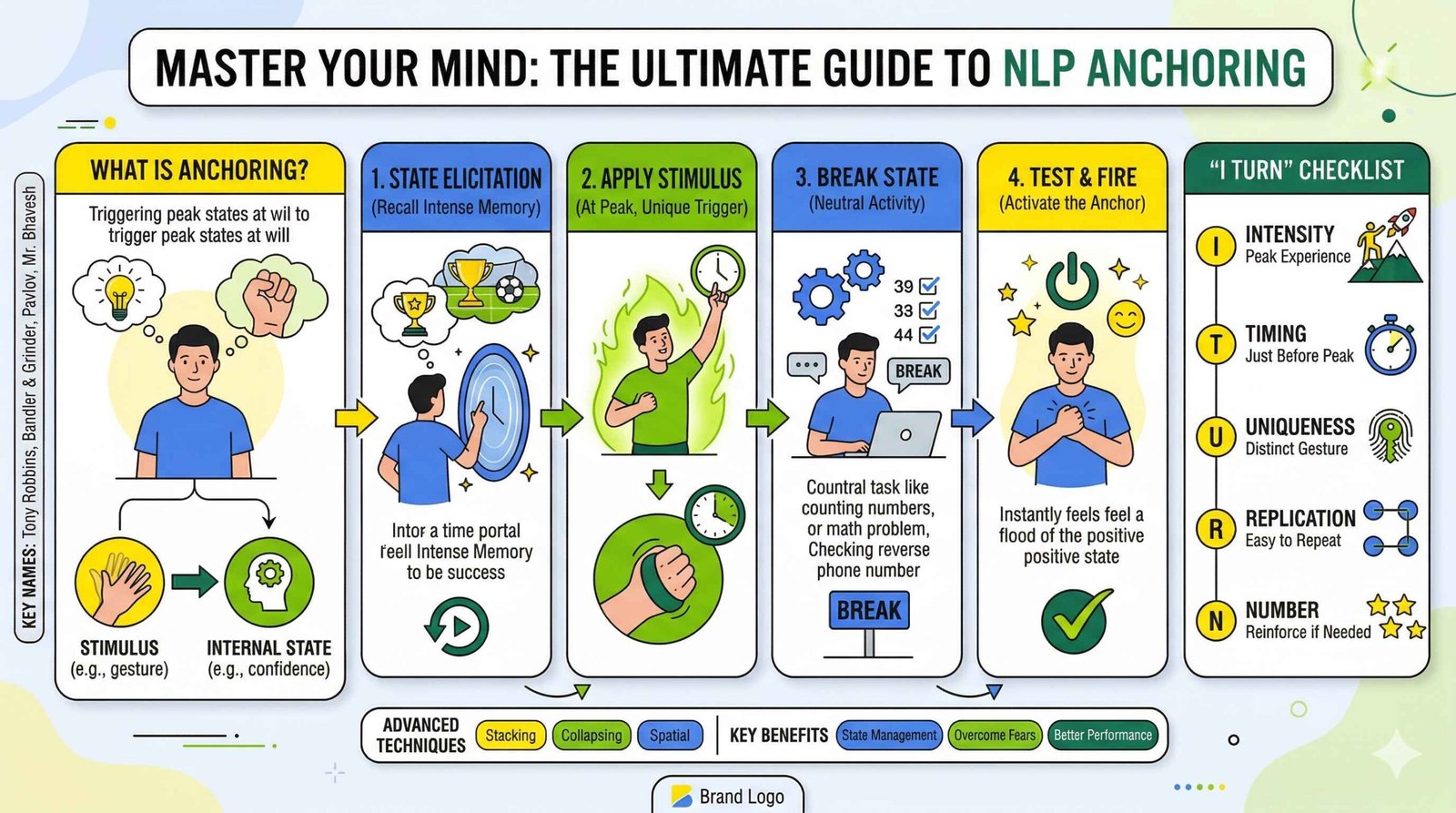
Setting an anchor is easy; setting an anchor that works every time requires precision. NLP experts use the mnemonic I TURN (coined by Tad James) to remember the five criteria for success:
1. Intensity of the State (I)
The person must be in a truly “peak” state. If you try to anchor “confidence” while you are only feeling “mildly okay,” the anchor will be weak. You need a 10-out-of-10 emotional experience.
2. Timing (T)
This is the most common mistake. You must apply the stimulus just before the state peaks. If you wait until the feeling is already fading, you are anchoring the “fading” feeling, not the peak.
3. Uniqueness (U)
The stimulus must be unique. If you anchor a state to a “handshake,” that anchor will be fired every time you meet someone, eventually “wearing out” or becoming contaminated. Choose a unique knuckle squeeze or a specific word said in a specific tone.
4. Replication (R)
You must be able to repeat the stimulus exactly. If you squeezed your left pinky finger to set the anchor, you can’t just touch your palm to fire it. It must be a precise match.
5. Number of Times (N)
While a “One-Trial Learning” anchor is possible if the intensity is high enough (like a phobia), usually, you need to repeat the process a few times to build a strong neurological “groove.”
Real-Time Problem Solving: The Case of Mr. Bhavesh
Let’s look at how this works in a real-world scenario.
Mr. Bhavesh is a high-level project manager who suffers from intense “Boardroom Anxiety.” Despite his expertise, every time he stands up to present to the directors, his palms sweat, his voice quivers, and his mind goes blank. He has a “negative anchor” associated with the boardroom.
Here is how an NLP practitioner would help Mr. Bhavesh using the Four Steps to Anchoring:
Step 1: State Elicitation
The practitioner asks Bhavesh: “Can you remember a time when you felt totally, 100% powerful and unstoppable? Perhaps it was during a sports match, a successful project, or even a personal hobby.” Bhavesh remembers a time he won a regional chess championship. As he describes it, his posture shifts, and his breathing deepens. He is “associating” into the memory.
Step 2: Apply the Stimulus
Just as Bhavesh reaches the peak of that winning feeling, the practitioner (or Bhavesh himself) applies a unique touch—squeezing the knuckle of his left thumb.
Step 3: Change State (Break State)
The practitioner suddenly asks: “Bhavesh, what was your phone number backward?” This forces the brain to move out of the “power” state and into a logical, neutral state.
Step 4: Test and Fire
After a minute, the practitioner says: “Now, just squeeze that thumb knuckle.” Bhavesh does it, and instantly, his shoulders back up, a smile crosses his face, and he feels that “winning” sensation again. He has successfully anchored a Resource State.
Now, when Bhavesh enters the boardroom, he fires his “Power Anchor” before he speaks. He has “collapsed” his anxiety by overriding it with a stronger, more resourceful state.
Advanced Anchoring Techniques
Once you master the basics, you can move into sophisticated applications:
1. Stacking Anchors
You don’t have to settle for just one feeling. You can anchor “Confidence,” then “Joy,” then “Determination” all onto the same physical spot. This creates a “Super-Anchor” or a “Resource State Stack.” As Damon Cart explains, this is exactly what Tony Robbins does when he hits his chest; he is firing a massive stack of peak-performance anchors.
2. Collapsing Anchors
If you have a powerful negative trigger (like Mr. Bhavesh’s boardroom anxiety), you can use a “Collapse” technique. You anchor the negative state in one place (e.g., right knuckle) and a much more powerful positive state in another (e.g., left knuckle). You fire both simultaneously. Because the brain cannot hold two diametrically opposed states at the same intensity, the stronger positive state “collapses” the neurological pathway of the negative one.
3. Spatial/Floor Anchors
Fritz Perls was famous for this. You can designate “spots” on the floor for different states.
- Spot A: Your “Stuck” state.
- Spot B: Your “Creative” state. By stepping into the creative spot, anchoring it, and then physically walking into the “stuck” spot while holding the creative anchor, you can literally “walk out” of your problems.
4. Sliding Anchors
Imagine your arm is a volume slider. You anchor a state on your wrist. As you slide your finger up toward your elbow, you imagine the intensity of that feeling increasing. This allows for granular control over your emotions—turning up the “calm” during a stressful flight or turning up the “focus” during a deadline.
Self-Anchoring: Damon Cart’s Expert Advice
Many people struggle to anchor themselves because, as Damon Cart mentions in his transcript, the moment you think “I need to anchor this,” you often “disassociate” (step out) of the feeling.
To solve this, Cart suggests the Wrist Squeeze Method:
- Gently hold your wrist as you begin to recall a positive memory.
- As the feeling intensifies, start to squeeze tighter.
- The squeeze becomes the “motorcycle throttle” for the emotion. The more you squeeze, the more the state rises.
This keeps you physically engaged with the anchor without having to “think” too much about the process.
Why Anchoring Matters for Your Life
We are all being “conditioned” by the world. Skillful filmmakers like the creators of Jaws use auditory anchors (the thumping heartbeat music) to trigger suspense. Trauma victims suffer because sudden noises act as “maladaptive anchors” to past pain.
NLP is about moving from unconscious reaction to conscious mastery. By learning to anchor yourself, you are:
- Managing your state: No longer waiting to “feel like” doing something.
- Breaking bad habits: Associating negative feelings with smoking or overeating.
- Improving performance: Like the 75-80 year old men in Ellen Langer’s Harvard study who were “anchored” back to 1959 and saw improvements in vision, grip strength, and IQ.
Image summary “Anchoring in NLP”
Conclusion: Take Charge of Your “Remote Control”
Anchoring isn’t just a technique; it’s a way of being. It is the realization that your internal world is your own. As Damon Cart says, “The more you learn NLP, the more you learn how to bring those unconscious processes into consciousness and then take charge of those programs so that you’re running the programs instead of the programs running you.”
Your Challenge: Today, identify one “Resource State” you need more of—be it Calm, Confidence, or Curiosity. Use the I TURN formula to set a simple knuckle anchor. Practice it for three days.
Are you ready to stop being a victim of your triggers and start being the architect of your emotions?
If you enjoyed this deep dive into NLP, share this post with someone who needs a “reset button” for their stress, and let us know in the comments: What state are you going to anchor today?
Read – The Ultimate Guide to 10 NLP Presuppositions: Rewiring Your Mind for Success
Know about more about NLP Presuppositions out on YouTube.
For more insights into personal transformation and coaching, visit KKnowlerience Path LLP, where we help you bridge the gap between knowledge and experience.
