

Rewrite your mental software! Discover how Neuro-Linguistic Programming (NLP) helps you decode your mind, break limiting habits, and transform your life. Have you ever wondered why some people effortlessly absorb complex information while others struggle to maintain focus for more than ten minutes? Or why a specific tone of voice from a colleague or family member instantly triggers a knot of anxiety in your stomach, even when you know you are safe?
We often view these reactions as fixed traits. We say things like, “I’m just a bad test-taker,” or “I just have a short temper.” But what if those traits aren’t who you are at all? What if they are simply outdated programs running in the background of your brain?
We are all operating on “legacy software”—invisible neurological programs installed during our childhood, shaped by our past experiences, and solidified by our daily habits. These programs dictate our fears, our learning limitations, and our social interactions.
The good news? You do not have to be a victim of your automatic reactions. By learning to decode your mind’s code with Neuro-Linguistic Programming (NLP), you gain the “admin password” to your own brain. You unlock the ability to systematically rewrite limiting beliefs, eliminate friction, and optimize your mental performance.
Table of Contents
What Exactly is Neuro-Linguistic Programming?
If psychology is the study of the mind, NLP is the user manual. Developed in the 1970s by Richard Bandler and John Grinder, NLP was born from studying top performers, brilliant therapists, and exceptional communicators to understand exactly how they produced their results.
To decode your mind’s code, we first need to break down the jargon into three accessible components:
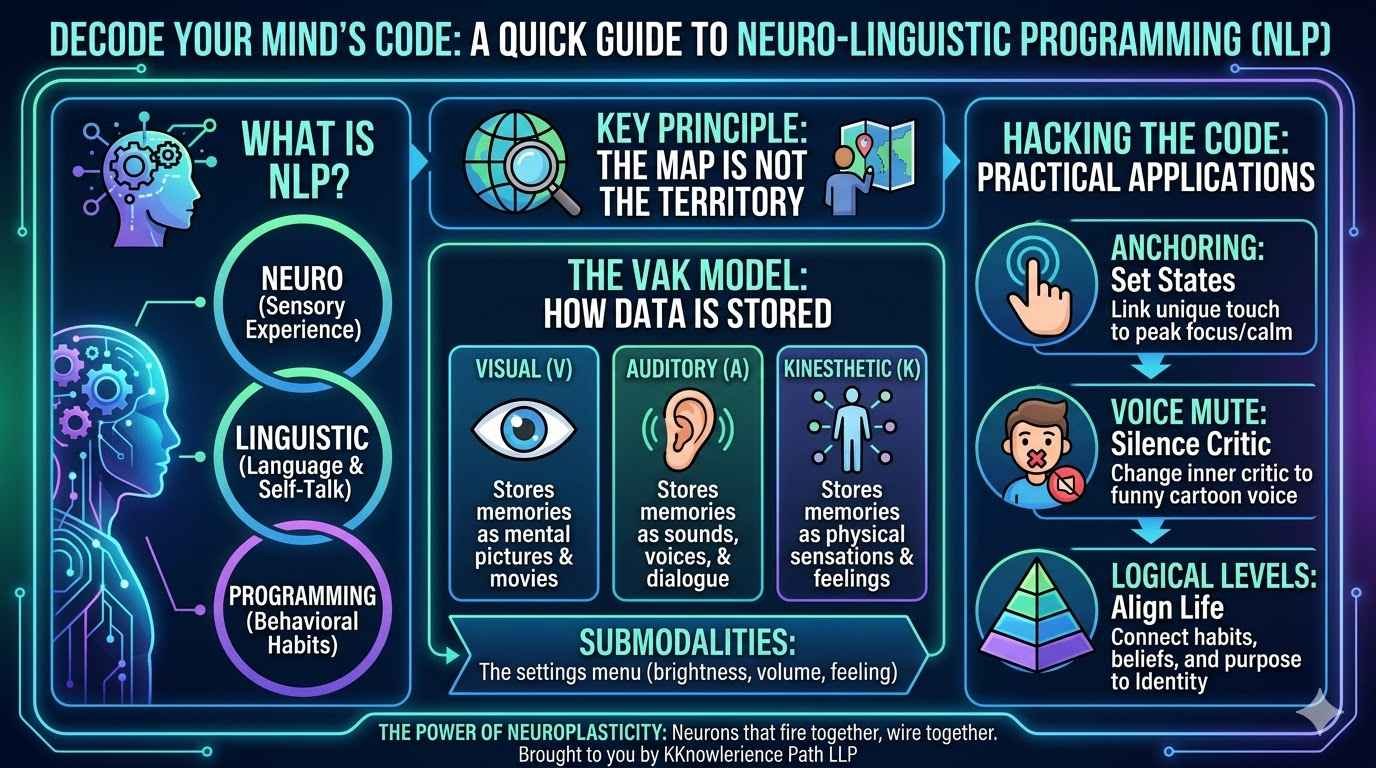
- Neuro (The Hardware): This refers to your nervous system. Every single experience you have—reading this sentence, tasting your morning coffee, feeling the texture of your chair—is gathered through your five senses. Your brain takes this raw sensory data and uses it to construct a mental map of reality.
- Linguistic (The Software): This represents the language you use. It is not just the words you speak out loud to others, but the silent, internal dialogue you maintain with yourself. The specific words you choose give meaning to the sensory data your neurology collects.
- Programming (The Execution): These are the automatic behavioral loops, emotional responses, and habits that result from how you combine your neurology and your language. If you consistently tell yourself “I am terrible at math” (Linguistic) every time you look at a spreadsheet (Neuro), your brain creates an anxiety response (Programming).
The Core Philosophy: The Map is Not the Territory
One of the most profound foundational principles of NLP is the phrase, “The map is not the territory.” Imagine looking at a menu in a restaurant. The menu (the map) is not the actual meal (the territory). It is just a representation. Similarly, your perception of reality is not actual reality. Two students can sit in the exact same classroom, listening to the exact same lecture. One experiences a thrilling intellectual awakening, while the other experiences soul-crushing boredom.
The event is identical. The internal representation of the event is entirely different. NLP teaches us that while we cannot always control the external territory of life, we have absolute control over how we draw our internal map. Read detailed post on NLP presuppositions
The VAK Framework: How Your Brain Stores Data
If you want to rewrite a piece of software, you must first understand the programming language it is written in. Your brain does not store memories and problems in generic data files; it stores them in sensory codes.
This is known as the VAK Framework. By identifying your primary processing style, you can pinpoint exactly where your mental code is breaking down.
1. Visual (V): The Mind’s Eye
Visual thinkers process the world in pictures, movies, and spatial relationships. When faced with a problem, they might say things like, “I can’t see a way out of this,” or “Things are looking dark.”
- The Coding Error: When experiencing anxiety, a visual processor will often generate massive, bright, overwhelming mental images of worst-case scenarios, playing out vividly like a movie on a theater screen inside their head.
2. Auditory (A): The Inner Dialogue
Auditory thinkers process the world through sound, rhythm, and dialogue. They learn best by listening and often talk through problems. They might say, “That sounds like a good idea,” or “That really resonated with me.”
- The Coding Error: When stressed, an auditory processor is usually tormented by an unrelenting inner critic. They hear a loud, harsh internal voice repeating past failures or echoing the negative words of a strict parent or teacher.
3. Kinesthetic (K): The Physical Sensation
Kinesthetic thinkers process the world through physical feelings, touch, and intuition. They need to physically “do” something to learn it. They use phrases like, “I have a bad feeling about this,” or “Let’s touch base later.”
- The Coding Error: For a kinesthetic processor, mental stress instantly converts into a physical burden. A tight chest, a knot in the stomach, or the feeling of carrying a heavy weight on their shoulders.
The Submodality Shift: The Secret to Changing the Code
Knowing whether you process visually, auditorily, or kinesthetically is only step one. Step two is manipulating the submodalities.
Submodalities are the fine-tuning dials of your senses. Think of them as the settings menu on your TV or smartphone.
- Visual submodalities: Brightness, color, size, distance, focus.
- Auditory submodalities: Volume, pitch, tempo, location of the sound.
- Kinesthetic submodalities: Temperature, pressure, location in the body, movement.
If you have a terrifying memory that causes you anxiety, NLP suggests that the anxiety isn’t caused by the memory itself, but by the sub modalities of that memory. The image is likely coded as very large, very bright, and very close to your face. If you deliberately take that mental image and shrink it down to the size of a postage stamp, drain it of color so it is black and white, and push it a mile away into the distance, the emotional weight of that memory vanishes. You have successfully hacked the code.
3 Practical Ways to Rewrite Your Mental Code Today
Let’s move from theory to execution. Here are three powerful, actionable NLP techniques you can use to debug your brain and optimize your daily life.
Let’s understand the applications of Neuro-Linguistic Programming
Application 1: Studying Smarter & Faster (Anchoring)
Have you ever heard an old song and been instantly transported back to your high school days, feeling the exact emotions you felt back then? That is a naturally occurring anchor.
In NLP, Anchoring is the process of intentionally linking a specific physical touch to a peak emotional state, so you can trigger that state on demand. This is the ultimate tool for accelerated learning and overcoming exam anxiety.
- Identify the State: Decide on the emotion you need (e.g., razor-sharp focus or deep calm).
- Recall a Memory: Close your eyes and vividly remember a time in your life when you felt that exact emotion with absolute certainty.
- Amplify the Submodalities: Step into that memory. See what you saw, hear what you heard, and feel what you felt. Make the colors brighter and the feeling stronger.
- Set the Anchor: Right as that positive feeling reaches its absolute peak, perform a unique physical action—like pressing your thumb and middle finger together firmly for five seconds.
- Test and Use: Release your fingers, open your eyes, and shake it off. A few minutes later, press those same two fingers together. You will feel a rush of that focused state return. Fire this anchor right before opening your textbook or walking into an exam hall.
Application 2: Silencing the Inner Critic (Auditory Submodalities)
If your progress is being blocked by a harsh inner voice telling you that you aren’t smart enough, capable enough, or ready enough, you do not need to argue with the voice. Arguing validates it. Instead, you just need to change its coding.
This technique is called the Voice Mute.
- Notice the critical voice in your head. Where is it coming from? The left side? The right?
- Pay attention to the tone and volume. It is usually authoritative and loud.
- Now, consciously change the sound of that voice. Pitch it up so it sounds exactly like a squeaky cartoon character, like Mickey Mouse or Donald Duck.
- Have the cartoon character repeat the negative thought.
Notice what happens to your anxiety. It is neurologically impossible to feel intimidated or depressed by a voice that sounds utterly ridiculous. You have broken the auditory code.
Application 3: Bridging the Spiritual and Practical (Logical Levels)
Sometimes, the bug in our mental software is a matter of misalignment. You might be taking the right actions but still feel empty or stuck. NLP uses Robert Dilts’ Neurological Levels of Change to diagnose this friction.
To achieve true alignment, these six levels must work in harmony:
- Environment: Where are you, and who are you with?
- Behavior: What are you specifically doing?
- Capabilities: What skills do you have?
- Beliefs and Values: Why do you do what you do? What matters to you?
- Identity: Who are you?
- Spirituality / Purpose: What is the larger system you are a part of?
If you want to become a top-tier student or a successful entrepreneur (Identity), but your environment (a messy, distracting room) and your behaviors (scrolling social media) do not match that identity, your brain will experience severe friction. To decode this, grab a journal and write down your ultimate Identity. Then, audit your environment and behaviors to ensure they are coded to support that Identity, rather than sabotage it.
The Science Behind the Software: Beyond “Positive Thinking”
It is crucial to understand that NLP is not just another flavor of “toxic positivity.” Standing in front of a mirror and chanting “I am happy” while feeling miserable does not rewrite your code; it just creates cognitive dissonance.
NLP is rooted in the very real, biological mechanics of the brain. The techniques we use are backed by the concept of Neuroplasticity—the scientifically proven ability of the brain to form new neural connections and reorganize itself throughout your entire life.
There is a principle in neuroscience known as Hebb’s Law: “Neurons that fire together, wire together.” Every time you use an NLP technique to interrupt a pattern of anxiety or trigger a state of focus, you are physically weakening the old neural pathways of failure and physically building new, robust neural pathways of success. You are quite literally re-wiring the physical structure of your brain.
Image summary of this article
Conclusion: You Are the Programmer
Your mind is the most sophisticated, powerful piece of technology in the known universe. Yet, most of us walk through life letting random events, past traumas, and societal conditioning write our code for us.
Whether the friction you are facing right now is mental, social, financial, or spiritual, it is not a permanent life sentence. It is simply a coding error waiting to be fixed. Once you understand the language of your mind—the visual images, the auditory sounds, and the kinesthetic feelings—you cease to be the program, and you become the programmer.
You have the tools. You understand the framework. The only question left is: What reality are you going to code for yourself next?
Ready to take control of your mental software? At Knowlerience, we believe that optimizing your mind is the first step to mastering your life. If you want to dive deeper into these NLP techniques and specifically apply them to accelerate your learning, build unshakable focus, and eliminate academic or professional friction, check out the Do you need NLP? – Web App. Start rewriting your code today.
Ready to take the next step?
Know about more about Neuroscience out on YouTube.

The event is identical. The internal representation of the event is entirely different. NLP teaches us that while we cannot always control the external territory of life, we have absolute control over how we draw our internal map. Read detailed post on NLP presuppositions