

Visual Learning is the high-bandwidth “firmware update” that replaces slow, linear transcribing with high-speed neural mapping. Your brain wasn’t evolved to parse abstract characters for eight hours a day; it was designed to recognize patterns, shapes, and spatial relationships. By using the Study Smarter Blueprint, we bypass the “Linear Drag” of traditional notes and tap into your brain’s native ability to process imagery instantly.
The Bottom Line: A picture isn’t just worth a thousand words; it’s worth a thousand hours of saved study time. Stop being a “Note-Taker” and become a “Mind Architect.” If you can’t see the system, you don’t own the knowledge.
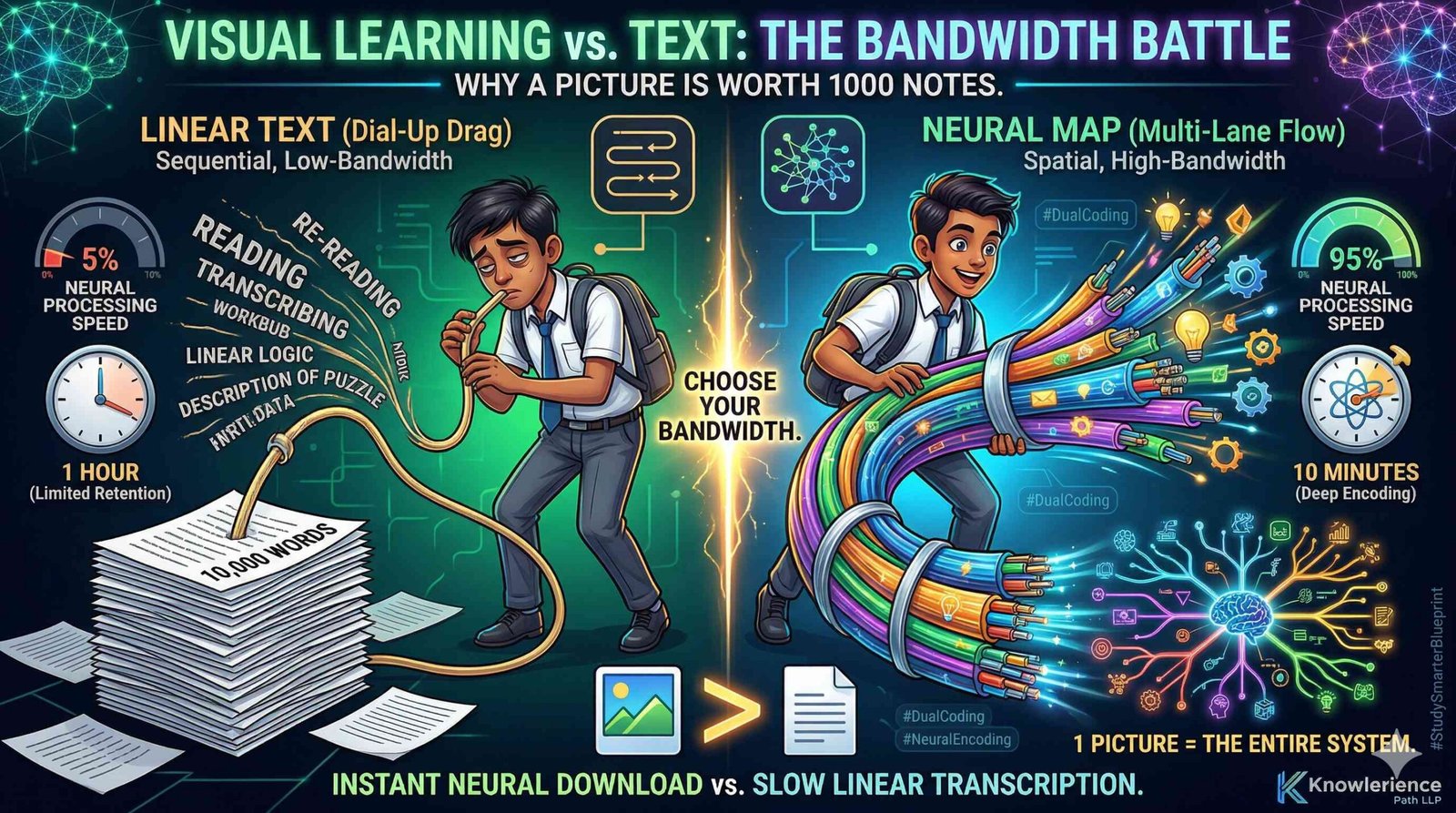
Let’s start with a biological reality that your current education system is choosing to ignore. The human brain processes visual information sixty thousand times faster than plain, boring text. Sit with that number for a second: 60,000x. If you are currently spending your nights transcribing textbooks into legal pads, you aren’t “studying.” You are participating in a 15th-century ritual that ignores the last fifty years of cognitive science. At KKnowlerience Path LLP, we call this “Linear Drag.” You are trying to download high-resolution data through a dial-up connection.
It’s time to stop the madness. It’s time to move from the “Page” to the “Pattern.”
Table of Contents
Section 1: The Evolutionary Architecture of Your Mind
To understand why visuals dominate, we have to look at our “factory settings.” Our ancestors survived by spotting predators, not by reading long-form, dry academic essays. Evolution didn’t design your brain to parse 12-point Times New Roman font for eight hours a day. It designed your brain to scan the horizon, recognize shapes, and understand spatial relationships instantly.
When you look at a wall of text, your brain has to perform a massive amount of “pre-processing” just to turn those abstract symbols (letters) into concepts. Reading text is like describing a puzzle. Seeing an image is the completed picture. One requires heavy cognitive labor; the other is an instant “Neural Download.”
Textbooks were designed for 15th-century printing presses, not the visual architecture of your brain. We are still using a medium optimized for Gutenberg, even though we live in a world optimized for the GPU. If you want to unlock elite-level retention, you have to stop fighting your DNA.
Section 2: The High-Bandwidth Fiber Optic Cable
Most students feel like they are “slow learners.” I’m here to tell you that you aren’t slow; your medium is just inefficient. Reading is a narrow straw. Visual learning is a high-speed, multi-lane fiber optic cable.
Think about the sheer bandwidth required to read a ten-page chapter on the circulatory system versus looking at a single, high-quality interactive diagram. The text requires linear time. You have to go from word A to word Z. The visual requires spatial time. You see the relationship between the heart, the lungs, and the arteries simultaneously.
Learn in ten minutes what takes others two hours by using visual anchoring techniques. By using the Study Smarter Blueprint, we bypass the “Linear Drag.” We teach you to encode information in a way that matches the high-speed processing power of your visual cortex.
Section 3: Exposing the “Note-Taking Theater”
We need to have an honest conversation about your “aesthetic” notes. Your hundred pages of handwritten notes are actually slowing down your neural processing speed. Many students fall into the trap of what I call “Note-taking Theater.” This is when you spend hours color-coding, underlining, and rewriting sentences in “pretty” cursive. It feels productive. It looks great on Instagram.
But POV: You finally stopped doing ‘Note-taking Theater’ and switched to high-speed visual encoding. The truth is, if you are just transcribing, you aren’t thinking. You are essentially a human photocopier. If you need ten pages to explain one concept, you don’t actually understand it. Complexity is often a mask for a lack of clarity. A master of a subject can reduce a hundred-page concept into a single, elegant diagram. That is the goal of the Study Smarter Blueprint.
Section 4: The Power of Dual Coding & Neural Mapping
How do we actually fix this? We use the “Science of Two.” Combine one simple image with three keywords to unlock the ‘Dual Coding’ memory superpower.
Dual Coding Theory suggests that when we encode information both verbally and visually, we create two distinct “memory traces” in the brain. It’s like saving a file on two different hard drives. If you forget the word, the image brings it back. If the image is fuzzy, the keyword triggers the recall.
One single mind map is more effective than ten thousand words of linear notes. The Visual Transformation:
- Paragraphs become Diagrams.
- Lists become Spatial Maps.
- Abstract Concepts become Visual Anchors.
I stopped writing paragraphs and started drawing systems. My memory retention exploded overnight. I stopped being a “Note Taker” and became a “Mind Architect.” When you see the world in systems and shapes, you don’t have to “memorize”—you just have to “see.”
Section 5: The Strategic Edge in 2026
Let’s look at the professional landscape. The world’s top strategic thinkers work in diagrams while you’re still stuck in paragraphs. Whether it’s a CEO mapping out a company’s future or a lead developer architecting a new AI model, they don’t use long-form essays. They use whiteboards. They use flowcharts. They use visual logic.
In 2026, if you can’t visualize complex data, you’re literally speaking a dead language. We are moving into an era of “Visual Intelligence.” With the rise of AI-generated content, the ability to synthesize and visualize information is the only way to stay ahead of the curve.
The Study Smarter Blueprint replaces ‘Note-taking Theater’ with high-impact, visual neural maps today. We aren’t just giving you a study tip; we are giving you a professional superpower that will serve you long after your final exam.
Conclusion: The Choice of Bandwidth
You are currently at a crossroads. You can choose the “Narrow Straw”—the slow, painful, linear path of text-heavy studying. You can continue to drown in your own notes and wonder why your retention is so low.
Or, you can choose the “Fiber Optic Cable.” You can embrace the Study Smarter Blueprint and start treating your brain like the high-speed visual processor it actually is.
A picture isn’t just worth a thousand words; it’s worth a thousand hours of saved time. At KKnowlerience Path LLP, we don’t want you to work harder. We want you to work at 60,000x speed.
Are you ready to stop reading and start seeing?
[Enroll in the Study Smarter Blueprint. Master Visual Learning and transform your cognitive bandwidth today.]
Want to see the mind maps that are disrupting the education industry? Join us: 👉 Subscribe to KKnowlerience on YouTube
