

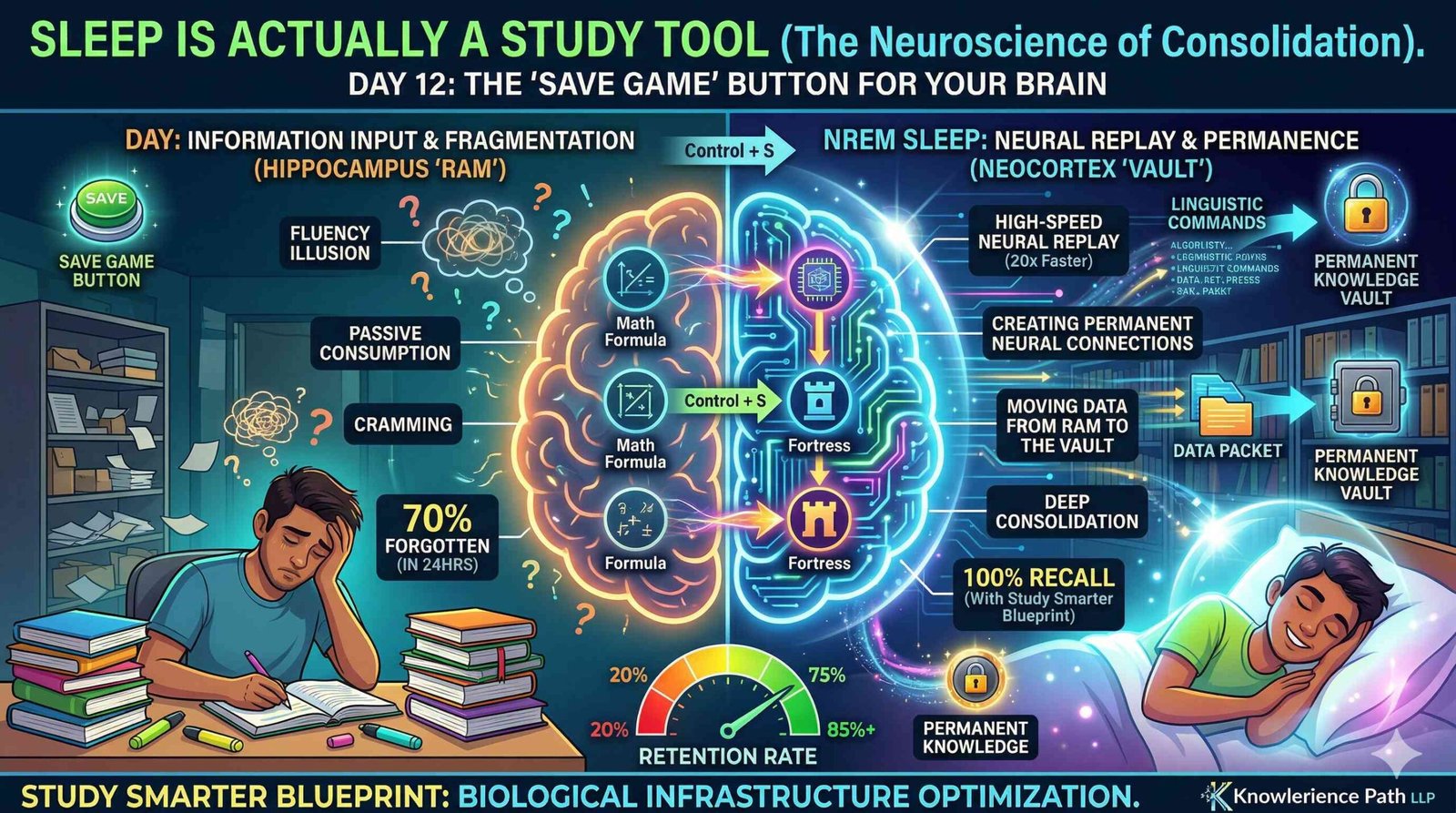
Most students view sleep as the “off” switch for productivity, but neuroscience proves it is actually the most active phase of learning. During NREM sleep, your brain replays your study notes at 20x speed, moving data from temporary storage to long-term memory. Within the Study Smarter Blueprint, we teach that Sleep is Actually a Study Tool—the biological “Save Button” that prevents your hard work from evaporating overnight.
The Bottom Line: Pulling an all-nighter isn’t “grinding”; it’s a systematic way to delete your progress. Stop the academic theater and let your neurons finish the job. If you haven’t slept, you haven’t hit “Save.”
The lights are dim, the coffee is cold, and the clock just struck 3:00 AM. You’ve got five chapters left, and you’ve decided that sleep is for the weak. You think you’re being a hero. You think you’re “grinding.” But as an NLP Coach who has watched thousands of students burn out over the last two decades at KKnowlerience Path LLP, I have a hard truth for you: Pulling an all-nighter is actually the most efficient way to fail your exam.
We’ve been conditioned to believe that the harder we push, the more we learn. We treat our brains like sponges that can just keep soaking up water indefinitely. But the biology of the human brain doesn’t care about your hustle. The ‘grind’ culture lied: sleep is actually the most productive part of your day. Without it, you aren’t building a future; you’re just performing an elaborate, exhausting ritual of self-sabotage.
Table of Contents
Section 1: The “Save” Button of the Human Brain
Imagine spending eight hours writing the most brilliant, life-changing essay of your career. You’ve poured every ounce of your intellect into the document. Then, right before you finish, you simply close the laptop without saving. That is exactly what you do to your education every time you skip a night of rest. Studying without sleep is like typing into a document but never hitting save.
In the tech world, we understand that a system needs time to process background data. Your brain is no different. Your brain literally ‘Control-S’ your study notes while you’re in dreamland. This process is scientifically known as Memory Consolidation.
When you are awake and “inputting” information, your brain stores that data in a temporary, fragile state in the hippocampus. Think of the hippocampus as the “RAM” of your computer—it’s fast, but it has limited space and is wiped easily. Pulling an all-nighter is like building a house but never putting the roof on. The moment a “storm” of stress hits, or even just a few hours of time pass, that unprotected structure collapses. You need sleep to move those memories from the fragile hippocampus to the permanent storage of the neocortex.
Section 2: The High-Speed Neural Replay
If you think your brain “shuts off” when you hit the pillow, prepare to be amazed. Sleep isn’t rest; it’s the high-speed download phase of your entire education. While your body is still, your neurons are working harder than they were during your actual study session.
Recent neuroimaging studies have shown something staggering: Your brain replays your study notes 20 times faster while you are sleeping. During NREM (Non-Rapid Eye Movement) sleep, your brain literally “re-runs” the neural firing patterns that occurred while you were learning. It’s like having a private tutor who reviews your entire day’s curriculum at 20x speed while you dream.
Sleep is the nightly firmware update that fixes your memory’s broken links. If you haven’t slept, those links remain frayed. You might “recognize” a concept when you see it on the page, but you won’t be able to “recall” it when the exam paper is staring back at you. I used to pull all-nighters until I realized I was just deleting my progress. I wasn’t getting ahead; I was just creating a “Fluency Illusion” that vanished the moment I felt the pressure of a timer.
Section 3: The Productivity Paradox
Let’s talk about the math of the “Grind.” Why study for ten hours if you are going to delete eight of them? When you are sleep-deprived, your prefrontal cortex—the part of your brain responsible for logic, focus, and decision-making—goes offline. You become reactive. You read the same paragraph six times and still don’t understand it. This is what we call “diminishing returns.”
If you don’t sleep, you’re not studying; you’re just performing academic theater. You’re sitting at a desk, looking at books, and feeling tired so that you can tell people you worked hard. But “Hard Work” that ignores biology is just “Busy Work.”
I’ve seen it happen time and again. A student stays up all night to “cram” 20% more material, but because they are exhausted, their retrieval speed for the other 80% drops by half. They end up performing worse than if they had studied less and slept more. I cut my study time in half by sleeping more. Here is the science. By ensuring my brain was in a “Consolidation State” every night, I made sure that every hour I spent at my desk actually stuck.
Section 4: The 10-Minute “Cheat Code”
Now, I’m not just telling you to sleep; I’m telling you how to sleep strategically. The best study tool in the world is free, and you’re currently ignoring it.
Inside the Study Smarter Blueprint, we teach a specific ritual to maximize the “Sleep-Learning” connection. Reviewing for ten minutes before bed is a cheat code for permanent memory. #TheBedtimePrimingRitual:
- Low-Intensity Review: Spend 10 minutes scanning your “Active Recall” questions or summary sheets right before you go to sleep.
- No Blue Light: Do this from physical paper or a dedicated e-ink device.
- Intentional Sleep: As you close your eyes, tell your brain: “This is the priority for tonight’s consolidation.”
By doing this, you are tagging specific neural pathways for the “20x Speed Replay.” You are telling your subconscious exactly which files to move to long-term storage first. It is the most low-effort, high-impact study habit in existence.
Section 5: Ending the Stigma of the “Lazy” Learner
We need to change the vocabulary of success. You’re not ‘lazy’ for sleeping; you’re just letting your neurons finish the job. In my 21 years of coaching, I’ve had to work hard to de-program the guilt students feel when they rest. We live in a world that rewards “the struggle.” But at KKnowlerience, we reward The System.
The Study Smarter Blueprint treats sleep as a non-negotiable part of the syllabus. We don’t see it as “time away from work.” We see it as the final, most crucial step of the work itself. You wouldn’t bake a cake for an hour and then throw it in the trash before it cools; why would you study for an hour and then skip the sleep that makes it permanent?
Conclusion: The Choice is Yours
You are standing at a crossroads. You can continue with the old way—the 2005 way. You can keep drinking the “hustle” Kool-Aid, pulling the all-nighters, and wondering why your grades don’t match your effort.
Or, you can embrace the 2026 way. You can start working with your brain chemistry instead of against it. You can realize that your pillow is just as important as your pen.
Sleep isn’t a luxury. It isn’t a reward for finishing your work. It is the tool that does the work.
Are you ready to stop the “Academic Theater” and start getting real results?
[Enroll in the Study Smarter Blueprint at KKnowlerience Path LLP. Let’s build a study schedule that actually respects your biology.]
Want to see the visuals of how your brain “saves” information while you sleep? Join the movement: 👉 Subscribe to KKnowlerience on YouTube
