

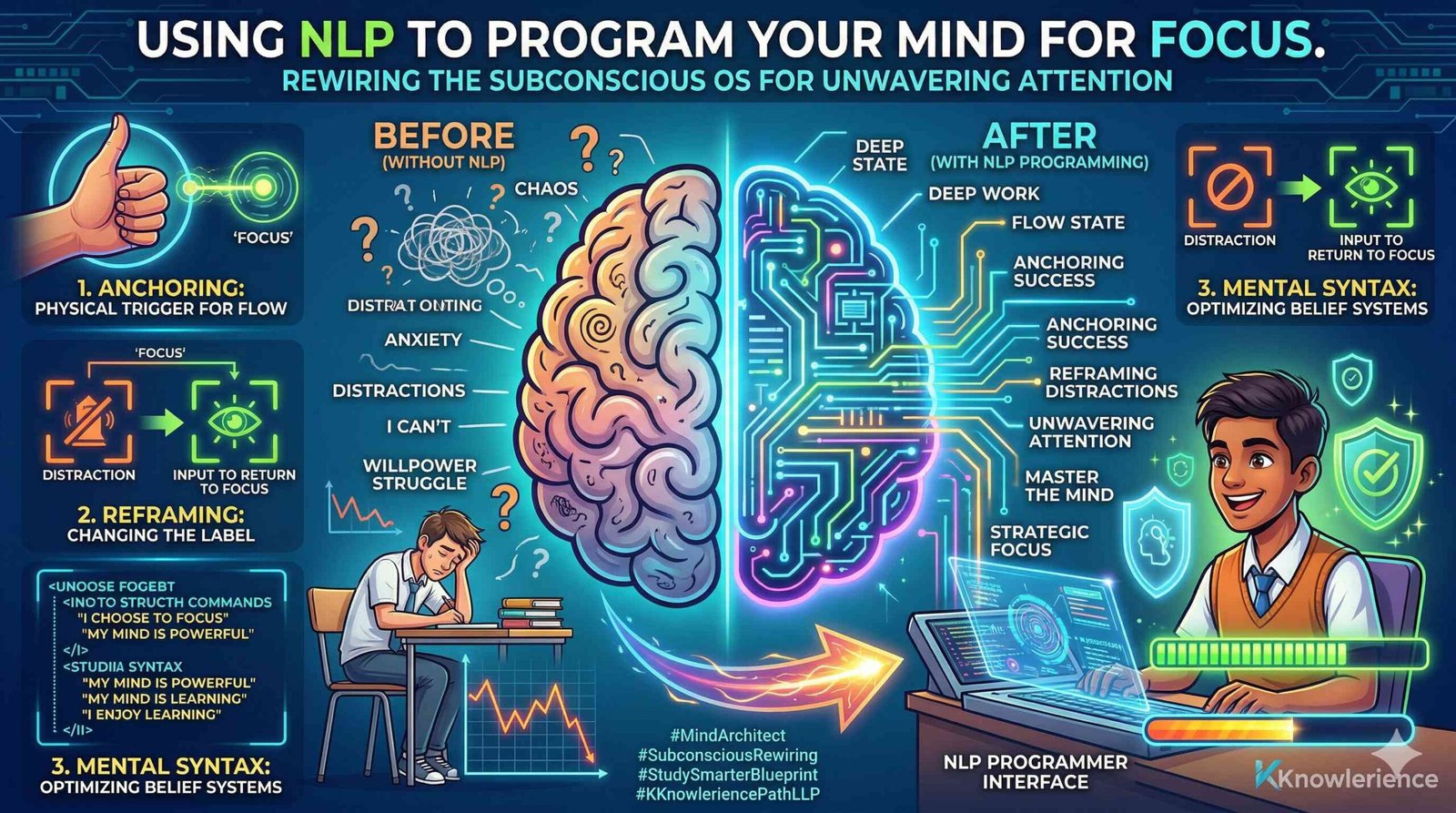
Willpower is a finite battery that eventually dies. NLP for Focus is the firmware update that fixes the “software” of your attention. By using Anchoring (linking a physical touch to a state of flow) and Reframing (changing the internal labels you give to distractions), you stop fighting your brain and start directing it. Inside the Study Smarter Blueprint, we treat focus as a programmable skill, not a personality trait.
The Bottom Line: You aren’t lazy; your mental code is just fragmented. Stop trying to “discipline” your way out of a software issue. Use NLP for Focus to patch the “Brain Rot” and lock your attention with the precision of a master architect.
I coached and learned, students for 20 years and found willpower is the worst way to focus. If you are currently sitting at your desk, forcing your eyes to stay on a page while your mind screams to check your phone, you are fighting a losing battle. You’ve been told that focus is a matter of “discipline,” a test of character, or a muscle you just need to squeeze harder. But after two decades at the helm of KKnowlerience Path LLP, I’m here to tell you the truth: willpower is a finite resource. It’s like trying to run a marathon by holding your breath. Eventually, you have to let go.
Stop trying to ‘discipline’ your way out of brain rot. Use NLP to patch it. In the year 2026, we don’t have a “laziness” problem; we have a “programming” problem. Your brain is a supercomputer, but most of you are still trying to navigate the complex demands of the modern world using an outdated interface. Your mind is running 2005 software in a 2026 world. You need an NLP update.
Table of Contents
Section 1: The Language of the Subconscious
Focus isn’t a gift; it’s a language your brain speaks. Most of you are illiterate.
Neuro-Linguistic Programming (NLP) is essentially the user manual for your brain. The “Neuro” refers to your neurology; the “Linguistic” refers to the language you use (both with others and yourself); and the “Programming” refers to the habits and patterns you’ve installed over time.
If you can’t focus, it’s not because you aren’t “smart enough.” If you can’t focus for 10 minutes, you’re not lazy. Your mental syntax is broken. Your brain follows the instructions you give it. If your internal “code” is a mess of anxiety, distraction, and “what-ifs,” your hardware will crash every time you try to open a “Deep Work” application.
The Virus in the System
Your internal dialogue is a virus slowing down your mental processor. Use NLP to delete. Most people don’t realize that your brain hears 50,000 words a day. If they’re the wrong ones, you’ll never focus. When you tell yourself, “I’m so distracted,” or “This is too hard,” you aren’t just making a comment; you are issuing a command. You are literally programming your brain to fail.
Section 2: Anchoring—The “God Mode” of Attention
What if I told you that you could “save” a state of mind just like you save a file on your computer? The top 1% use mental ‘anchors’ to enter flow state in under 60 seconds.
In NLP, we use a technique called “Anchoring.” It is based on the principle of stimulus-response. Just as a certain song can instantly take you back to a specific memory, a physical anchor can take you back to a state of peak focus.
Touching your thumb and finger can instantly trigger deep focus. It’s called NLP anchoring. #How to Build Your Focus Button:
- Recall: Remember a time you were completely “in the zone”—perhaps playing a sport, a video game, or a hobby you love.
- Amplify: Close your eyes and make that memory vivid. Make the colors brighter, the sounds louder, and the feeling of competence stronger.
- Set the Anchor: At the peak of that feeling, press your thumb and forefinger together firmly for 5 seconds.
- Repeat: Do this multiple times until the physical touch is “linked” to the emotional state.
Now, when you sit down to study, you don’t need a miracle. You just need to press your “Focus Button.” This 60-second NLP visualization works better than three cups of coffee for morning focus.
Section 3: Reframing the Distraction
Focus isn’t about removing distractions. It’s about how you label them in your subconscious.
We spend so much time trying to create the “perfect” environment. We buy noise-canceling headphones, we hide our phones, and we lock our doors. But the real distraction is internal. NLP teaches us “Reframing.”
Instead of seeing a distraction as an enemy that “breaks” your focus, you can reframe your internal “Syntax” to see it as a signal to return to center. NLP is the ‘Ctrl+F’ for your brain, helping you find focus in the chaos. By changing the labels you use for your experiences, you change the physiological response your body has to them.
Section 4: The Validation You’ve Been Waiting For
For years, students have come to me feeling broken. They say, “Kamlesh, I think I have a shorter attention span than a goldfish.” You aren’t ADHD; you just haven’t been taught the code to lock your attention. (Disclaimer: While clinical ADHD is real, a vast majority of “focus issues” are simply the result of poor mental hygiene and a lack of strategy.)
You’ve been shamed for your inability to sit still in a system that wasn’t designed for the 2026 brain. At KKnowlerience Path LLP, our Study Smarter Blueprint starts with validation. You aren’t the problem. Your outdated “Operating System” is. Once we patch the software, the hardware performs exactly as it should.
Section 5: Focus as Survival in the AI Era
We have to look at the landscape of the future. In an AI world, deep focus is the only skill that keeps humans relevant. AI can generate text, code, and images in seconds. It can process data faster than we ever could. But AI cannot intend. It cannot hold a deep, sustained vision for a complex project without human direction.
If you cannot focus, you cannot direct the tools of the future. You become a passenger in a world driven by those who can master their own minds.
Conclusion: From Struggle to Decision
21 years of learning taught me that focus is a decision, not a struggle.
When you learn to program your mind using NLP, the “grind” disappears. You stop fighting yourself. You start navigating your own neural pathways with the precision of a master architect. You realize that you have always had the power to be the most focused person in the room—you just didn’t have the “syntax” to unlock it.
The Study Smarter Blueprint isn’t just about passing an exam; it’s about a total firmware upgrade for your life.
Are you ready to stop fighting your brain and start programming it?
[Enroll in the Study Smarter Blueprint. Master the NLP techniques of the 1% and unlock your focus today.]
Unlock the code to your subconscious and join our growing community of Mind Architects: 👉 Subscribe to KKnowlerience on YouTube
