

Real academic “main character energy” comes from neuro-efficiency, not exhaustion. By ditching the brute-force method for the Study Smarter Blueprint, you’re swapping mindless rote learning for high-octane neuroplasticity and NLP hacks.
Stop treating your brain like a 2005 flip phone. The 10-hour study grind is just “productivity theater” that leads to massive burnout and a 70% memory wipe by morning. It’s time to work with your biology, not against it. Use the system to lock in focus, crush your exams, and finally get your life back.
The Bottom Line: Your brain isn’t broken—your system is. It’s time for an upgrade.
Studying for 10 hours straight isn’t a flex—it’s a symptom of a broken brain.
There, I said it. In a world obsessed with “hustle culture” and aesthetic “study with me” videos that last longer than a flight from Mumbai to London, we’ve started valuing exhaustion over execution. If you’re currently camping out in a library, surrounded by empty coffee cups and textbooks highlighted so much they look like neon street signs, this is your wake-up call.
You aren’t a martyr for your education; you’re a victim of the Hard Work Trap.
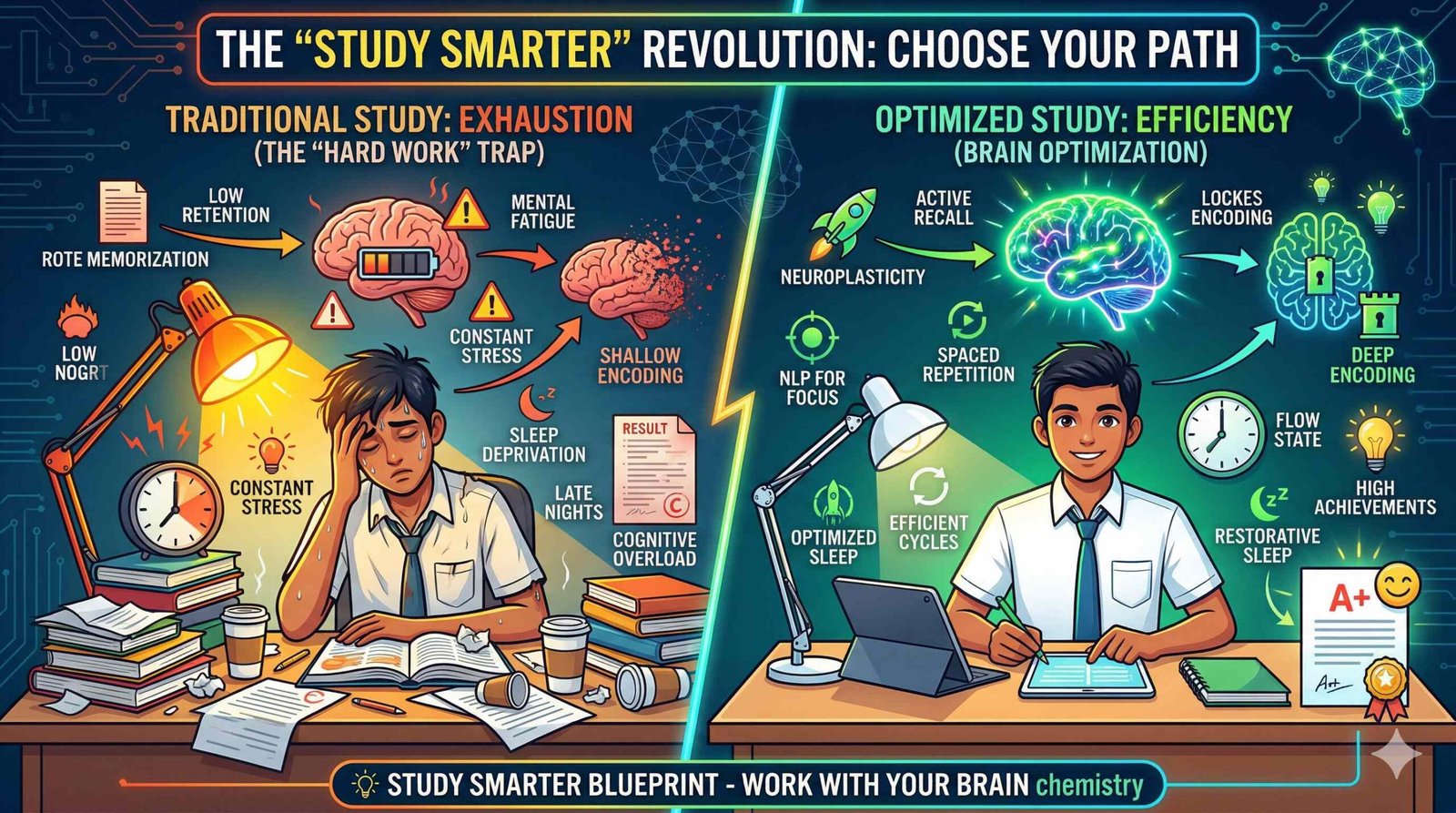
The 3 AM Hallucination: My Journey from Grind to Growth
Back in 2005, when I started my journey into coaching and personal development, I was just like you. I thought the only way to “earn” success was through suffering. I remember staring at a page of notes at 3 AM, the words blurring into a grey soup. I was “working hard,” yet the next morning, I couldn’t remember a single concept.
The reality? I was participating in Productivity Theater. I was performing the act of studying without actually doing the work of learning.
Since then, through KKnowlerience Path LLP, I’ve spent two decades dissecting the neuroscience of how we actually encode information. The truth is much sexier than a 10-hour grind: Your brain is a high-performance machine, and you’ve been treating it like a Windows 95 desktop.
Table of Contents
You tube Story: How Shravan saved from Hard-Work Trap?
Section 1: The Neuroscience of Why You’re Failing
Your brain doesn’t care about your “to-do” list. It cares about survival and energy efficiency. When you force a 10-hour study session, you are fighting against millions of years of evolution.
1. The Prefrontal Cortex Meltdown
Your Prefrontal Cortex (PFC) is the “Main Character” of your brain. It handles complex planning, focus, and decision-making. But here’s the catch: the PFC is an energy vampire. After about 90 minutes of intense focus, your glucose levels dip and your neural firing slows down.
When you push into hour six, seven, or ten, you aren’t “learning”—you’re just sitting in a chair. This is what we call Cognitive Overload. Your brain literally stops recording data to protect itself from burning out.
2. The Forgetting Curve is Real
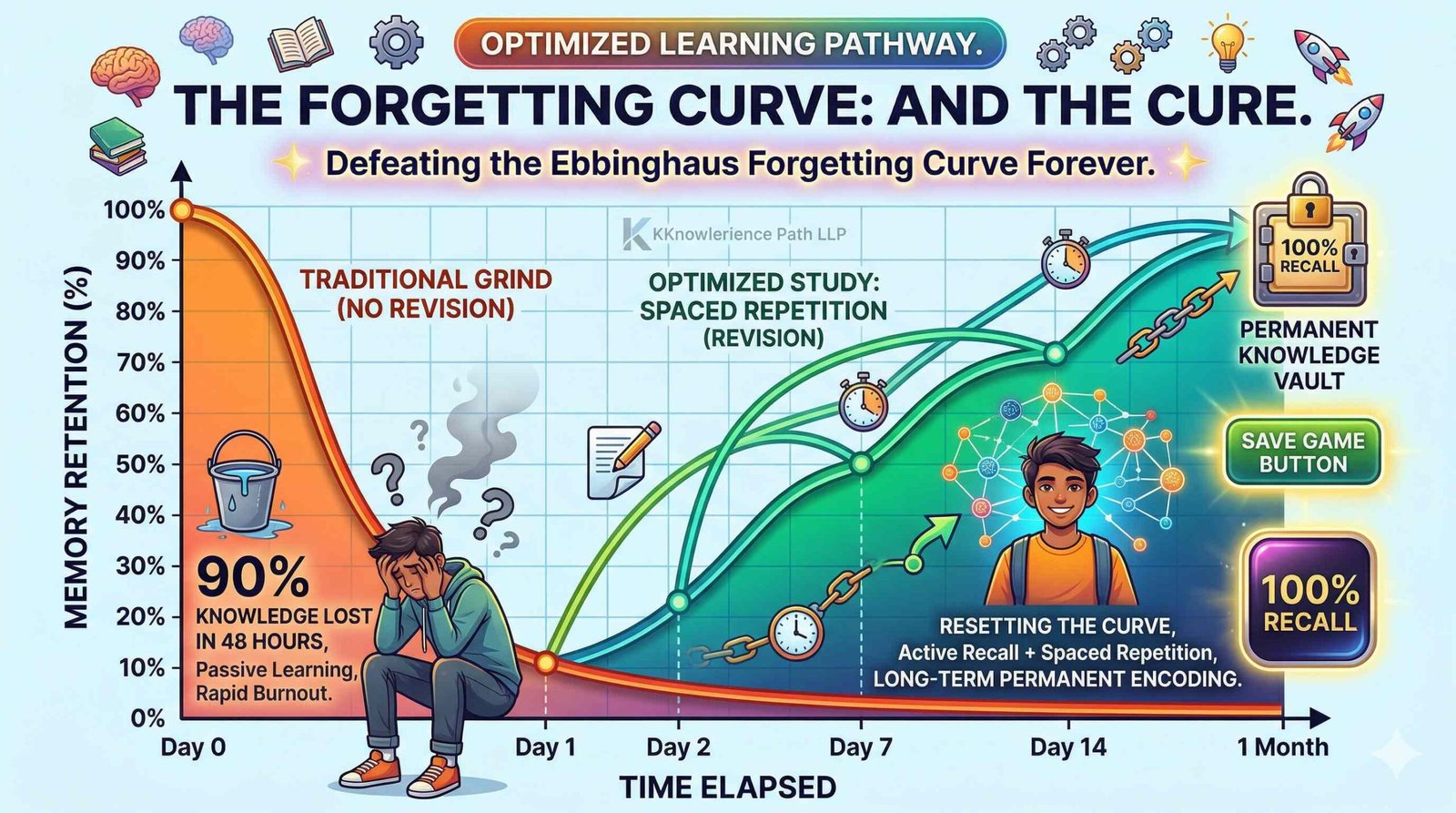
Ever heard of Hermann Ebbinghaus? He discovered the Forgetting Curve. Without a specific system, you will forget 70% of what you learned today within 24 hours. 10 hours of study becomes 3 hours of actual retention by tomorrow morning. Does that sound like a good ROI (Return on Investment) for your time?
3. Rote Memorization is “Slow-Motion Failure”
In the old school, we were taught to repeat things until they stuck. In the Study Smarter Blueprint, we call this “Brute-Forcing.” Rote learning creates weak neural pathways that collapse under the pressure of an exam. If you want “A-list” results, you need deep-coded memories, not shallow echoes.
Section 2: The “Hustle Culture” Lie
Gen Z is the most “plugged-in” generation in history, yet the academic pressure has never been higher. You’re being told to “grind while they sleep.”
Stop. Sleep is not a luxury; it is a performance-enhancing drug. During REM sleep, your brain performs a process called Consolidation. This is where the short-term notes you took today get moved into long-term storage. If you study for 10 hours and only sleep for 4, you are essentially deleting your own hard drive before you hit “save.”
| Old Way (The Trap) | New Way (The Blueprint) |
| 10 Hours of Passive Reading | 3 Hours of Deep Focus |
| Highlighting Everything | Active Recall (Testing Yourself) |
| Sleep Deprivation | 8 Hours of “Neural Consolidation” |
| Stress & Anxiety | NLP-Based State Management |
Section 3: Enter the “Study Smarter Blueprint”
So, how do we break the trap? We move from “Hard Work” to Brain Optimization. At KKnowlerience Path LLP, we don’t just teach you what to learn; we teach you how your brain is wired to receive it.
1. Active Recall: The #1 Focus Hack
Stop reading. Start asking. Research shows that the act of retrieving information from your brain strengthens the neural pathway far more than putting it in. If you read a chapter, close the book, and try to explain it to an imaginary audience, you’ve done more work in 10 minutes than a “passive reader” does in two hours.
2. Neuroplasticity: Rewiring for Genius
Your brain is plastic. It’s constantly changing. By using specific NLP (Neuro-Linguistic Programming) triggers, you can actually “prime” your brain to enter a Flow State. This isn’t magic; it’s biology. When you anchor a specific “learning state” to your environment, you stop fighting procrastination and start leaning into focus.
3. Spaced Repetition: Hacking the Clock
Instead of 10 hours in one day, imagine doing 1 hour, five times a week, at specific intervals. This triggers the Spacing Effect, which signals to your brain that this information is critically important. The Study Smarter Blueprint uses this to ensure you remember your syllabus months after the exam is over.
Section 4: The Emotional Toll of the Trap
Let’s get real for a second. The “Hard Work” trap isn’t just inefficient; it’s dangerous. It leads to:
- Burnout: That feeling where you just want to throw your laptop out the window.
- Imposter Syndrome: Thinking you aren’t “smart enough” because the 10 hours didn’t work.
- Exam Anxiety: The “blank out” that happens when your brain is too fried to retrieve data.
You are not “dumb.” You just have a bad operating system. You’re trying to run 2026 software on 1995 hardware.
Section 5: 3 Immediate Shifts to Make Today
If you want to escape the 10-hour grind and start living your life while still topping your class, do these three things immediately:
- The 90/20 Rule: Study for 90 minutes of high-intensity focus (no phone, no music with lyrics), then take a 20-minute total brain break. Go outside. Look at a tree. Do not scroll TikTok.
- The “Feynman” Check: After every study session, try to explain the core concept in simple terms to a 10-year-old. If you can’t, you don’t understand it yet.
- Audit Your “State”: Before you open your book, use a 2-minute NLP breathing exercise to shift your physiology from “Stressed” to “Curious.”
Conclusion: Choose the Blueprint, Not the Burnout
The world doesn’t reward you for the number of hours you sit at a desk. It rewards you for the value you can produce and the knowledge you can apply.
The Study Smarter Blueprint is more than a course—it’s a declaration of independence from the “Grind.” It’s about using Neuroscience and NLP to become the “Main Character” of your academic journey.
Are you ready to stop being a “Hustle Culture” statistic and start being a high-performance learner?
Your brain is capable of incredible things. Stop standing in its way.
Ready to hack your habits?
[Click here to explore the Study Smarter Blueprint and join the Knowlerience movement.]
Follow us for more daily brain-hacks on how to work less and achieve more.
Know about more about Study Smarter Techniques out on YouTube.
