

The NLP principle “Every Behavior Has a Positive Intention” asserts that all actions, including negative habits, are the mind’s misguided attempts to fulfill a fundamental need for safety or comfort.
Have you ever found yourself doing something that felt completely self-sabotaging? Perhaps you’ve snapped at a loved one for no reason, procrastinated on a career-defining project until the final hour, or reached for a sugary snack despite your commitment to health. In those moments, it’s easy to label yourself as “lazy,” “undisciplined,” or “toxic.”
But what if I told you that beneath every single one of those “bad” behaviors lies a loyal, protective, and deeply positive motive?
In the world of Neuro-Linguistic Programming (NLP), one of the most transformative presuppositions is this: Every Behavior Has a Positive Intention. While it sounds radical—and perhaps even counterintuitive—mastering this principle is the key to ending the war within yourself and others.
By the end of this guide, you will understand how to stop judging the what of your behavior and start understanding the why, allowing you to reframe your habits and unlock a level of personal growth you previously thought impossible.
Table of Contents
1. Decoding the Concept: Intention vs. Behavior
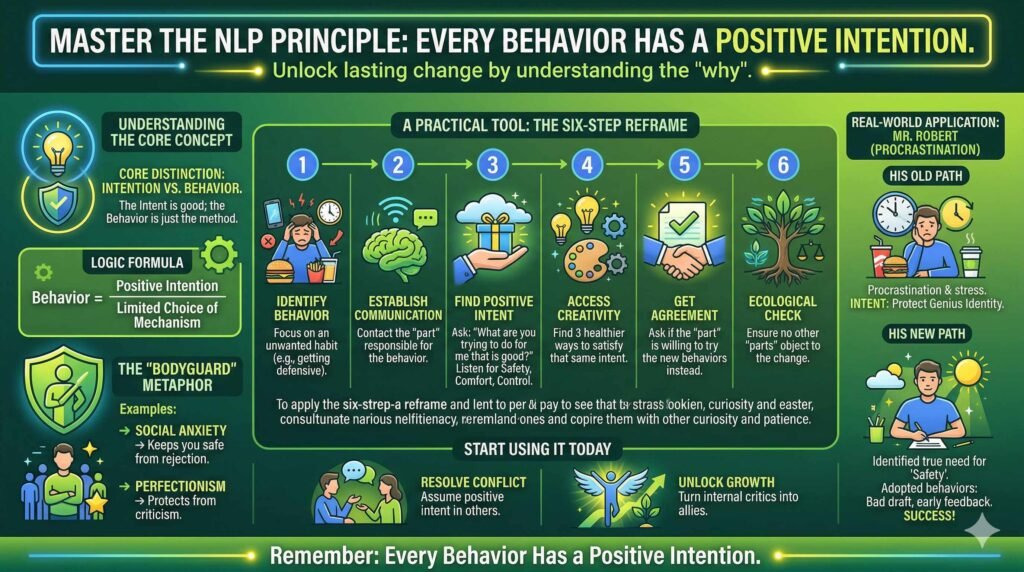
To master this NLP principle, we must first make a critical distinction that most people miss: The Intention is not the Behavior.
Imagine a person who smokes. The behavior is lighting a cigarette, which is objectively harmful to their physical health. However, the positive intention of that behavior might be to find a moment of peace, to breathe deeply for five minutes, or to bond with colleagues during a break. The intention (relaxation and social connection) is “good,” even if the mechanism (smoking) is “bad.”
The “Bodyguard” Metaphor
Think of your unconscious mind as a highly sophisticated, albeit sometimes clumsy, bodyguard. This bodyguard’s sole job is to keep you safe, happy, and functional. However, if this bodyguard was “trained” twenty years ago, it might still be using outdated tools to solve modern problems.
- Social Anxiety is the bodyguard’s way of keeping you safe from the perceived “threat” of social rejection.
- Perfectionism is the bodyguard’s way of ensuring you are never criticized or judged.
- Procrastination is the bodyguard’s way of protecting you from the pain of a potential failure.
When we realize that our behaviors—no matter how messy—are just misguided attempts to help us, our internal dialogue shifts from “What is wrong with me?” to “What is this behavior trying to achieve for me?”
2. The Psychology of “Secondary Gain”
In clinical psychology, the concept of Every Behavior Has a Positive Intention is often referred to as Secondary Gain. This is the “hidden benefit” that maintains a problematic behavior even when the individual consciously wants to change it.
Why We Get Stuck
If a behavior persists despite your best efforts to stop it, it’s because that behavior is satisfying a need that isn’t being met elsewhere. This is why “willpower” so often fails. Willpower tries to kill the behavior without addressing the intention.

If you remove the behavior (the denominator) without providing a new, healthier mechanism to satisfy the intention (the numerator), your unconscious mind will eventually rebel. This is the root of the “yo-yo” effect in dieting and habit change.
3. Addressing the Skeptics: What About “Evil” or Malice?
Whenever this NLP principle is discussed, a valid question arises: “What is the positive intention of a criminal, a bully, or someone who causes harm to others?”
It is vital to understand that “Positive Intention” is subjective to the individual performing the action. It is not a moral judgment by society; it is a functional goal within that person’s “Map of the World.”
- A bully might have the positive intention of feeling powerful or significant because they feel powerless at home.
- An aggressive negotiator might have the positive intention of providing for their family by winning at all costs.
Identifying the positive intention does not mean condoning the behavior. Understanding that a thief is motivated by “survival” or “providing” doesn’t make the theft legal or moral—but it does provide a psychological roadmap for rehabilitation. If you can show that person how to provide for their family through legitimate means, the “need” for the criminal behavior evaporates.
4. The Toolkit: The Six-Step Reframe
Now that we understand the theory, how do we apply it? The gold standard in NLP for this is the Six-Step Reframe. This process allows you to communicate directly with the “part” of your mind responsible for an unwanted behavior.
- Identify the Behavior: Focus on a specific habit or emotional response you want to change (e.g., “I get defensive during feedback sessions”).
- Establish Communication: Close your eyes and address the “part” of you that handles this behavior. Ask, “Will the part of me responsible for this behavior communicate with me in consciousness?” Wait for a feeling, a word, or a signal.
- Find the Positive Intent: Ask that part, “What are you trying to do for me that is good?” Listen without judgment. You might hear: “I’m trying to protect your self-esteem” or “I’m trying to keep you from being controlled.”
- Access Creativity: Ask your “Creative Part” to come up with three new, healthier ways to satisfy that exact same intent.
- Example: If the intent is “Safety,” new behaviors might be “Asking clarifying questions,” “Taking a deep breath before responding,” or “Writing down the feedback to review later.”
- Agreement: Ask the original “part” if it is willing to try these new behaviors for a limited time (like one week) instead of the old one.
- Ecological Check: Ask if any other part of you objects to these new behaviors. If you feel a “tug” of doubt, go back to step 4 and refine the alternatives.
5. Case Study: How Mr. Robert Reclaimed His Career
To see this principle in action, let’s look at the real-world example of Mr. Robert, a high-level marketing executive who came to me with a debilitating problem: Chronic Procrastination.
The Problem
Robert was brilliant, but he had developed a habit of waiting until the night before a major presentation to start his work. He would spend weeks “researching” (scrolling through industry news) but would never actually write. He was stressed, his team was frustrated, and his health was suffering from all-nighters fueled by caffeine. Robert felt he was “lazy” and “incapable of focus.”
The Discovery
Using the NLP Six-Step Reframe, we went looking for the Positive Intention.
When Robert sat with his “procrastination part,” he discovered something shocking. The intent wasn’t laziness—it was Protection. Robert was terrified that if he gave himself two weeks to write a presentation and it still wasn’t perfect, it would mean he wasn’t actually talented.
By waiting until the last minute, he created a “Safety Net.” If the presentation was just “okay,” he could tell himself, “Well, I only spent four hours on it; imagine what I could do with two weeks.” The positive intention was to protect his identity as a ‘genius.’
The Transformation
Once Robert realized his brain was just trying to protect his ego, the shame vanished. We worked on the “Creative Part” to find new ways to feel safe:
- New Behavior 1: “The Shitty First Draft”—permitting himself to write a bad version early.
- New Behavior 2: Internal Validation—recognizing that his worth wasn’t tied to a single slide deck.
- New Behavior 3: Feedback Loops—sharing early outlines with a trusted peer to get “safety” through collaboration.
Within three months, Robert was finishing projects days in advance. He didn’t need to “fix” his personality; he just needed to give his “bodyguard” a better way to do its job.
Read article – 12 Powerful NLP Secrets to Master the Art of Selling and Mind Reading
6. Implementing This in Your Daily Life
You don’t need a formal coaching session to start using this. Today, whenever you feel frustrated with yourself or someone else, ask one simple question:
“If I assume this person (or myself) has a positive intention, what could it possibly be?”
- In Conflict: Instead of seeing your partner’s silence as “coldness,” see it as an intent to “avoid further escalation.”
- In Productivity: Instead of seeing your distraction as “lack of discipline,” see it as an intent to “find variety and joy” in a monotonous day.
Conclusion: From Judgment to Mastery
Mastering the NLP presupposition that Every Behavior Has a Positive Intention is the ultimate act of radical empathy. It moves you out of the cycle of shame and into the seat of the “Architect of Change.”
When you stop viewing your “flaws” as enemies to be defeated and start viewing them as allies that have simply lost their way, the path to personal growth becomes clear. You no longer have to fight yourself to change; you simply have to negotiate a better deal with your own brilliant, protective mind.
What is one “annoying” habit you have? Based on what you’ve learned today, what do you think its hidden positive intention might be? Share your thoughts in the comments below—let’s reframe them together!
Image summary for “Every Behavior Has a Positive Intention”
The beauty of these principles is that you do not need to wait for permission to use them. You can start right now. Do you need NLP? Lets check here
Read – The Ultimate Guide to 10 NLP Presuppositions: Rewiring Your Mind for Success
Over to you: Which of these NLP Presuppositions will you consciously adopt today to shift your reality? Let us know your thoughts and experiences in the comments below!
Know about more about NLP Presuppositions out on YouTube.
