

In a world where artificial intelligence can write code, analyze massive datasets, and automate our daily routines, Emotional Intelligence makes you truly irreplaceable?
We are living in an era of hyper-connectivity, yet people are reporting feeling more disconnected, stressed, and overwhelmed than ever before. For decades, the blueprint for success was heavily weighted toward raw intellectual intelligence (IQ) and relentless hustle. Today, that old model is visibly breaking down, leading to widespread burnout and fractured relationships. The solution to navigating this complex modern landscape is not working harder; it is adapting smarter.
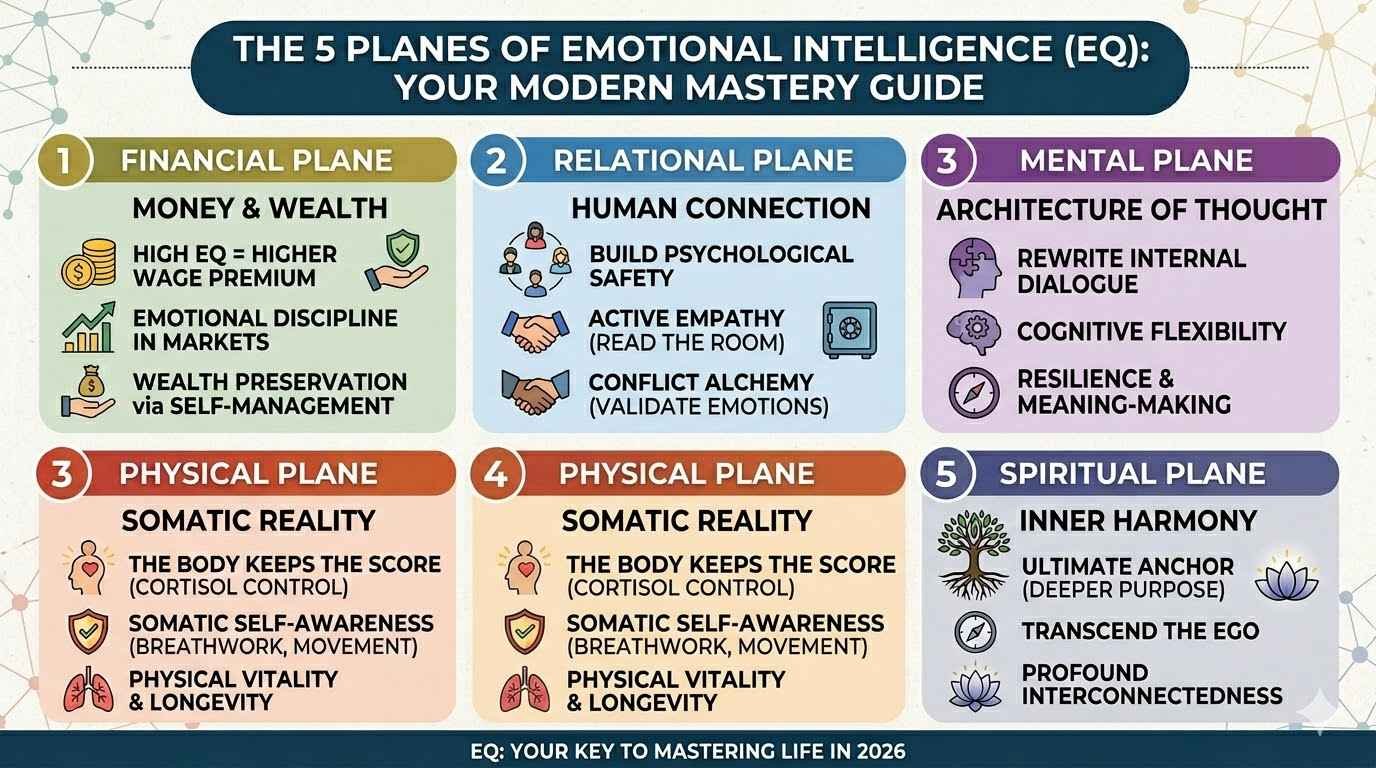
Emotional Intelligence (EQ) is no longer just a corporate buzzword or a “soft skill” relegated to human resources. It is the fundamental survival mechanism of our time. However, true emotional intelligence in people goes far beyond basic empathy or simply “being nice.” To unlock its full potential, EQ must be cultivated and mastered across five interconnected planes of human experience: the Financial, Relational, Physical, Mental, and Spiritual.
Here is a deep dive into how mastering these five planes can transform your trajectory, safeguard your well-being, and help you build a more profound, resilient life. Read the quick summary here or go through table of contents on Emotional Intelligence.
Table of Contents
1. The Financial Plane: Why EQ is the New Currency
Historically, wealth accumulation was often attributed to ruthless calculation or sheer luck. Today, the data tells a vastly different story. Emotional intelligence directly impacts earning potential, wealth preservation, and long-term financial stability.
The EQ Wage Premium
Economists and market analysts have identified what is now known as the “EQ Wage Premium.” Studies consistently show a strong statistical correlation between high emotional regulation and higher income brackets. In the modern workplace, up to 90% of the competencies that differentiate top-tier performers from average ones are linked to emotional intelligence.
As automated systems take over routine tasks, the highest-paid skills are those that cannot be coded: empathy, nuanced communication, and the ability to navigate complex human dynamics. Whether you are leading a team, consulting, or building a new business venture, your relational capital is your most valuable asset.
Emotional Discipline and Wealth Preservation
Financial intelligence is, at its core, a test of emotional discipline. The stock market, business ventures, and economic cycles are inherently volatile. An investor who panics during a market downturn operates from a place of fear, often realizing devastating losses. Conversely, a financially intelligent individual practices delayed gratification. They recognize the impulse to react, sit with the discomfort, and make decisions grounded in long-term strategy rather than short-term panic.
Key Takeaway: By managing your internal emotional state, you prevent costly, impulsive financial decisions and position yourself to capitalize on opportunities that others abandon in fear.
2. The Relational Plane: The Art of Human Connection
The way we work, live, and interact has fundamentally shifted. With the rise of distributed teams and digital communication, physical proximity no longer guarantees connection. In this environment, the relational plane of emotional intelligence is what holds families, friendships, and companies together.
The Shift to a Coaching Mindset
The era of the authoritarian, dictator-style leader is over. Today’s most effective leaders, partners, and parents operate with a coaching mindset. They focus on empowering others, asking the right questions, and creating an environment where people feel seen and valued.
Building relationships with EQ requires active empathy. It is the ability to read the “unsaid” in everyday conversations—noticing the slight hesitation in a colleague’s voice or the subtle shift in a friend’s body language. It is about validating the underlying emotion before rushing in to “fix” the logical problem.
Psychological Safety and Conflict Alchemy
At the heart of relational EQ is psychological safety. High-EQ individuals deliberately create spaces where others feel safe to express vulnerability, pitch unconventional ideas, and admit mistakes without the paralyzing fear of retribution.
When disagreements inevitably arise, emotionally intelligent people practice conflict alchemy. They do not avoid friction; they transform it. By understanding that anger is often just a defensive mask for fear, hurt, or insecurity, they navigate conflicts with curiosity rather than defensiveness, turning potential ruptures into opportunities for deeper trust.
Key Takeaway: Cultivate psychological safety in your interactions. Approach relationships as a coach rather than a critic, and watch the quality of your connections transform.
3. The Physical Plane: The Body Keeps the Score
We often make the critical error of treating the mind and the body as two separate entities. In reality, emotional regulation is a biological imperative. Your emotional intelligence is physically manifested in your nervous system.
The Neurobiology of Stress
When emotional intelligence is low, stress is left unmanaged. This triggers a perpetual state of autonomic arousal, flooding the human body with cortisol and adrenaline. Over time, this chronic stress response wreaks havoc on the system. Clinical research links poor emotional regulation to severe physical ailments, including hypertension, suppressed immune function, digestive issues, and a significantly higher risk of cardiovascular disease. The body literally keeps the score of every unexpressed emotion and unmanaged anxiety.
Somatic Intelligence
Mastering the physical plane requires developing somatic intelligence—the ability to tune into your body’s subtle physical signals. Emotionally intelligent people recognize that a tightening in the chest, shallow breathing, or a clenched jaw are early warning signs of an impending emotional hijacking.
Instead of letting the mind spiral, they use physical interventions to restore a baseline state of calm. Practices like deliberate breathwork, grounding exercises, or mindful movement act as biological reset buttons, signaling to the brain that it is safe to down-regulate the nervous system.
Key Takeaway: Do not ignore your physiology. Use somatic awareness to catch stress early, and employ breathwork or movement to keep emotional regulation and health in harmony.
4. The Mental Plane: Architecting Your Internal Reality
The mental plane is the control room of your existence. It is where cognitive processing meets emotional response. The most profound realization of emotional intelligence on this plane is that we do not react to the external world; we react to our internal map of the world.
The Power of Internal Representations
Every experience you have is coded in your mind through specific internal representations. If you face a daunting task, how do you picture it? High-EQ individuals possess a sophisticated understanding of how to edit these internal structures.
By consciously shifting the submodalities of your thoughts, you can radically alter your emotional state. For example, if a past failure triggers intense anxiety, you can visualize that specific mental image shrinking in size, draining of its vibrant color, and moving further away in your mind’s eye. This simple act of cognitive flexibility can instantly neutralize the negative emotion attached to the memory.
Building a Smarter Blueprint
The half-life of skills is shrinking rapidly. To thrive, you must become a lifelong learner, which requires immense emotional resilience. When faced with a setback, a low-EQ mind catastrophizes, tying the failure to their core identity.
Conversely, a high-EQ mind acts as its own internal coach. It separates the specific failure from self-worth, extracts the necessary data, and uses it to build a study smarter blueprint for the future. This mental agility allows you to embrace the vulnerability of being a beginner again and again without your ego shattering.
Key Takeaway: You are the architect of your internal reality. By learning to adjust how you represent challenges in your mind, you unlock unparalleled cognitive flexibility and resilience.
5. The Spiritual Plane: The Root System of Resilience
If the other four planes represent the trunk and branches of your life, the spiritual plane is the root system. Recent psychological research has increasingly focused on the integration of Spiritual Intelligence (SQ) with EQ, recognizing it as the ultimate anchor for human flourishing.
The Ultimate Anchor in a Chaotic World
Spiritual intelligence, in this context, is not necessarily bound to organized religion. It is the profound capacity to connect with a deeper meaning, a broader purpose, or a universal essence. When the external world is in turmoil—whether through economic shifts or personal crises—this spiritual connection provides an unshakable internal anchor.
People with high SQ consistently seek deeper insights into their existence. They do not merely survive; they look for the larger lesson in their struggles.
Transcending the Ego
A developed spiritual plane naturally enhances emotional intelligence by shrinking the ego. When you operate from a place of profound interconnectedness—recognizing that you are part of a larger whole—empathy becomes effortless. Gratitude, humility, and compassion cease to be forced behaviors that you have to practice; they become your natural state of being.
This inner harmony overcomes existential fear. It creates a quiet, powerful environment within you that allows your mental clarity, physical health, relational depth, and financial abundance to grow organically.
Key Takeaway: Cultivate your spiritual intelligence by connecting to a purpose larger than yourself. This root system will sustain you through any storm.
Image summary of the Emotional Intelligence article
Conclusion: Integrating the 5 Planes
Emotional intelligence in people is not a static trait; it is a dynamic, lifelong practice. By mastering your financial discipline, deepening your relational connections, tuning into your physical somatic signals, rewriting your mental blueprints, and anchoring yourself in spiritual purpose, you build a holistic, unbreakable foundation.
You do not have to tackle all five planes simultaneously. True mastery begins with awareness.
Over to you: Take a look at your life today. Which of these five planes of Emotional Intelligence is currently your strongest anchor, and which one is quietly asking for your attention? Know more about Neuroscience out on YouTube.
