

NLP Sub modalities & Contrastive Analysis looks difficult to find? Let’s start by question? Have you ever paused to wonder why certain memories make your heart race with intense excitement, while other memories—perhaps objectively more important ones—feel like a distant, blurry photograph? The difference is not merely in the narrative of what happened; the difference lies entirely in how your brain actually coded the event.
In the vast landscape of coaching, personal development, and the neuroscience of accelerated learning, practitioners often focus intensely on the “stories” we tell ourselves. We try to use positive affirmations to overwrite negative self-talk, or we attempt to logically reason our way out of procrastination. However, true, lasting, and rapid behavioral change happens when we look under the hood at the “software” of our subjective experience. This mental software is constructed of fundamental building blocks, and learning to manipulate them requires mastering NLP Sub modalities & Contrastive Analysis.
By identifying and consciously changing these internal settings, we can perform a highly powerful and effective intervention that fundamentally alters the meaning of any given experience. Whether you are designing a comprehensive Study Smarter Blueprint to help students accelerate their learning, or simply trying to break through your own limitations, understanding this mental architecture is revolutionary.
This comprehensive guide will walk you through the exact frameworks, checklists, and analytical tools used by master practitioners to decode the human mind using NLP Sub modalities & Contrastive Analysis.
Table of Contents
I. Understanding the VAK Framework: The Building Blocks of Thought
To successfully apply NLP Sub modalities & Contrastive Analysis, you first have to be able to read the internal “code.” Our brain processes every internal thought, memory, and imagined future through our primary sensory modalities: Visual, Auditory, and Kinesthetic (VAK).
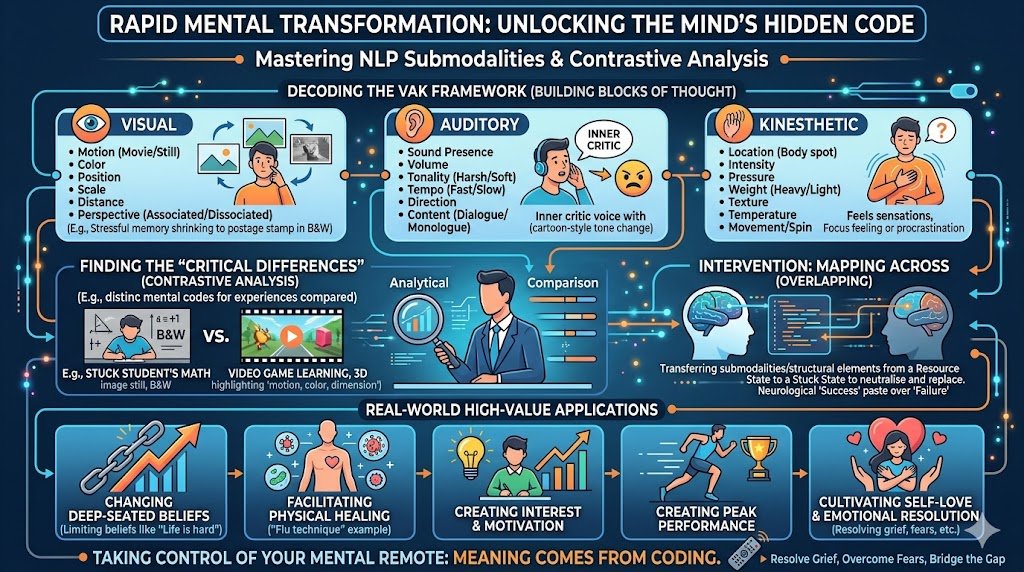
Within each of these broad sensory categories are “fine-grained” settings. Submodalities are the fundamental components of our experience. You do not just “see” a memory; you see it with a specific level of brightness, at a certain distance, and with a specific volume.
Let us deeply explore the exhaustive checklists used to elicit these details during a session of NLP Sub modalities & Contrastive Analysis.
1. The Visual Checklist (Sight)
When you picture a massive goal or a past failure, your brain assigns specific visual attributes to it. For many people, a terrifying prospect is pictured as massive, dark, and looming right in front of their faces. Identifying these precise visual codes is the crucial first step in NLP Sub modalities & Contrastive Analysis.
- Motion: Is it a movie or still frame?
- Color and Light: Is it colour or black and white? Is the image bright, dim or dark?
- Position and Framing: Is the image on the right, left or Centre? Is the image panoramic or framed? Is the image up, middle or down?
- Scale and Dimension: Is the image life-size, bigger or smaller? Is it 2-D or 3-D?
- Distance and Speed: Is the image close or far? Is the speed of the image fast, medium or slow?
- Perspective: Are you in the picture or watching from a distance?
- Emotional Triggers: Is there any colour that impacts you most? Is there anything visual that triggers strong feelings?
Practical Exploration for NLP Sub modalities & Contrastive Analysis:
When you think of a subject you struggle to learn, does the visual image of it look heavy, dark, and close to your face? If you take a stressful visual memory and consciously shrink it down to the size of a postage stamp in black-and-white, notice how rapidly your emotional response changes.
2. The Auditory Checklist (Sound)
Internal dialogue and remembered sounds carry massive emotional weight. A harsh inner critic can completely derail a student’s focus or a professional’s confidence. Altering the auditory settings is a core component of NLP Sub modalities & Contrastive Analysis, as it can instantly reduce the power of that critical voice.
- Sound Presence: Is there any sound in it?
- Structure: Is it monologue or dialogue?
- Volume and Tonality: What is the volume of the sound; high, low or medium? What is the tonality; harsh, soft or medium?
- Tempo and Rhythm: What is the speed of the sound; fast, slow or medium? Is the sound regular or irregular?
- Direction: What direction does this sound seem to be coming out?
- Content: What specifically are you saying or hearing? Are certain words emphasized?
- Nuance: How long did the sound last? What is unique about this sound? Anything else (auditory) that triggers strong feelings?
Practical Exploration for NLP Sub modalities & Contrastive Analysis:
If your internal inner critic speaks to you, whose voice does it actually sound like? What happens to your anxiety if you change the tonality of that harsh internal voice to sound like a squeaky, high-pitched cartoon character?
3. The Kinesthetic Checklist (Feeling)
Kinesthetic submodalities deal with the actual physical sensations in the body. When practicing NLP Submodalities & Contrastive Analysis, this is often where concepts like “stress” or “motivation” are physically discovered.
- Location: Where is the feeling located in the body?
- Intensity: What is the level of intensity, low or high?
- Pressure: What is the level of pressure, hard or soft?
- Weight: What is the weight? Light or heavy?
- Texture: What is the texture, rough or smooth?
- Temperature: What is the temperature? Hot or cold?
- Movement: Is there any movement or spin?
Practical Exploration for NLP Sub modalities & Contrastive Analysis:
When you feel totally in the zone and focused, where does that feeling originate in your body, and in what direction does it move or spin?
II. The Art of Elicitation: Unlocking the Mind’s Hidden Code
Having the checklists is only half the battle when utilizing NLP Sub modalities & Contrastive Analysis. The conscious mind likes to make up stories; the unconscious mind holds the actual sensory data. Master practitioners outline a precise protocol for successfully eliciting these crucial distinctions during NLP Sub modalities & Contrastive Analysis:
- Set Rapport: Set rapport with the person.
- Use Simple Language: Use simple language.
- The Power of Presupposition: Presuppose there are sub modality distinction. Don’t ask, ‘Is there any picture? because it introduces doubt. Ask, “What picture do you have?”
- Be Direct: Be direct. Ask them to see what they saw, hear what they heard.
- Maintain a Lively Pace: Keep lively pace of your voice. Don’t give person to get confused.
- Elicit, Don’t Install: Elicit, don’t install. Don’t suggest. Give the person freedom to explore their subjective experience. Don’t presuppose it will be the same as yours.
- Watch Non-Verbal Clues: Look and listen for non-verbal clues
III. Contrastive Analysis: Finding the “Difference that Makes the Difference”
The core engine of this methodology is the analytical phase. Contrastive analysis in NLP is a process of analyzing two sets of Sub modalities to discover the differences. It is a technique that enables you to distinguish the different ways that some codes their thinking. It is an exercise for wider use in NLP; an important tool to bring about the change.
To execute NLP Sub modalities & Contrastive Analysis, take two experiences and find the difference in their sub modality structure. These will show you the critical differences that give these experiences their meaning.
A Practical Example of NLP Sub modalities & Contrastive Analysis
Imagine you are working with a client who is trying to master a difficult curriculum. They feel completely “stuck” when trying to study mathematics, but they can memorize complex rules for a video game with absolute ease. The reason the student struggles isn’t because of their intelligence; it’s because they code “math” as a dark, flat still-frame, while they code “learning” as a bright, moving movie. The critical differences here are motion, color, and dimensionality.
IV. Mapping Across (Overlapping): The Mechanics of Rapid Change
Once you have completed the NLP Sub modalities & Contrastive Analysis and found the critical differences, you move to the intervention phase. Mapping across means transferring the sub modalities or elements from one particular state or context to another. You are essentially taking the neurological code for “success” and pasting it over the code for “failure.”
Master practitioners highlight several incredibly powerful, best-use scenarios for NLP Sub modalities & Contrastive Analysis and Mapping Across:
1. Changing Deep-Seated Beliefs
Beliefs dictate our reality. Through NLP Sub modalities & Contrastive Analysis, you can work on changing beliefs. Map across concepts like Life is hard, Cancer is incurable, Money brings evils. Think of the visuals that represent your inner truth or believe. Explore its sub modalities like location, colors etc. Now, think of the situation where you wish to create positive belief; like achieving any outcome etc. check its sub modalities and map across Do the same thing to create doubt or disempowering any belief.
2. Facilitating Physical Healing
The mind-body connection is profound. NLP Sub modalities & Contrastive Analysis allows for facilitating healing. Map across incurable disease Vs Easily curable Think of the disease you think is incurable or you are suffering from. Check its sub modalities. Think of the disease you know that your body will heal automatically like flue, viral fever or a cut. Check its sub modalities. Find the difference and map across.
3. Creating Unstoppable Interest and Motivation
If you have a task you need to do but lack the drive, NLP Sub modalities & Contrastive Analysis provides the solution by creating interest in any task. Map the Task you need to do Vs the task you do with motivation
4. Creating Peak Performance for Sportspersons
Athletes require absolute mental clarity. To begin creating the belief of peak performance for sportspersons using NLP Sub modalities & Contrastive Analysis, think of the event you performed well. Check its sub modalities. Think of the upcoming event where you wish to perform well. Check its sub modalities. Find the difference and map across.
5. Cultivating Self-Love and Emotional Resolution
Through NLP Sub modalities & Contrastive Analysis, you can cultivate self-love/respect. Map People or role models you love or respect Vs Your image Furthermore, this technique is incredibly effective for grief. Map The person who has dies and you have accepted the death Vs The grief causing scenes Also for forgiveness, jealousy, worry, revenge, hurt, past painful memories, OCD etc.
The Visual Summary of NLP Sub modalities & Contrastive Analysis article
V. Conclusion: Taking Control of Your Mental Remote
The principles behind NLP Sub modalities & Contrastive Analysis prove that our mental representations are the literal, structural reality of how your brain interprets the world. Once you deeply understand that “meaning” is simply a byproduct of “coding,” the mental remote control is finally back in your hands.
By utilizing the meticulous VAK checklists to perform NLP Sub modalities & Contrastive Analysis, you uncover the hidden differences that drive human behavior. By Mapping Across those exact sub modalities, you possess the unprecedented ability to transfer resourceful, powerful states into any area of your life.
If you are a coach please go to NLP Sub modalities & Contrastive Analysis link and use ready-made platform to use on clients detailed information about NLP SM and CA.
The power to change your life doesn’t require a new story; it requires a new structure. Armed with the knowledge of NLP Sub modalities & Contrastive Analysis, the only question left is: Which mental dial are you going to turn first?
Ready to take the next step?
Know about more about Neuroscience out on YouTube.
