

It is 8:00 PM on a Tuesday. Dinner is finished, the backpack is unzipped, and the math textbook is open on the kitchen table. But right next to it, face up, is a smartphone. The screen lights up with a single notification. Your child glances at it, picks it up “just for a second,” and suddenly, 45 minutes have evaporated. When you finally intervene and ask them to hand over the device, the reaction is instantaneous: frustration, eye-rolling, or perhaps even a full-blown meltdown.
Welcome to the new parenting battleground. If you have experienced this exact scenario, take a deep breath and know this: you are not failing, and your child is not inherently lazy.
The digital landscape has fundamentally altered how our children process information. Passive digital consumption is fracturing their attention spans and driving a wedge into their emotional well-being. But the traditional parenting advice—simply banning the screens or locking the devices away—is proving wildly ineffective. Banning creates resistance, secrecy, and resentment.
To truly help our children thrive, we must shift our paradigm. We have to understand the underlying neuroscience of child digital habits and learn how to replace passive digital consumption with active, real-world experience.
Here is the science behind why screen bans fail, and the actionable strategies you can use to rebuild your child’s focus and emotional resilience.
Table of Contents
The “Swipe Brain” vs. The “Study Brain”
To understand why your child cannot simply “put the phone down and focus,” we have to look inside their developing brain. When a child engages in deep learning—like reading a chapter book, solving a complex equation, or practicing an instrument—they are using their “Study Brain.” This requires the prefrontal cortex to exert immense cognitive effort, filtering out distractions and delaying gratification.
When they open a social media app or a fast-paced video game, they activate the “Swipe Brain.”
The Dopamine Loop and the Slot Machine Effect
Social media algorithms and digital games are engineered by some of the brightest minds in the world to be neurologically inescapable. They operate on a psychological principle called a “variable reward schedule”—the exact same mechanism that makes casino slot machines so addictive.
Every time your child swipes to a new short-form video or receives a “like” on a post, their brain receives a micro-dose of dopamine, the neurotransmitter associated with pleasure and reward. Because the brain never knows exactly when the next highly entertaining video or notification will appear, it becomes hooked on the anticipation.
Over time, this constant flooding of dopamine artificially raises the brain’s baseline for stimulation.
The Contrast with Deep Learning
Now, imagine taking a brain that is accustomed to receiving a high-definition, hyper-stimulating dopamine hit every 15 seconds, and asking it to read a static, black-and-white history textbook.
It is not that the textbook is uniquely terrible, or that your child lacks intelligence. It is that, by comparison to the digital world, the neurochemistry of studying feels painfully, agonizingly boring. The brain actually perceives the lack of stimulation as a deficit.
Consider the bright, capable middle schooler who sits down to write an essay. They write one sentence, feel a slight dip in cognitive energy, and immediately reach for their phone to task-switch. They scroll for three minutes, get their dopamine hit, and return to the essay. But every time they task-switch, they drain their cognitive battery. A 30-minute homework assignment stretches into a grueling two-hour ordeal of cognitive fatigue, leaving the student feeling frustrated, inadequate, and emotionally drained.
The Hidden Toll on Emotional Well-Being
When we discuss child digital habits, we often focus purely on academic performance. However, the most severe consequences of unregulated screen time manifest in a child’s mental health. Digital habits are not just a behavioral quirk; they are a core pillar of a student’s emotional well-being.
The Shrinking Attention Span and Academic Anxiety
Research indicates a drastic drop in average attention spans over the last decade. A brain that is trained to consume information in 30-second bites loses the stamina required for deep, sustained thought.
When a child cannot maintain focus in the classroom, they begin to fall behind. This lack of comprehension breeds intense academic anxiety. The child begins to internalize this struggle, shifting from “I am distracted” to “I am not smart enough.” They then retreat back to the digital world to escape these negative feelings, creating a vicious, self-perpetuating cycle of anxiety and avoidance.
The Sleep Connection and Melatonin Disruption
Perhaps the most silent but destructive impact of screen time is its effect on sleep hygiene.
The blue light emitted by smartphones, tablets, and laptops mimics daylight. When a child stares at a screen in the evening, this light travels through the retina and signals the pineal gland to halt the production of melatonin, the hormone responsible for inducing sleep.
Chronic, low-grade sleep deprivation in children is disastrous. It suppresses the immune system, hinders physical growth, and crucially, impairs the brain’s ability to regulate emotion. A sleep-deprived child often presents with symptoms that perfectly mimic ADHD: severe irritability, sudden mood swings, inability to sit still, and defiance. Before seeking medical interventions for behavioral issues, we must first audit the digital and sleep habits that form the foundation of their physiological health.
The “Experience” Solution: 3 Strategies to Rebuild Focus
If banning screens outright leads to rebellion, and unregulated use leads to emotional and cognitive distress, what is the middle ground?
The answer lies in transition. We must guide our children from being passive consumers of digital content to active participants in their physical world. The goal is to turn abstract knowledge into lived, tangible experience. Here are three neuroscience-backed strategies to help you rebuild your child’s focus.
1. Dopamine Swapping
When you ask your child to turn off the television or hand over the tablet, their brain experiences a sudden, steep drop in dopamine. If you send them to an empty room and tell them to “go read” or “find something to do,” they will likely complain of intense, agonizing boredom.
Instead of leaving a void, practice “Dopamine Swapping.” Replace the digital stimulation with a high-dopamine, physical-world activity.
- Physical Challenges: The brain loves movement. Suggest a quick, physical challenge to reset their nervous system, like seeing how long they can balance on a wobble board, a 5-minute jump rope challenge, or a quick outdoor sprint.
- Tactile Building: Engage their hands. Whether it is building a complex Lego set, constructing a DIY project out of PVC pipes, or cooking a new recipe from scratch, tactile activities force the brain to engage its spatial reasoning and focus, rewarding them with a profound sense of accomplishment that a screen can never replicate.
2. Scaffolding Focus (The 25-Minute Rule)
You cannot expect a child who is used to scrolling for hours to suddenly focus on a textbook for 60 uninterrupted minutes. Their “focus muscle” has atrophied, and like any muscle, it must be rebuilt gradually.
Use physical scaffolding to separate the study environment from the digital environment completely.
- Remove all digital devices from the room during homework time. Do not just turn them face down; remove them from the visual field entirely.
- Use a physical, ticking kitchen timer (not a phone app).
- Set the timer for 25 minutes. During this time, the only acceptable activity is the task at hand.
- When the timer rings, mandate a 5-minute non-screen break. Let them stretch, get a glass of water, or pet the dog.
This technique trains the brain to work in focused, high-intensity bursts, healing the fragmented attention span and vastly improving the efficiency of their learning.
3. Co-Regulation over Control
The moments of transition—when a screen is turned off—are the most volatile. A child’s prefrontal cortex is often not developed enough to handle the sudden frustration independently. If you meet their frustration with anger and control (“I said turn it off right now or you lose it for a week!”), you escalate their nervous system into a fight-or-flight response.
Instead, practice co-regulation. Sit next to them a few minutes before screen time ends. Show interest in what they are doing. When the time is up, gently but firmly enforce the boundary, and if they become upset, help them identify the physical sensation. Ask, “I know it is frustrating to stop playing. What does your body feel like right now?” By naming the emotion and sitting with them through the discomfort, you build their emotional intelligence. You teach them that they can experience frustration without being consumed by it.
Go through image summary
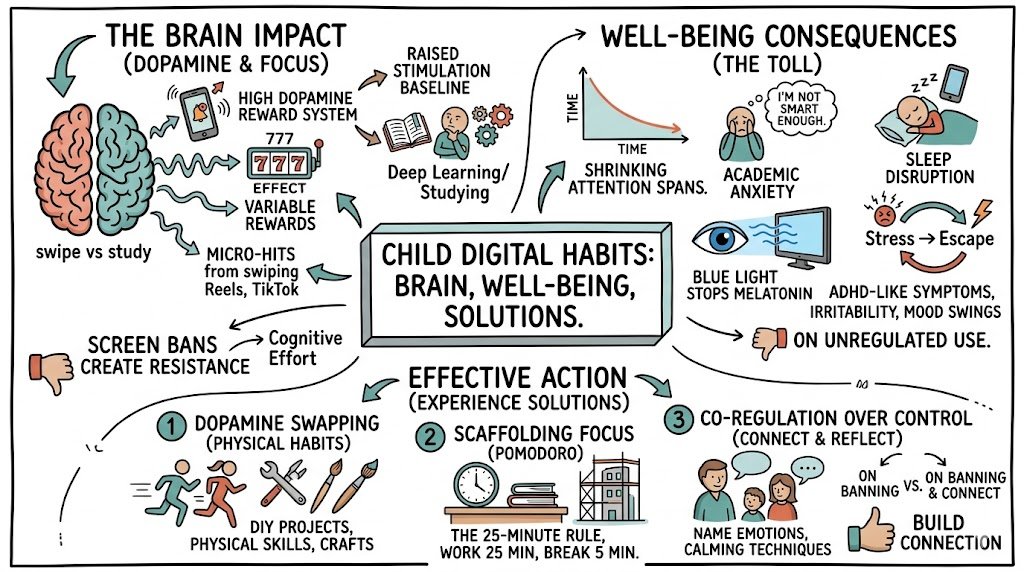
Conclusion: From Passive Knowledge to Active Experience
Navigating child digital habits is one of the most complex challenges of modern parenting. Fighting technology with anger, rigid bans, or guilt simply does not work. True, lasting success comes from understanding the neuroscience of how your child learns, grows, and feels.
We must protect their cognitive bandwidth by establishing clear, healthy boundaries around screen time, prioritizing sleep, and most importantly, giving them compelling reasons to engage with the real world. We must help them build the skills to turn their passive scrolling into active, physical mastery.
Ask yourself this thought-provoking question: If your child’s digital world disappeared tomorrow, what real-world experiences would they have the skills to build today?
Take the Next Step: Are you ready to understand exactly how technology is impacting your child right now? Start by taking our free Child Digital Habit Assessment. In just a few minutes, you will receive a personalized score and a custom set of “Working Tricks” to address your child’s specific emotional and digital needs.
If you are looking for a comprehensive, step-by-step system to help your child master their attention, overcome academic anxiety, and learn how to learn, explore the Study Smarter Blueprint. This course is designed to equip students and parents with the exact frameworks needed to thrive both inside and outside the classroom.
Know about more about on YouTube.
