

Let’s understand focus finder challenge in analogical way. It is 6:00 PM on a Tuesday. You have just asked your child to sit down and finish their math homework. What happens next is a scene playing out in living rooms across the globe: a blank stare directed at an open textbook, a pencil being endlessly tapped against the desk, a sudden and desperate need for a snack, and the inevitable, creeping urge to check a tablet or smartphone.
If you try to remove the device, the reaction is often swift and intense—ranging from mild complaints to a full-blown meltdown.
As a parent, you are exhausted. You might find yourself wondering, “Why can’t they just sit still and focus? Is something wrong with my child’s attention span?” Before you jump to clinical diagnoses or label your child as “lazy,” take a deep breath. Your child is likely not the problem. The modern environment we have built for them is. Today’s children are experiencing a severe “Focus Crisis,” driven by an invisible but potent force: digital overload. You are not fighting a discipline issue; you are fighting multi-billion-dollar algorithms engineered by some of the smartest minds on the planet to hijack human attention.
At Knowlerience, we believe in turning knowledge into real-world experience. It is not enough to just know screens are distracting; we need actionable ways to fix the problem. That is why we designed The Focus Finder Challenge. By understanding the root cause of digital distraction, you can implement brain-based strategies to rebuild your child’s natural focus.
Table of Contents
The Neuroscience of Distraction: Why Screens Always Win
To solve the focus crisis, we first have to look inside the brain. Why does a video game hold a child’s attention for three hours, but a history book loses them in three minutes? The answer lies in how the brain processes rewards.
The Dopamine Dilemma
Whenever a child plays a fast-paced game, scrolls through short-form videos like YouTube Shorts or Instagram Reels, or receives a notification, their brain releases a neurotransmitter called dopamine. Dopamine is the brain’s “feel-good” chemical, closely tied to motivation and reward.
These digital platforms provide variable rewards—unpredictable hits of dopamine that keep the brain craving more. It is the exact same neurological mechanism that makes slot machines so addictive. The brain quickly learns that staring at a screen equals an instant, high-intensity chemical reward with zero physical or mental effort.
Attention Fatigue and the “Boring” Reality to know Focus Finder
Now, contrast that hyper-stimulating digital world with the slow-paced reality of deep learning, reading a novel, or doing chores.
Math problems do not flash bright colors or play victory music when you solve a step. Reading a chapter book requires sustained, quiet mental effort to visualize the story. Because your child’s brain has become accustomed to the rapid-fire dopamine hits of the digital world, normal, everyday tasks suddenly feel physically exhausting. This is known as attention fatigue. The brain is simply under-stimulated by reality.
The Myth of Multitasking
Many older children and teens claim they can study while keeping their phone on the desk or listening to a YouTube video in the background. Neuroscience tells a different story which affect the focus finder abilities.
The human brain cannot truly multitask when it comes to high-level cognitive work; it rapidly task-switches. Every time your child glances at their phone face-down on the study desk, their brain uses up valuable cognitive capacity. This constant “micro-switching” drains their mental battery, increases academic anxiety, and prevents the deep, focused state required for true skill mastery.
Taking The Focus Finder Challenge: Where Does Your Child Stand?
You cannot fix what you do not measure. The Focus Finder Challenge is a targeted diagnostic tool designed to help you evaluate your child’s environment and habits honestly.
The assessment is broken down into three core pillars:
- Digital Habits & Screen Time: How much, what kind, and when is the content being consumed?
- Attention Span & Task Completion: How does your child handle unstructured time, boredom, and multi-step instructions?
- Environment & Lifestyle: Are sleep, physical activity, and nutrition supporting a healthy brain?
Once you complete the assessment, your child’s habits will fall into one of three distinct zones:
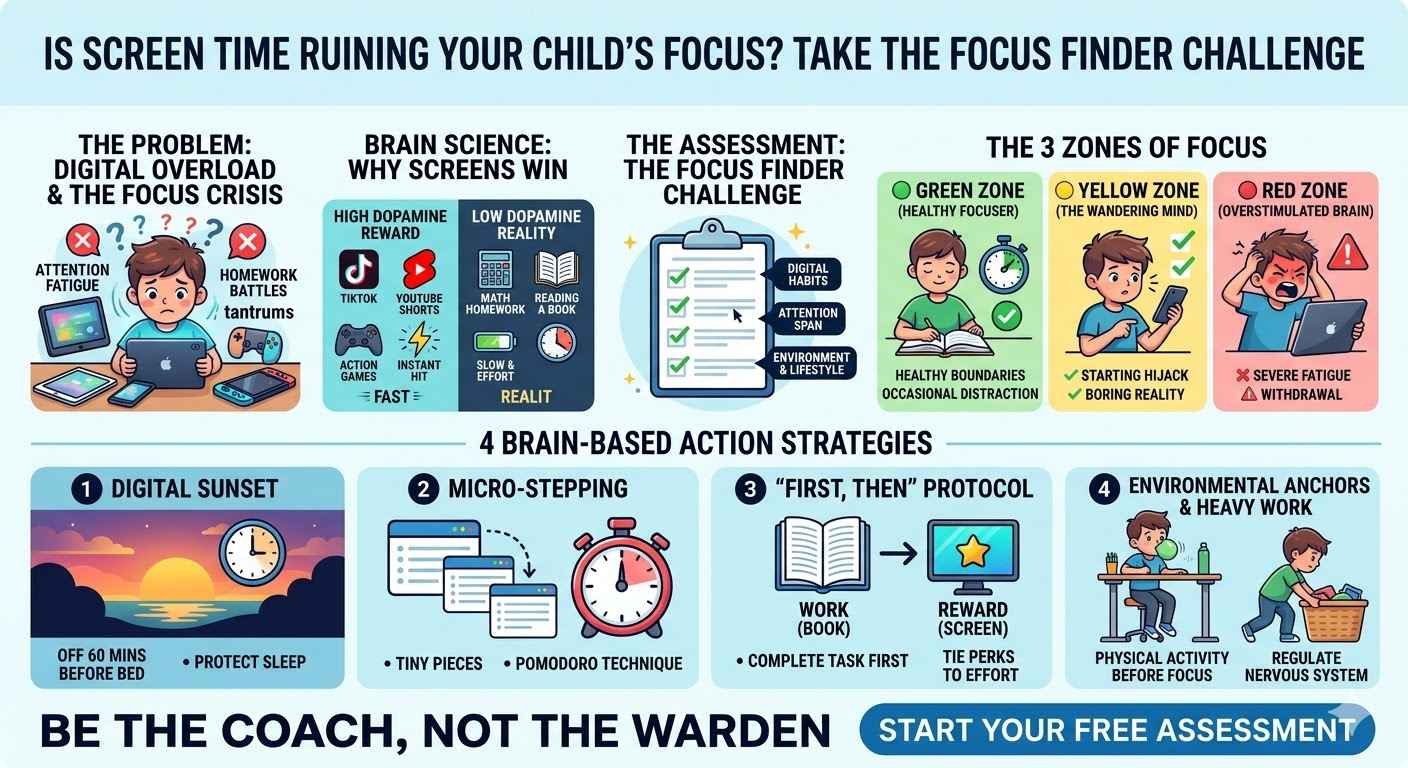
🟢 The Green Zone (The Healthy Focuser): Your child has healthy boundaries with technology. Occasional distraction is completely normal, and they just need consistent, gentle boundaries to continue thriving.
🟡 The Yellow Zone (The Wandering Mind): Your child’s dopamine system is starting to get hijacked. You will notice that slow-paced tasks feel impossibly dull to them, and they reach for a screen the moment they feel “bored.”
🔴 The Red Zone (The Overstimulated Brain): Your child is experiencing severe attention fatigue. Digital overload has peaked, and withdrawal symptoms—like irritability, aggression, or tantrums—occur frequently when screens are removed.
Focus Finder Challenge-Based Strategies for Parents
Identifying the problem is only half the battle. If you want to improve your child’s focus and concentration, you have to change their environment. Here are four brain-based strategies you can implement today to help your child reclaim their attention span.
Strategy 1: The “Digital Sunset” & Sleep Protection
Sleep is when the brain consolidates learning, processes memories, and clears out cognitive toxins. If a child’s sleep is disrupted, their focus the next day will be shattered.
The blue light emitted by screens actively suppresses melatonin, the hormone responsible for making us sleepy.
- The Action: Implement a strict “Digital Sunset.” All screens—phones, tablets, and televisions—must be turned off exactly 60 minutes before bedtime. Remove all devices from the bedroom permanently. The bedroom must become a sanctuary strictly for sleep and offline reading. Do not rely on a child’s willpower to ignore a phone on their nightstand.
Strategy 2: Micro-Stepping and the Pomodoro Technique
When an overstimulated child looks at a worksheet with 20 math problems, their brain perceives it as a massive, unrewarding threat. This leads to homework paralysis and procrastination.
You must shrink the task to match their current attention span.
- The Action: Teach them the Pomodoro Technique. Use a visual kitchen timer (not a phone timer).
- How to apply it: Say, “We are only going to do homework for 15 minutes. That’s it. When the timer rings, you can stop and take a 5-minute break to stretch or grab a snack.” By breaking the work into ridiculously small, achievable steps, you reduce anxiety and build momentum. Once they finish 15 minutes successfully, they will feel a natural sense of accomplishment.
Strategy 3: The “First, Then” Protocol
You have to rebuild the brain’s reward system by tying digital perks to actual effort. Currently, many children get screen time by default, teaching the brain that it doesn’t need to work for dopamine.
- The Action: Implement the “First, Then” rule. “First you complete 20 minutes of focused reading, then you get 15 minutes of screen time.” Never give the reward before the hard work is done. If they argue or refuse to do the reading, calmly explain that the screen time is paused until the work is complete. Hold the boundary.
Strategy 4: Environmental Anchors & “Heavy Work”
Children are not designed to sit perfectly still at a kitchen table for hours. If you have a fidgety child whose mind is wandering, their nervous system might be dysregulated.
- The Action: Before any study session, have your child do 5 to 10 minutes of “heavy work.” This includes jumping jacks, running a lap around the house, or pushing a heavy laundry basket across the floor. This provides deep proprioceptive input to the brain, which naturally calms and regulates the nervous system.
- During study time: Give them sensory anchors. Let them chew sugar-free gum, sit on a wobble cushion, or stand at a high counter while doing their homework. Channeling their physical energy allows their mental energy to focus on the task at hand.
Conclusion: Be the Coach, Not the Warden
Rebuilding a child’s attention span in a digital world is a marathon, not a sprint. There will be days of pushback, complaints of “I’m bored,” and moments where you just want to hand over the iPad for some peace and quiet.
Remember that you are not doing this to punish them. You are stepping in to protect their brain’s health. Do not act as a warden handing out sentences; act as a coach guiding them toward better habits. Validate their frustration—“I know it’s hard to put the game away, it’s designed to be super fun”—but hold your boundaries firm.
Take a moment and look at your child’s primary study area right now. What is one digital distraction you can remove tonight to give their brain a much-needed break?
Stop guessing and start solving. If you are ready to find out exactly where your child stands and what specific steps you need to take next, it is time to take action.
[Click here to take the free, 2-minute Focus Finder Assessment]
and get your personalized, brain-based action plan delivered straight to your inbox today!
The image summary of The Focus finder challenge
Ready to take the next step?
If you want to dive deeper into these techniques, check out our “Study Smarter Blueprint” course at Knowlerience. We’ve designed every module based on these 2026 neuroscientific breakthroughs to ensure you don’t just learn—you transform.
