

Let’s understand Academic Anxiety Trap in analogy. It is Sunday evening. The weekend is winding down, and the familiar, heavy tension begins to settle over the house. You ask the dreaded question: “Have you finished your homework for tomorrow?”
Suddenly, the atmosphere shifts. Your child becomes defensive, irritable, or perhaps they simply shut down. They complain of a sudden stomachache. You find them an hour later, staring blankly at a textbook with a smartphone glowing in their hand, having made zero progress. The arguments start, the tears follow, and by bedtime, both of you are emotionally exhausted.
If this scenario sounds intimately familiar, you are not alone, and you are not failing as a parent. Your child is not necessarily lazy, unmotivated, or trying to be difficult. Instead, they are likely caught in what educators and child psychologists call The Academic Anxiety Trap.
In this comprehensive guide, we are going to decode exactly what the Academic Anxiety Trap is, why modern digital distractions act as the ultimate trap door, and how you can reset your home environment to stop the homework battles for good.
Table of Contents
Decoding the Academic Anxiety Trap: What is Actually Happening?
To help your child, we first have to understand the invisible weight they are carrying. The Academic Anxiety Trap is a vicious, self-perpetuating cycle where the intense pressure to perform academically triggers a psychological “fight or flight” response.
When a child looks at a massive project or a difficult math concept, their brain perceives it as a threat. Because they cannot physically run away from school or their parents’ expectations, they flee mentally. They procrastinate. They avoid.
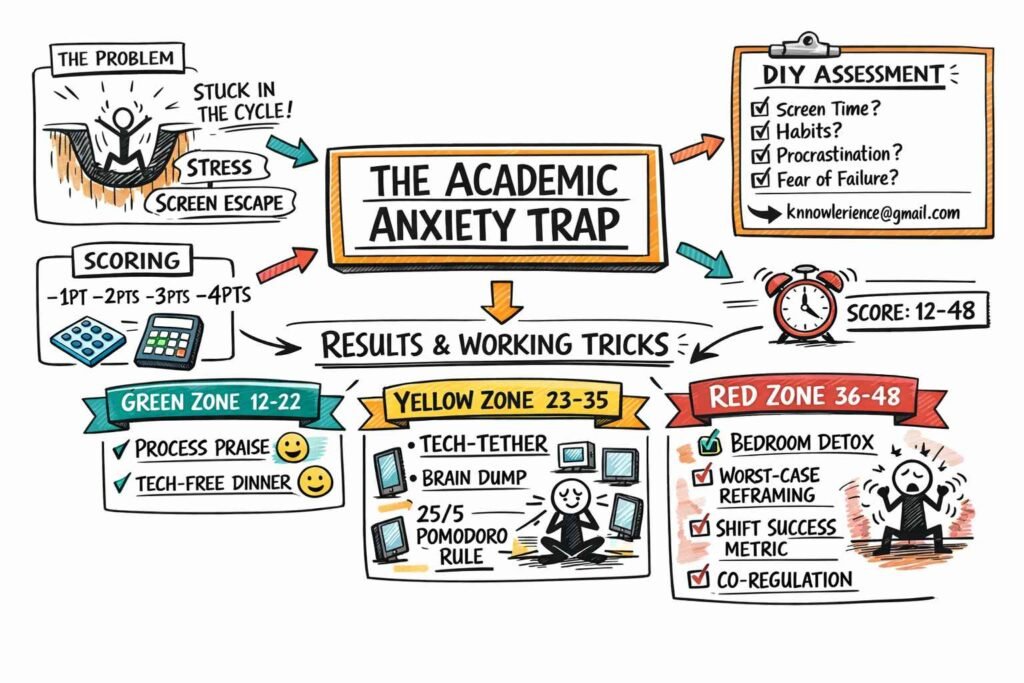
This cycle of Academic Anxiety Trap typically looks like this:
- High Pressure & Overwhelm: The child faces a difficult academic task and fears failure or making a mistake.
- Anxiety Spike: The nervous system kicks into overdrive. Cortisol (the stress hormone) floods the brain, making logical thinking incredibly difficult.
- Avoidance Behavior: To soothe the immediate anxiety, the child avoids the work. They reach for their phone, play a video game, or start an argument to deflect.
- Poor Performance: Because they avoided the work, they are unprepared. They get a poor grade or a reprimand from the teacher.
- Increased Pressure: The poor grade leads to disappointment from parents and teachers, which instantly increases the pressure for the next assignment, starting the cycle all over again, but worse.
Consider the story of a seventh-grader we will call Rohan. Rohan was constantly mislabeled by his teachers as “lazy.” He never turned in his assignments on time and spent hours staring at his screen. But when you sat down and actually talked to Rohan, the truth came out: he was terrified. He believed that if he didn’t get an ‘A’, he was a failure who was letting his family down. The fear of writing a “bad” essay was so paralyzing that he chose to write nothing at all.
Rohan wasn’t lazy; he was trapped.
The Silent Symptoms: How to Spot the Academic Anxiety Trap
Academic anxiety doesn’t always look like a panic attack. Often, it wears a disguise. Here is how to spot the red flags that your child is struggling with severe school stress:
1. Physical (Somatic) Red Flags
Children often lack the vocabulary to say, “I am feeling overwhelmed by my cognitive load.” Instead, their bodies speak for them.
- Unexplained Illnesses: Frequent complaints of stomachaches, nausea, or tension headaches right before school, tests, or designated study times.
- Sleep Disruption: Difficulty falling asleep because their mind is racing about tomorrow’s assignments, or sleeping far too much to escape reality.
- Appetite Changes: Skipping breakfast due to a “knotted stomach” or stress-eating junk food while studying.
2. Emotional Red Flags
Watch for shifts in their self-esteem and how they talk about their abilities.
- Catastrophizing: Blowing small setbacks out of proportion. “If I fail this one math quiz, I’ll never get into a good college, and my life is over.”
- The Reassurance Loop: Constantly asking you or their teachers if their work is “good enough,” seeking external validation because they have no internal confidence.
- Perfectionism: Tearing up their work and starting over multiple times because it isn’t flawless, eventually leading to a complete meltdown.
3. Behavioral Red Flags
This is where the trap becomes most visible to parents.
- Extreme Procrastination: Waiting until 11:00 PM the night before a project is due to even open the instructions.
- The Default Escape: The absolute immediate, almost subconscious instinct to grab a screen or a video game the second they feel frustrated by a homework problem.
The Digital Escape: Why Screen Time is the Ultimate Trap Door
You might be wondering, “Why do they always turn to their phones when they should be studying?” It is not a coincidence. When a child is trapped in academic anxiety, the mobile phone is the perfect, perfectly engineered escape hatch.
The Dopamine Factor Learning is hard work. It requires sustained attention, delayed gratification, and the willingness to make mistakes. When a child is stressed, their brain craves quick relief. Social media scrolling, YouTube shorts, and video games are designed by neuroscientists to deliver instant, predictable hits of dopamine (the reward chemical in the brain). The brain quickly learns: Math homework = pain and stress. TikTok = instant pleasure and relief.
The Fractured Focus Even if your child is not actively using their phone, just having it visible on the desk destroys their concentration. Every time a notification pings, their focus is broken. It takes the human brain roughly 20 minutes to return to a state of deep concentration after an interruption. If a child checks their phone every 10 minutes, they are never actually studying. They are just experiencing a state of fractured focus, making a 30-minute assignment take three grueling hours.
The Sleep Connection Finally, screen time is the enemy of anxiety regulation. The blue light emitted by phones suppresses melatonin production, delaying sleep. Furthermore, consuming highly stimulating content right before bed keeps the nervous system engaged. Without deep, restorative sleep, the brain cannot consolidate the day’s learning, and the child wakes up the next morning with a baseline of anxiety that is already too high.
Breaking Free: Actionable Strategies for Parents to break Academic Anxiety Trap
Escaping the Academic Anxiety Trap requires a hard reset of your home environment and your family’s expectations. Here are the working tricks and techniques you can implement today.
Step 1: Redefining Success (The Mindset Shift)
If your child is paralyzed by the fear of poor grades, you must temporarily remove the grades from the pedestal.
- Implement Process Praise: Stop praising the “A” and start praising the effort. Say things like, “I am so proud of how hard you focused on that science project for an entire hour,” or “I saw how frustrated you got with that math problem, but you didn’t give up. That’s real resilience.”
- Normalize Mistakes: Talk openly about your own failures at work or in your daily life. Show them that making a mistake is not a disaster; it is simply data that helps you learn for the next time.
Step 2: The Tech-Tether Technique (The Boundary Shift)
You cannot expect a child with an underdeveloped prefrontal cortex to resist the pull of a smartphone on their own. You must build the physical boundaries for them.
- Separate Spaces: The desk is for studying; the living room is for digital downtime. Never let the two mix.
- The Bedroom Detox: This is non-negotiable for highly anxious children. Screens must leave the bedroom at night. Buy a cheap, standard alarm clock for their nightstand. Their bedroom must become a sanctuary for sleep, not a hub for late-night scrolling and stress.
- Use Website Blockers: If they need a laptop for homework, install software that temporarily blocks social media and gaming sites during designated study hours.
Step 3: The 25/5 Rule (The Study Shift)
When a child looks at three hours of homework, they shut down. You have to break the cognitive load into manageable, bite-sized chunks.
- The Pomodoro Technique: Have your child study intensely for exactly 25 minutes, followed by a strict 5-minute break.
- The Golden Rule of the Break: The 5-minute break cannot involve a screen. If they check their phone, they will get sucked into the digital dopamine loop. Instead, they should stretch, drink a glass of cold water, step outside for fresh air, or pet the dog. This physically resets their nervous system, bringing their cortisol levels back down before they tackle the next 25-minute block.
Step 4: Co-Regulation
When your child does hit a wall and has a meltdown, do not try to use logic. A brain flooded with stress hormones cannot process logic. Sit with them, take deep breaths together, and offer a physical reset. Say, “I can see you are really overwhelmed. Let’s close the book, go get a cold drink, and walk around the house for five minutes before we look at this again.”
Your Next Step Forward
The Academic Anxiety Trap is real, and the battle between healthy study habits and the magnetic pull of screen time is the defining parenting challenge of this generation. However, by understanding the psychology behind their avoidance, setting firm boundaries around technology, and shifting the focus from perfect grades to resilient effort, you can help your child break the cycle.
It takes time, consistency, and a lot of patience, but peace can return to your Sunday evenings.
Are you wondering exactly how deep your child is in the Academic Anxiety Trap? It’s time to get a clear picture. We have created a free, interactive DIY Assessment designed specifically for parents. By answering 12 simple questions about your child’s screen time, mood, and study habits, you will instantly receive a “Stress Baseline Score” and a customized action plan tailored to your child’s specific zone.
[Take the Free Academic Anxiety Trap Assessment Here] Assessment Link
Mastering these emotional regulations and organizational habits isn’t just about surviving school—it is about equipping them for life. At Knowlerience, we believe that these foundational soft skills are exactly what students need to thrive. If you are ready to take the next step in transforming your child’s relationship with learning, explore our Study Smarter Blueprint to discover the tools that turn anxious students into confident, independent learners.
Stop the homework battles today. You have the tools; now it’s time to use them.
The image summary of The Academic Anxiety Trap
Ready to take the next step?
If you want to dive deeper into these techniques, check out our “Study Smarter Blueprint” course at Knowlerience. We’ve designed every module based on these 2026 neuroscientific breakthroughs to ensure you don’t just learn—you transform.
Know about more about Neuroscience out on YouTube.
