

Let’s understand Neuroscience with example.
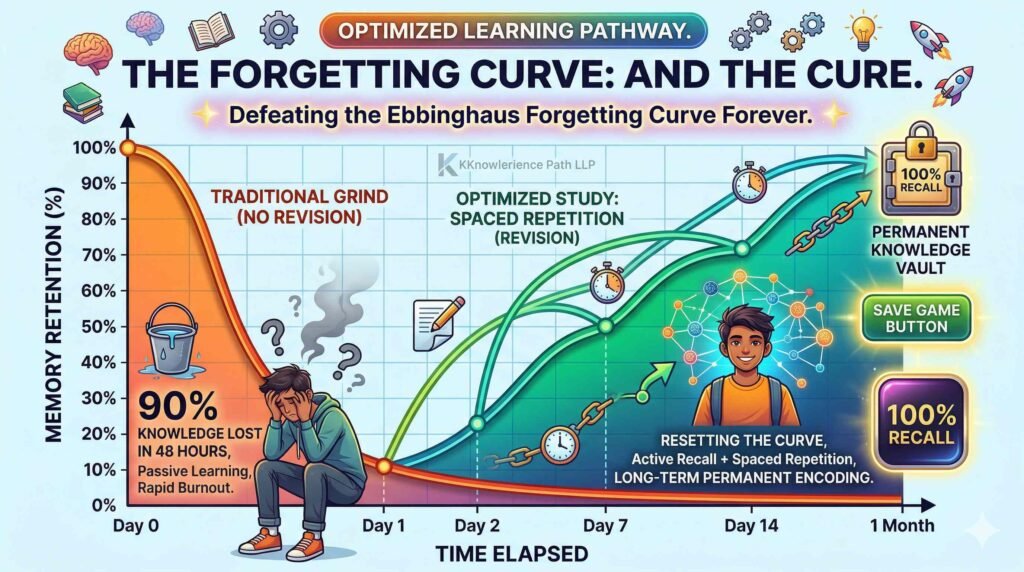
Have you ever spent an entire weekend devouring a business book or an online course, only to realize by Tuesday morning that you can barely remember the main thesis? If you feel like your brain is a “leaky bucket,” you’re not alone—and more importantly, you’re not the problem.
The problem is that most of us were taught what to learn, but never how our brains actually process information. We treat our minds like hard drives where we can simply “save” data. In reality, the human brain is a biological organ that operates on very specific neurochemical rules. In the hyper-digital landscape of 2026, where information is infinite but attention is scarce, trying to learn without understanding neuroscience is like trying to drive a car without knowing where the engine is.
At Knowlerience, we believe the bridge between “Knowledge” and “Experience” is built with the bricks of brain science. Today, we’re opening the hood. Here are five neuroscience-backed techniques to help you master any skill 2x faster.
Table of Contents
1. The “AGES” Framework: Your Brain’s Learning DNA
For Neuroscience , If you want to move information from your short-term “working memory” into long-term storage, you need to follow the AGES Model. Developed by the Neuro Leadership Institute and refined by 2026 research, this framework identifies the four non-negotiable pillars of memory encoding.
Attention: The Focused Spotlight
Your brain cannot learn what it does not attend to. Neurochemically, attention is driven by the release of norepinephrine. When you multitask, you aren’t “doing two things at once”; you are rapidly switching tasks, which causes “attention residue” and prevents deep encoding.
- The 2026 Fix: Use the 25/5 Rule. Engage in 25 minutes of high-intensity focus, followed by a 5-minute “Negative Rest” period. During this rest, do not check your phone. Close your eyes or look out a window. This allows the hippocampus to begin the “offline” consolidation process.
Generation: Creating Your Own Meaning
Passive reading is the enemy of retention. To truly learn, you must generate the information yourself. This is why teaching a concept to someone else makes you better at it. You are literally “firing” your own neural pathways rather than just following someone else’s.
Emotion: The Memory Glue for the Neuroscience
The amygdala (the brain’s emotional center) sits right next to the hippocampus (the memory center). When a piece of information is tied to a strong emotion—curiosity, surprise, or even a bit of frustration—the amygdala signals the hippocampus that this info is “important” and needs to be saved.
Spacing: The End of the “Cram”
Your brain requires “down time” to synthesize new proteins for memory. Spaced repetition—reviewing info at increasing intervals (1 day, 3 days, 1 week)—prevents the Forgetting Curve from taking hold.
2. Beyond Repetition: The Power of “Neural Teamwork”
For decades, we believed that learning a skill was about making specific neurons “stronger” through isolated repetition. However, a landmark study from the University of Rochester in March 2026 has shifted the paradigm.
Researchers found that mastery isn’t about isolated neurons working harder; it’s about Neural Coordination. As we master a skill, neurons that were previously acting independently begin to work as a unified “task force.” They share information more efficiently and reduce “background noise.”
Key Takeaway: Don’t just repeat a task in a vacuum. Connect it to what you already know. This is called Relational Learning. If you’re learning a new soft skill like “Conflict Resolution,” don’t just memorize steps; relate them to a specific past experience where a conversation went south. You are essentially “inviting” more neurons to the team.
3. The “Stress Sweet Spot”: Why Comfort is the Enemy of Growth
Most people think that a perfect learning environment is one that is stress-free and comfortable. Neuroscience says otherwise. To trigger neuroplasticity—the brain’s physical changing of its structure—you actually need a specific level of chemical arousal.
This is known as the Yerkes-Dodson Law.
If you are too relaxed, your brain doesn’t see a reason to change. If you are too stressed (high cortisol), your prefrontal cortex shuts down, and you enter “fight or flight” mode. The “Sweet Spot” is a state of Eustress (positive stress).
- How to apply it: Introduce “Desirable Difficulties.” Don’t make your practice sessions too easy. If you get 100% of your practice questions right, you aren’t learning; you’re just rehearsing. Aim for a “70-80% success rate.” That 20% of struggle is exactly where the growth happens.
4. Visual Anchors: Why Your Brain Thinks in Maps, Not Lists
The human brain did not evolve to read bullet points on a slide. We evolved to navigate 3D environments and recognize visual patterns. This is where Dual Coding Theory comes in.
When you combine a verbal concept with a visual image, you are encoding that information through two separate channels in the brain. If one channel fades, the other acts as a backup.
At Knowlerience, we champion the use of Sketchnoting and Mind Mapping helps deeper Neuroscience learnings.
- The Science: Visuals are processed roughly 60,000 times faster than text.
- The Action: Instead of taking linear notes, try drawing your notes. Use arrows to show relationships and simple icons to represent complex ideas. This forces your brain to “translate” the information, which is a high-level “Generation” task (refer back to the AGES model!).
5. AI as a “Neuroscience or Neural Scaffold”: The 2026 Learning Edge
In 2026, we no longer view AI as a tool that “replaces” thinking. Instead, we use it as a Neural Scaffold.
One of the most effective neuroscience techniques is Retrieval Practice (testing yourself). You can use AI to instantly turn your notes into a quiz.
- Don’t ask AI to summarize the book for you.
- Do ask AI: “Based on these notes, give me three difficult scenarios where I would have to apply these principles. Then, critique my answers.”
By using AI to create “Feedback Loops,” you are providing your brain with the immediate data it needs to correct its internal models. This real-time correction is the fastest way to achieve “Experience” from “Knowledge.”
Conclusion: From “Knowing” to “Knowlerience”
The “Neuroscience of Learning” isn’t about being a genius; it’s about being an efficient operator of the most complex machine on the planet. By focusing on Attention, encouraging Neural Coordination, finding your Stress Sweet Spot, using Visual Anchors, and leveraging AI for Retrieval, you move past passive learning and into true mastery.
Remember: Your brain is a garden, not a warehouse. You don’t just dump information into it; you have to plant it, water it with sleep, and cultivate it with practice.
What’s your “learning whisper”? Which of these five techniques are you going to trial in your next study session? Share your thoughts in the comments below—let’s fire those neural pathways together!
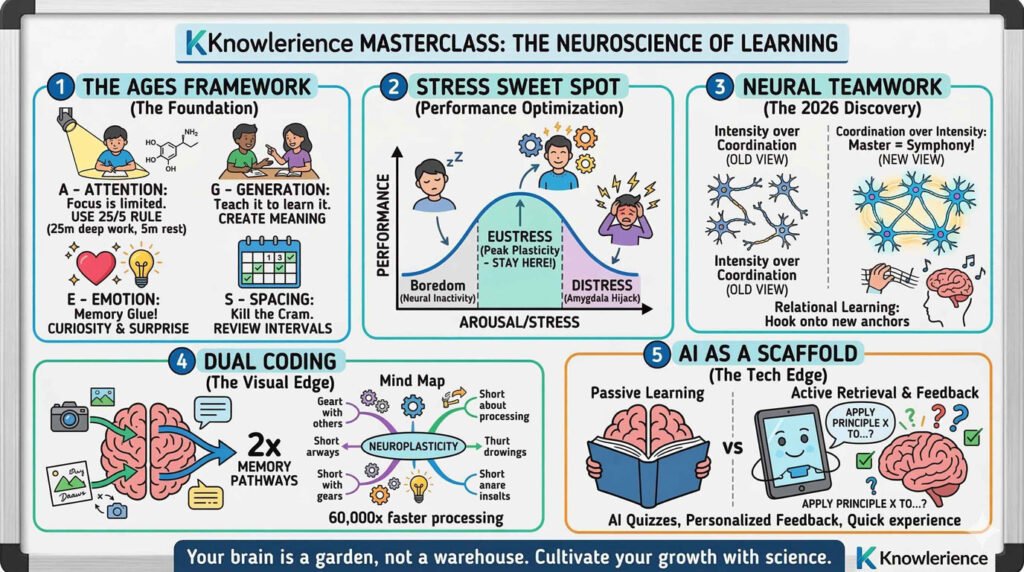
Summary of Neuroscience learning below
Ready to take the next step?
If you want to dive deeper into these techniques, check out our “Study Smarter Blueprint“ course at Knowlerience. We’ve designed every module based on these 2026 neuroscientific breakthroughs to ensure you don’t just learn—you transform.
Know more about Neuroscience out on YouTube.
